


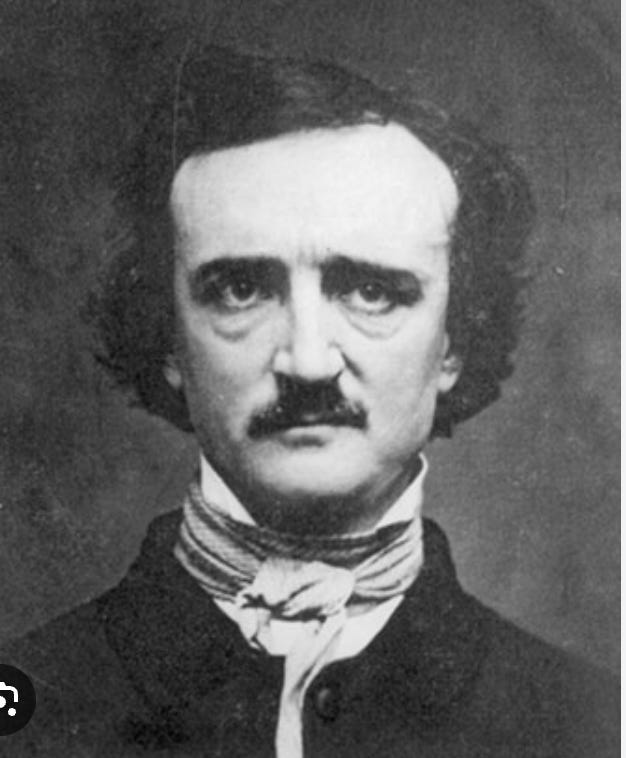
Edgar Allen Poe’s, “The System of Doctor Tarr and Professor Fether" tells the story of a man who visits a French mental asylum known for its "soothing system" of treatment,. Eventually, the narrator discovers that the patients have overthrown the staff and are now running the asylum themselves. It takes the narrator a while to realize this. He begins to get a weird feeling when he is invited to a “faculty dinner” and perceives the faculty members to be very strange.
The ringleader of the inmates who have taken over the asylum, Monsieur Maillard, is a clever man who humorously advises the narrator to “believe nothing you hear, and only one half that you see.”
For some time in this country it has seemed to me that the inmates have taken over the asylum, and that much of what we are told is a smoke and mirror show. Thus we are, to use a fancy Greek expression from academic philosophy, suffering an epistemic crisis, or breakdown in a society's shared system for determining truth.
This has resulted in widespread disagreement on facts and a loss of trust in official information sources. Our crisis severely undermines our rational decision-making, divides us, and causes us great mental distress.
Unsure of what to believe, millions of Americans have placed their hope in the leader of their preferred political party. They have convinced themselves that “at last, we have a leader who cares about us and will tell us the truth.”
However, if your only means of evaluating the truthfulness of a representation is your trust in the man who makes the representation, how do you know you aren’t being deceived by the man? In our private lives we are better able to resolve this question through the process of “getting to know” someone, but even then we may later discover to our surprise and distress that people aren’t always who they seem to be.
Since I was a boy, I have been in the habit of questioning everything and every authority, which resulted in considerable disciplinary problems at school, summer camp, and Sunday school.
I carried this habit with me into adulthood, when I one day discovered a remark by Rudyard Kipling.
The individual has always had to struggle to keep from being overwhelmed by the tribe. To be your own man is a hard business. If you try it, you will be lonely often, and sometimes frightened. But no price is too high to pay for the privilege of owning yourself.
Perusing reader comments on my recent posts about the US war against Iran, I note that many readers are angry at me for questioning the war and its motives. While I welcome criticism and always strive to learn from it, I cannot bring myself to cease noticing and questioning things that strike me as implausible at best.
Because most humans have such a strong tribal identity, they assume that other tribes that have been led astray are composed of stupid and immoral people. In this respect, we often talk about the German people in the years 1933-1945.
Most Americans never stop to consider that if they were living in Germany at this time, they would have almost certainly thought, believed, and behaved in the exact same way as the majority of Germans did at the time.
Do you really believe that, if you had grown up in Germany between 1875 and 1933, you would have been just like the German writer Thomas Mann, who recognized in 1933 that the country he loved was slipping into barbarism and therefore emigrated to the US?
Do you believe that, had you been a German in 1943 and read in the newspaper that the German military governor of Poland had destroyed the Warsaw ghetto to suppress a dangerous uprising and threat to public safety, you would have questioned this official narrative and tried to protest it? I doubt it.
I was astonished by dozens of reader comments on my post in which I protested Donald Trump’s threat to destroy Iranian civilization forever. Many readers pushed back that he was just bluffing, and that I am foolish to take seriously such threats to commit genocide.
This attitude strikes me as the ultimate expression of our epistemic crisis. Millions of Americans observe their president state genocidal intent to destroy one of the oldest civilizations on earth, and they are confident they know him well enough to know that he is just bluffing. They believe they knew he was just bluffing but the Iranian regime didn’t know this.
I wonder if they have considered that Iranian, Russian, and Chinese psychologists—not to mention Israeli—have been studying Donald Trump for years, and are as skilled as anyone in evaluating when he is bluffing and when he is serious.
My protest of Trump’s statement was not predicated on my estimation of whether or not he would carry it out his threat. I wanted to be on record as protesting and condemning the statement itself, regardless of whether he carried it out. I prayed that he would not carry it out and was deeply relieved when he didn’t.
A few years ago, a man from a prominent Texas family owned a beautiful piece of property on a lake in East Texas. As beautiful as it was, he reckoned it would be even more beautiful if it included his neighbor’s property. His neighbor was a simple country fellow whose family had purchased the property long before rich people from Dallas started acquiring lots on the lake, and he had no interest in selling it. He was also a bit of a redneck who didn’t maintain his house and yard in accordance with the standards of the new rich set moving in from Dallas.
Tensions arose between the rich city slicker and the redneck next door, and the rich city slicker apparently made statements that the redneck interpreted as a threat. And so, one day, when the rich city slicker went to the redneck’s front door to have a word with him, the redneck shot him point blank with a shotgun, killing him instantly. Everyone was shocked by this incident except me. I have long observed that complacent people never think that such disasters could happen to them until they do.
People who feel under pressure by hostile strangers take threats seriously, even if the threats are likely mere bluffs. President Trump—who possesses codes to an enormous battery of Minuteman Intercontinental Ballistic Missiles that could annihilate an entire country—just threatened to end “forever” an entire civilization. The Iranians were already being bombed by Israel and the US at the time President Trump made this statement, and they are all acutely aware of what the Israelis have done to Gaza.

The world will never forget Trump’s statement, and I am confident it will have all manner of negative consequences for the United States of America and its people. Every American who enjoys international travel should think long and hard about how he or she will now be perceived abroad. My advice to all Americans abroad is to refrain from our annoying American habit of speaking loudly in public places. I too am inclined to speaking loudly, and must endeavor to check myself.
The greatest challenge for every individual and nation is learning to recognize that other people don’t see you as you see yourself. A serious philosopher, observing the American people today, might be tempted to conclude that we have slipped into a state of Solipsism—that is, we assume that the external world and other minds either conform to our personal consciousness or are simply wrong. Solipsism may be described as extreme egocentrism or self-absorption.
How to resolve America’s epistemic crisis? The first step is to recognize that whenever our government officials—Republican or Democrat—embark on a grand and wildly expensive adventure abroad, the stated reasons for doing so are probably false.
If a man who has a wife and children tells his family that he must dedicate himself and his resources to taking care of all manner of things apart from his home, his wife and children, they can rest assured that he isn’t telling the truth about what he is doing.
Same applies to Washington. Our government is constantly telling us that it must govern the fractious tribes of the Middle East. At the same kind, our government can’t manage to maintain the greater Washington D.C. sewer line that recently ruptured and catastrophically polluted the Potomac and all downriver estuaries, including the Chesapeake.
When US government officials execute their duties in working for We the People, we can trust that they are telling us the truth.
When they indulge in all manner of grand schemes and adventures that enrich special interest groups and lobbyists, but do nothing for the citizenry, we can rest assured they are lying.
Bret Weinstein has been talking about, what he calls, our Cartesian Crisis for years which probably goes as far back, or at least we can spot its origins, in the Wilsonian propaganda campaign during WW1, and refined through the contributions of men like Edward Bernays, Jacque Ellul, and Walter Lippmann. Nearly all that we think we know about the world comes to us from people we have never met. Journalism is corrupt beyond recognition because it's designed to support narrative rather than fact. The only truth is inside the covers of the Bible.
Right on Target John - Thank you!