


By Peter A. McCullough, MD, MPH
While public health officials and hospital representatives are portraying Hantavirus pulmonary syndrome as being unassailable, waiting for a vaccine to arrive, the story on favipiravir is being suppressed.
🔬 Scientific Review: Favipiravir (T-705) in Hantavirus Pulmonary Syndrome (HPS)
🧪 Mechanism of Action
Favipiravir (6-fluoro-3-hydroxy-2-pyrazinecarboxamide), or T-705, represents a significant advancement in the development of broad-spectrum antiviral therapeutics. Unlike nucleoside analogs that mimic natural precursors, favipiravir functions as a potent, selective inhibitor of the viral RNA-dependent RNA polymerase (RdRp) complex.
Upon entering the cellular environment, T-705 undergoes intracellular phosphoribosylation to its active form, favipiravir-ribofuranosyl-5’-triphosphate (T-705-RTP). This active metabolite acts as a pseudo-purine, effectively terminating viral RNA chain elongation. This mechanism is particularly effective against the negative-sense, single-stranded RNA viruses responsible for Hantavirus Pulmonary Syndrome (HPS), including Andes virus (ANDV) and Sin Nombre virus (SNV).
🐹 Efficacy in Animal Models
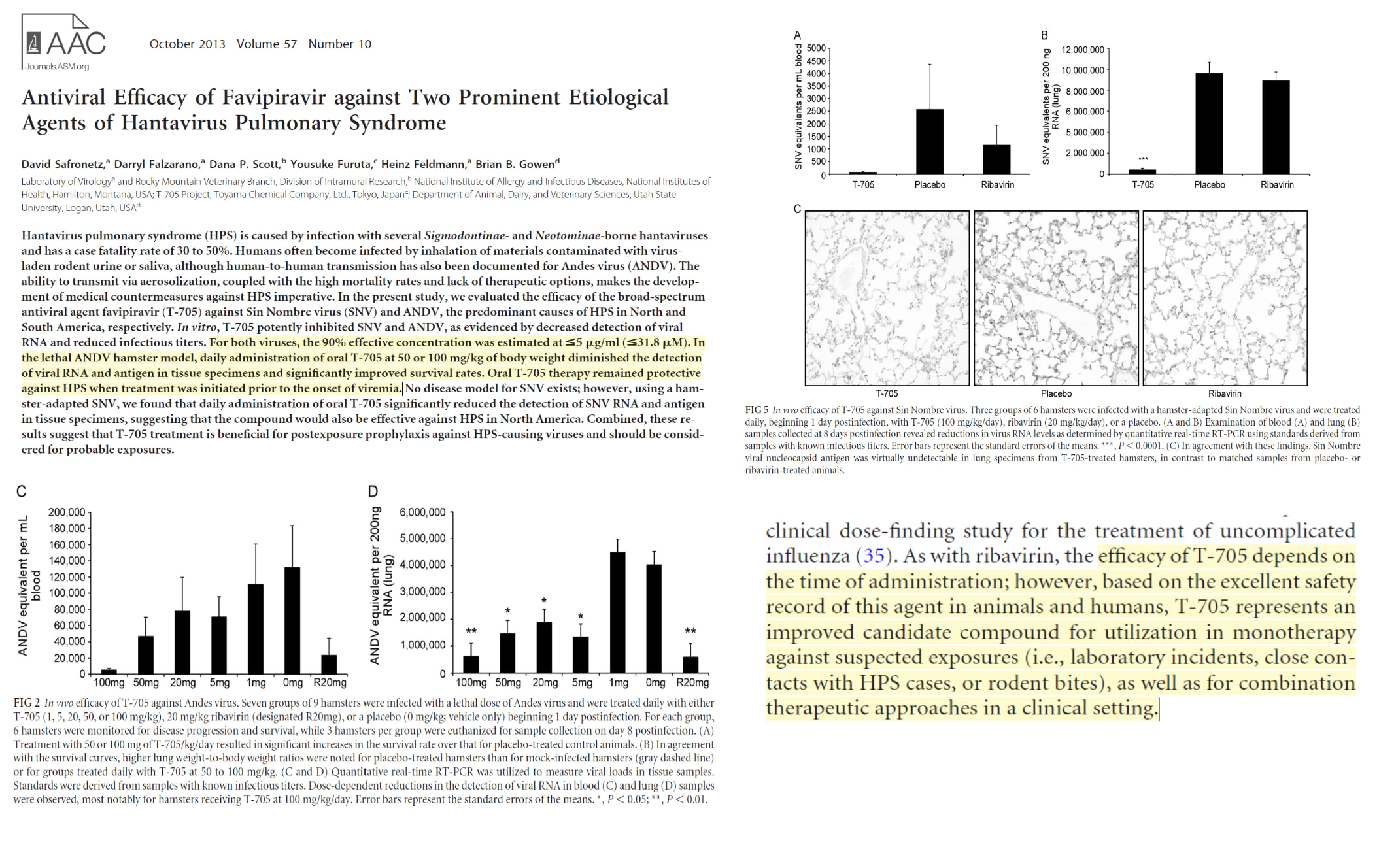
Preclinical data have consistently demonstrated that favipiravir provides substantial protection when administered in the early phases of infection. In the hamster model of HPS—which recapitulates the severe pulmonary edema and capillary leak syndrome observed in human patients—T-705 significantly reduced mortality rates and viral titers in pulmonary and lymphatic tissues.
Crucially, favipiravir exhibits superior pharmacokinetic profiles compared to ribavirin, the conventional, albeit problematic, standard of care for HPS. Ribavirin is characterized by significant hematological toxicity, including dose-dependent hemolytic anemia. In contrast, favipiravir is generally better tolerated, exhibiting a wider therapeutic window and fewer dose-limiting side effects in mammalian models, positioning it as the premier candidate for clinical translation.
💊 Oral Administration
The oral route is the well-established delivery method for favipiravir. These tablets are typically manufactured as 200 mg immediate-release units for human use. Because the drug undergoes extensive metabolism by aldehyde oxidase (AO) and to a lesser extent by xanthine oxidase, it requires relatively high loading doses to achieve and maintain therapeutic plasma concentrations. In instances where patients are unable to swallow tablets—such as those in critical care settings—compounded oral suspensions administered via nasogastric tubes could be utilized.
🌍 Global Availability and Regulatory Status
The availability of favipiravir varies significantly by jurisdiction, reflecting the complex interplay between public health crises and pharmaceutical regulation.
🇯🇵 Japan: Favipiravir (marketed as Avigan) was approved by the Ministry of Health, Labour and Welfare primarily for the treatment of pandemic influenza strains resistant to standard neuraminidase inhibitors. It remains available under strict protocols.
🇷🇺 Russia: The Ministry of Health has approved domestic formulations of favipiravir for a range of viral indications, following accelerated review processes during recent public health emergencies.
🇮🇳 India: Several pharmaceutical manufacturers were granted emergency use authorization for favipiravir to address large-scale viral outbreaks, resulting in widespread availability in both private and public health sectors.
🇹🇷 Turkey & Other Markets: Various nations in the Middle East and Southeast Asia have integrated favipiravir into their national stockpiles or treatment protocols for emerging infectious diseases.
🇺🇸/🇪🇺 United States & European Union: Favipiravir lacks broad approval for general clinical use. Access is restricted to clinical trials or emergency investigational protocols, largely due to concerns regarding potential teratogenicity observed in preclinical rodent studies, necessitating rigorous monitoring.

⚖️ Conclusion
Favipiravir stands as a robust candidate for treating highly pathogenic hantaviral infections. While animal models confirm its high inhibitory potential and favorable safety profile compared to ribavirin, human clinical data remain the missing link for definitive validation. Future clinical trials must prioritize optimized dosing regimens to maximize efficacy in the critical early window of HPS progression. The passengers in biocontainment facilities and in home quarantine should be urgently tested with oral favipiravir. Additionally, the thirty crew and medical personnel currently on the contaminated MV Hondius sailing for Rotterdam should have favipiravir airlifted to them on the ship.
Please subscribe to FOCAL POINTS as a paying ($5 monthly) or founder member so we can continue to bring you the truth. Alter AI may be used to assist in searches, synthesis, and review.
Peter A. McCullough, MD, MPH
President, McCullough Foundation
FOCAL POINTS has partnered with Patriot Mobile to defend your medical freedom. Join Patriot Mobile today!

📚 References
Safronetz D, Falzarano D, Scott DP, Furuta Y, Feldmann H, Gowen BB. Antiviral efficacy of favipiravir against two prominent etiological agents of hantavirus pulmonary syndrome. Antimicrob Agents Chemother. 2013 Oct;57(10):4673-80. doi: 10.1128/AAC.00886-13. Epub 2013 Jul 15. PMID: 23856782; PMCID: PMC3811478.
Antiviral Research: Comparative analysis of T-705 and ribavirin in hamster models of HPS.
The Lancet Infectious Diseases: Reviews on broad-spectrum RdRp inhibitors and emerging pathogen preparedness.
National Health Authority databases: Regulatory status reports (Japan MHLW, India CDSCO).
Dr MCC, are in in disagreement with Dr Malone's post where he said: ''Human-to-Human Transmission: Rare, Documented, and Misrepresented...
Here is what the science actually shows about the Andes strain and human-to-human transmission: it is possible, but extraordinarily rare, and it requires sustained, intimate contact—the kind of contact that occurs between spouses, between healthcare workers and critically ill patients, or among family members living in close quarters during an active outbreak...'' https://curativabay.substack.com/cp/196705214
Why are we spending so much time on Hantavirus? Is this some type of epidemic. Perhaps it would clear things up if you could tell me how many people in the world actually die of hantavirus. These victims all appear to be older, and perhaps not in good health. How many people visit public dumps with a high number of rats present just to see a "special" bird. I have visited trash dumps in the US and never even seen a rat. Perhaps our advice is to just to use common sense.
For the last few years I have seen this fear porn several times. What happened to the bird flu epidemic? Has it been replaced by the hantavirus epidemic? If you want to prevent unnecessary death, how about about telling people to just eat better, stop smoking, and stop drinking so much. How about we just tell them to increase their activities of daily living?
I guess there is just no money in that. Better to give people pills of some kind and call them supplements. I hear most of these will prevent rabies, being eaten by lions and bears, and keep you from being struck by lightening.
How much do these pill making machines cost. I still have the bark from some trees that were struck by lightening, and small doses of this back have prevented many diseases in me, including hantavirus. I hope to bring them to market soon.