


On October 12, 2026, the United Nations General Assembly adopted a new pandemic declaration, with 153 countries voting in favor, three against, and two abstaining. The United States, Israel, and Argentina voted against the declaration.
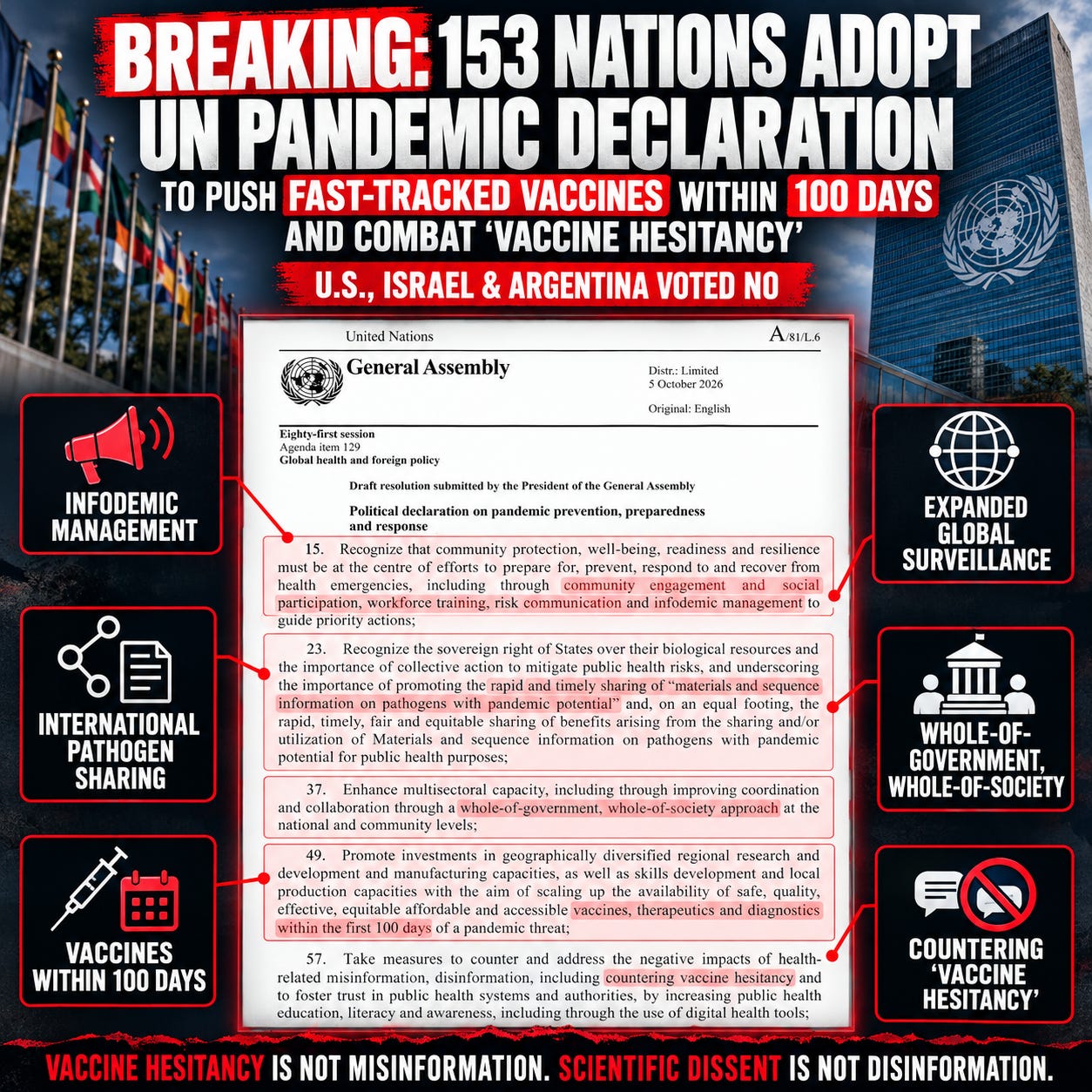
Buried within the nine-page document is a provision that should concern anyone who values scientific freedom, informed consent, and the right to question public-health authorities.
Paragraph 57 explicitly calls for governments to counter vaccine hesitancy as part of broader efforts against health-related “misinformation” and “disinformation.”
The declaration goes even further, explicitly endorsing “infodemic management” and a “whole-of-government, whole-of-society” pandemic response.
This sounds like more scientific censorship, lockdowns, and experimental vaccine mandates.
The sweeping declaration also promotes:
VACCINES WITHIN 100 DAYS: Scaling up vaccine, therapeutic, and diagnostic availability within the first 100 days of a pandemic threat, raising concerns about another Operation Warp Speed disaster.
EXPANDED GLOBAL SURVEILLANCE: Strengthening disease-monitoring networks, early-warning systems, laboratory capacity, and digital health infrastructure, raising concerns about privacy breaches and oversight.
INTERNATIONAL PATHOGEN SHARING: Promoting rapid sharing of potentially dangerous pathogen materials and genetic sequences across borders, raising concerns about biosafety.
BILLIONS IN PANDEMIC FUNDING: Highlighting a $15 billion annual preparedness financing gap while encouraging expanded international funding, public-private partnerships, and support for the WHO.
SUPPORT FOR THE WHO PANDEMIC AGREEMENT: Endorsing further negotiations to finalize the agreement’s pathogen-sharing provisions and facilitate future signature and ratification.
The declaration is non-binding and does not itself authorize censorship, compulsory vaccination, or expanded WHO enforcement powers. However, it establishes a broad international policy agenda that seriously endangers health freedom.
Questioning a vaccine’s safety, effectiveness, necessity, or long-term consequences is not misinformation. It is an essential part of scientific inquiry and informed medical decision-making. The scientific community must remain free to investigate adverse events, challenge regulatory decisions, publish contradictory findings, and question public-health policies without fear of retaliation.
Vaccine hesitancy is NOT misinformation.
Scientific dissent is NOT disinformation.
Questioning public-health authorities is NOT a threat to public health.
No international pandemic framework should undermine those fundamental principles. The Bio-Pharmaceutical Complex has already gotten away with the COVID disaster, and now they’re trying to lock in the same playbook for their next global health emergency.
Epidemiologist and Foundation Administrator, McCullough Foundation
Support our mission: mcculloughfnd.org
Please consider following both the McCullough Foundation and my personal account on X (formerly Twitter) for further content.
There are serious consequences for not voting. You may not agree with Trump on everything, but without him the U.S. would have voted for this UN tyranny, the J6ers would still be rotting in prison, the country would be overrun by illegals and gang members, and likely destoryed in a few short years, with independent voices like Nicolas Hulscher silenced. Vote.
Whenever someone uses the phrase “vaccine hesitancy” in front of me, I respond by saying: “Oh, I’m not ‘hesitant’. I am violently opposed.” 😂