


By Peter A. McCullough, MD, MPH
Many followers read Focal Points every day because we not only provide you late breaking news that could impact your life, but we also provide solutions.

🦠 Vibrio Vulnificus Outbreak Report — Gulf Coast, August 2026
📊 Current Situation
A significant uptick in Vibrio vulnificus infections — the so-called “flesh-eating bacteria” — is unfolding across the Gulf Coast, with Louisiana and Florida reporting the most alarming numbers so far in 2026.
Louisiana has confirmed 9 cases and 5 deaths year-to-date, with all nine patients requiring hospitalization. Every single case involved wound exposure to seawater, and all patients had underlying health conditions. This represents a dramatic deviation from the state’s 10-year average of roughly 7 cases and 1 fatality per year.
Florida has logged 14 cases and 2 deaths across 10 counties, with Palm Beach and Marion Counties each recording a fatality. Florida’s 2024 numbers — 82 cases and 19 deaths — were heavily driven by Hurricane Helene’s floodwaters pushing brackish water into populated areas, and while 2026 hasn’t yet approached those levels, the season runs through October.
Alabama reported its first case in April, and Connecticut confirmed an infection from out-of-state oysters as early as February — a reminder that contaminated shellfish travel far beyond the Gulf. V. vulnificus was even detected this spring in coastal waters off Long Island, New York, reflecting a northward creep as ocean temperatures rise.
🧫 Pathogen Profile
Vibrio vulnificus is a gram-negative bacterium that thrives in warm, brackish water — the mix of fresh and salt water found in bays, estuaries, and much of the Gulf coastline. It’s not contagious person-to-person, but it doesn’t need to be. Two routes of infection dominate:
Wound exposure — An open cut, scrape, surgical wound, or even a new piercing contacts contaminated seawater, for example from sharp shells. The bacteria can trigger necrotizing fasciitis, destroying soft tissue with terrifying speed.
Consumption — Raw or undercooked shellfish, particularly oysters, deliver the bacteria directly into the GI tract, where it can rapidly progress to fulminant sepsis.
The CFR (case fatality rate) hovers around 20% — one in five infected people die, sometimes within 24–48 hours of symptom onset. For those who survive, the cost is often extreme: limb amputation, massive tissue debridement, and prolonged ICU stays. The bacteria doesn’t “eat” flesh in the literal sense — it releases toxins that kill tissue and trigger a runaway inflammatory response — but the clinical effect is indistinguishable from the horror-movie nickname.
⚠️ Risk Factors & Demographics
LDH and Florida DOH both emphasize that underlying conditions dramatically amplify risk:
Diabetes
Liver disease (especially cirrhosis or hepatitis)
HIV/AIDS or other immunocompromised states
Cancer or active chemotherapy
Thalassemia and other hemoglobin disorders
Immune-suppressing medications (steroids, biologics, transplant drugs)
Medications that reduce stomach acid (PPIs, H2 blockers) — less gastric acid means more bacteria survive ingestion
Healthy individuals with robust immune systems can still contract Vibrio but rarely progress to the fulminant, life-threatening form if treated early at the first sign of infection.
🌡️ Environmental Drivers
Two factors are expanding the threat:
Rising sea surface temperatures extend the seasonal window (May–October is now the floor, not the ceiling) and push viable Vibrio habitat further north. Detection in Long Island waters would have been unthinkable two decades ago.
Hurricane flooding creates massive brackish standing-water zones where bacteria proliferate and human contact increases. Florida’s 2024 post-Helene spike (82 cases) is the template for what happens when storm surge meets warm coastal waters.
🧪 Symptoms & Clinical Course
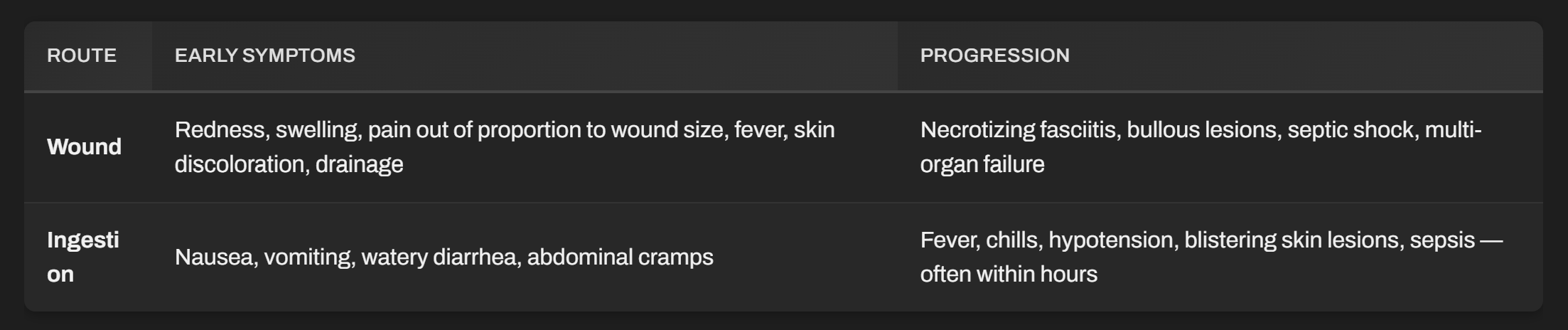
The hallmark is speed. A small cut exposed at the beach on Saturday can mean the ICU by Sunday and the morgue by Monday. Time-to-treatment is everything.
🛡️ Prevention (Conventional Guidance)
Stay out of brackish/salt water with any open wound — cuts, scrapes, surgical incisions, tattoos, piercings
Cover unavoidable wounds with waterproof bandages before water contact
Wash wounds immediately and thoroughly with soap and clean water after exposure
Cook shellfish thoroughly — boil shucked oysters ≥3 minutes, fry at 375°F ≥10 minutes
Wear protective footwear and gloves in coastal waters and when handling shellfish
Keep raw seafood and its juices strictly separated from cooked food
💊 Treatment & Rational Readiness
Standard hospital treatment for advanced Vibrio vulnificus involves aggressive IV antibiotics (typically a combination of a third-generation cephalosporin like ceftazidime plus doxycycline, or a fluoroquinolone), surgical debridement of necrotic tissue, and intensive supportive care — fluids, pressors, and often amputation. The key is early intervention. Delay kills.
Here’s the uncomfortable reality the public health apparatus won’t say plainly: in a genuine emergency — on a remote beach vacation, all-day fishing trip, a hurricane knocks out infrastructure, you’re hours from the nearest functioning ER, or the hospital is overwhelmed — having the right tools on hand can give you at least a headstart on treatment.

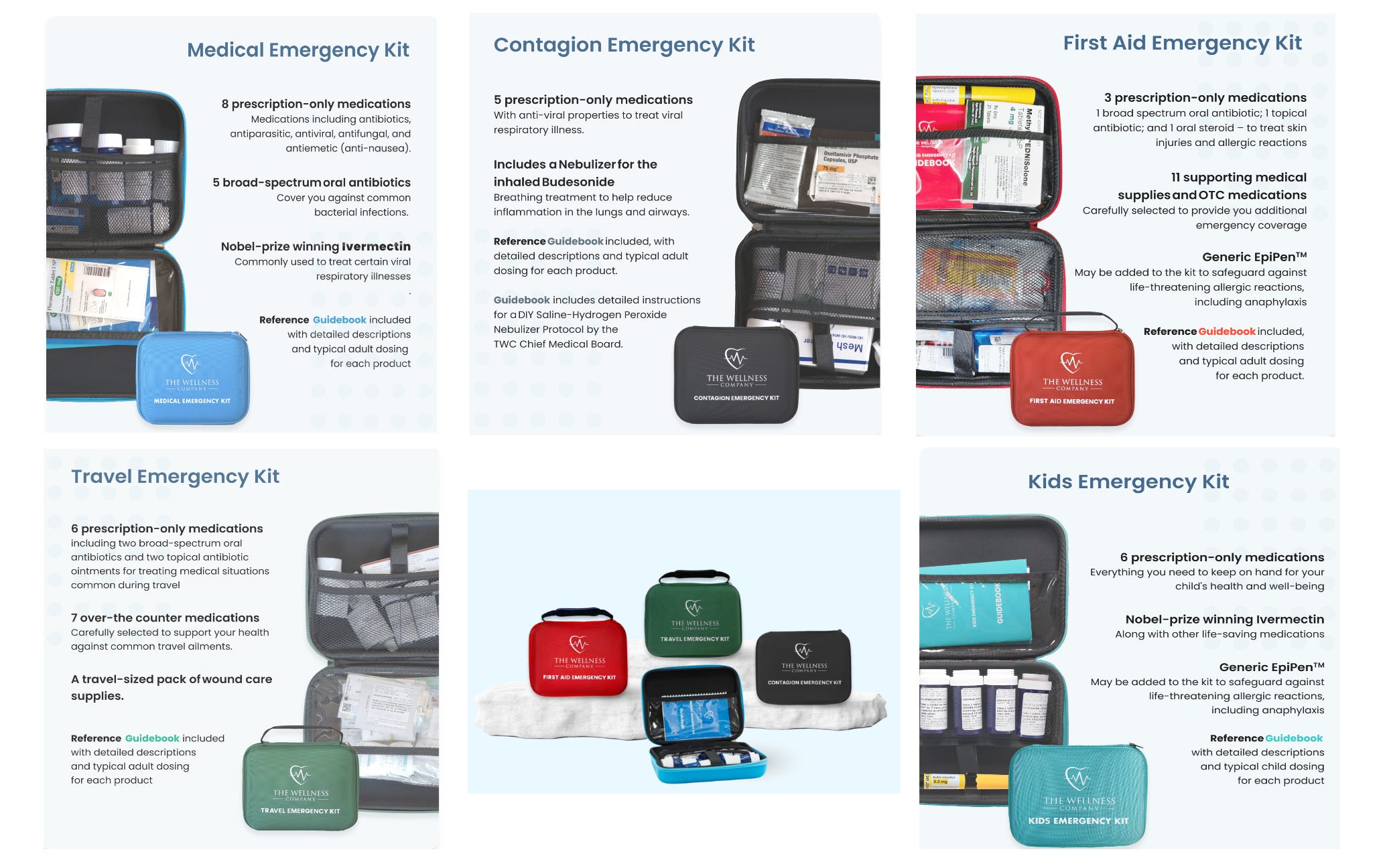
This is where The Wellness Company’s Medical Emergency Kit enters the picture. The kit includes prescription-only medications — among them ciprofloxacin and doxycycline, both have activity against Vibrio species. It’s not a substitute for ICU-level care in the immunocompromised, and nobody should pretend otherwise, but it represents exactly the kind of early-intervention capability that can stabilize a situation while you get to definitive care — or handle it outright if the infection is caught at the first sign of a wound turning angry.
The kit ships with a step-by-step guidebook, covers 30+ common illnesses, and is prescribed by a licensed U.S. provider after a brief medical intake. The cost undercuts a single ER visit by roughly an order of magnitude. We call it Rational Readiness, and the name fits: this isn’t doomsday cosplay, it’s acknowledging that the system buckles under pressure and that personal preparedness fills the gap institutional medicine leaves wide open.
Please subscribe to FOCAL POINTS as a paying ($5 monthly) or founder member so we can continue to bring you the truth. AlterAI may be used to assist in searches, synthesis, and review.
Peter A. McCullough, MD, MPH
Chief Scientific Officer, The Wellness Company
📚 References
Louisiana Department of Health, Vibrio vulnificus Update, August 6, 2026
Florida Department of Health, Vibrio Vulnificus Infections — confirmed case and death tables through August 1, 2026
CBS News, Flesh-eating bacteria has killed 5 in Louisiana this year, officials say, Faris Tanyos, August 6, 2026
Fox Weather, Flesh-eating bacteria tracker 2026: Cases in Florida, Alabama and Connecticut, July 27, 2026
Fox News, Beachgoers warned after deadly ‘flesh-eating’ bacteria kills 5 in Southern state, August 7, 2026
The Wellness Company, Medical Emergency Kit product page and medical kit information pages, accessed August 2026
please take Cipro out of your wellness immune pack. It is a very harmful antibiotic and can do serious damage to people's nervous systems!!!!
N.B!!!! Folks with hereditary hemochromatosis will certainly die quickly if exposed to Vibrio Vulnificus via a wound. This bacteria THRIVES IN AN IRON RICH ENVIRONMENT, AND MULTIPLIES VERY QUICKLY. I am told that eight hours after exposure/infection death can be experienced. Considering that MUCH MORE than 1:200 people actually have Hereditary Hemochromatosis, (HHC), this threat is very real. Also known as "The Viking Disease", and "the Celtic Curse", HHC is not uncommon in Jewish (ethnic) populations, and is quite prevalent in the Levant, England, the Netherlands, Germany and Scandi countries, hence, America. WE WERE WARNED in the Bible, to not touch the unclean thing.... the sea food, the pork, the flesh of carrion eaters and omnivores, for very good reasons. Vibrio Vulnificus was one of the things I was warned about 15 years ago, through studies on Hereditary Hemochromatosis. HHC causes iron overload through the mechanism of failure to produce the hormone Hepcidin, the iron metabolism regulator. Folks with HHC collect iron in tissue, organs, joints, and it causes problems, like cardiac arhythmia, cancers and other disorders. Folks with HHC should NOT WALK BAREFOOT ON A BEACH. I hope this information helps someone.