


For years, people around the world have raised serious concerns about mRNA vaccine shedding—the possibility that vaccine-derived materials could spread beyond the individuals who received the injections. Despite years of public concern and debate, critical questions surrounding this possibility have remained unanswered.
We decided to examine the scientific evidence comprehensively, tracing what happens to vaccine-derived materials inside the body, how they spread between cells, and whether biological mechanisms exist that could allow these materials to pass from one person to another.
Our resulting paper, titled “mRNA Vaccine Shedding: Internal Transcriptional Dissemination and Potential Human-to-Human Transfer,” was coauthored by John A. Catanzaro, NMD, PhD, of Neo7Bioscience, Inc., and Nicolas Hulscher, MPH (myself), and Peter A. McCullough, MD, MPH, of the McCullough Foundation.
Drawing on published human investigations, molecular experiments, and research involving extracellular vesicles, we examined the existing evidence and identified two distinct forms of mRNA vaccine shedding:
1. Human-to-human shedding: The potential transfer of vaccine-derived materials from vaccinated individuals to other people through biological secretions.
2. Transcriptional shedding: The production, fragmentation, persistence, and internal spread of vaccine-derived molecular products throughout the body.

1. Human-to-Human Shedding: Potential Transfer Between Individuals
Studies have detected vaccine-derived spike protein and mRNA on or within circulating exosomes multiple years after vaccination. Exosomes are microscopic, membrane-bound particles that protect and transport proteins, genetic material, and other biological cargo between cells.
Importantly, these same types of particles are naturally present in bodily secretions that may come into contact with other individuals:
Breast milk: Vaccine-derived mRNA has already been detected within exosomes in human breast milk. This documents the presence of vaccine genetic material in a secretion naturally transferred from vaccinated mothers to their infants.
Saliva: Exosomes are confirmed in human saliva, yet their potential carriage of vaccine-derived spike protein, mRNA, or plasmid-associated DNA remains untested.
Exhaled breath: Exosomes and other extracellular vesicles have been recovered from exhaled breath and breath condensate. Whether these particles carry vaccine-derived materials following mRNA vaccination has not been directly investigated.
Sweat: Extracellular vesicles have also been detected in human sweat, but their potential carriage of vaccine-derived molecular products remains untested.
Exosomes are not simply passive containers. Experimental research demonstrates that they can protect genetic material, enter recipient cells, and deliver molecular cargo capable of altering cellular activity.
These findings provide a plausible biological foundation for human-to-human transfer pathways beyond breast milk.
Adding to these concerns, an observational study involving thousands of respondents found associations between proximity to vaccinated individuals and menstrual irregularities among unvaccinated women.
Despite these observations, whether vaccine-derived spike protein, mRNA, or plasmid-associated DNA can transfer between individuals through saliva, exhaled breath, sweat, or other non-milk bodily secretions has never been directly tested.
2. Transcriptional Shedding: Internal Spread Throughout the Body
The second form of shedding examined in our paper involves the production, fragmentation, persistence, and dissemination of vaccine-derived molecular materials within the vaccinated individual.
Following mRNA vaccination, human cells manufacture SARS-CoV-2 spike protein. This protein can be broken into fragments through enzymatic processes, released into circulation, and transported through the body inside or on the surface of exosomes.
We examine two additional mechanisms that could extend this process.
Cell division (mitosis): When cells containing vaccine-derived proteins divide, their daughter cells may inherit portions of the altered cellular contents. This proposed mechanism could extend the presence and biological effects of vaccine-derived materials across successive generations of cells.
Cell-to-cell spread: Exosomes can transport spike-related materials and regulatory genetic cargo to distant cells that never directly received vaccine mRNA. Experimental studies involving spike-expressing cells demonstrate that exosomal cargo can alter signaling pathways in recipient cells.
Together, these mechanisms suggest a potentially self-reinforcing cycle of molecular dissemination and cellular signaling disruption:
Spike production → Protein fragmentation → Exosome release → Cellular signaling disruption → Further dissemination
As vaccine-derived materials spread between cells, they interfere with five interconnected biological systems: blood coagulation, innate immune sensing, tumor-suppressor signaling, cellular receptor regulation, and interferon signaling.
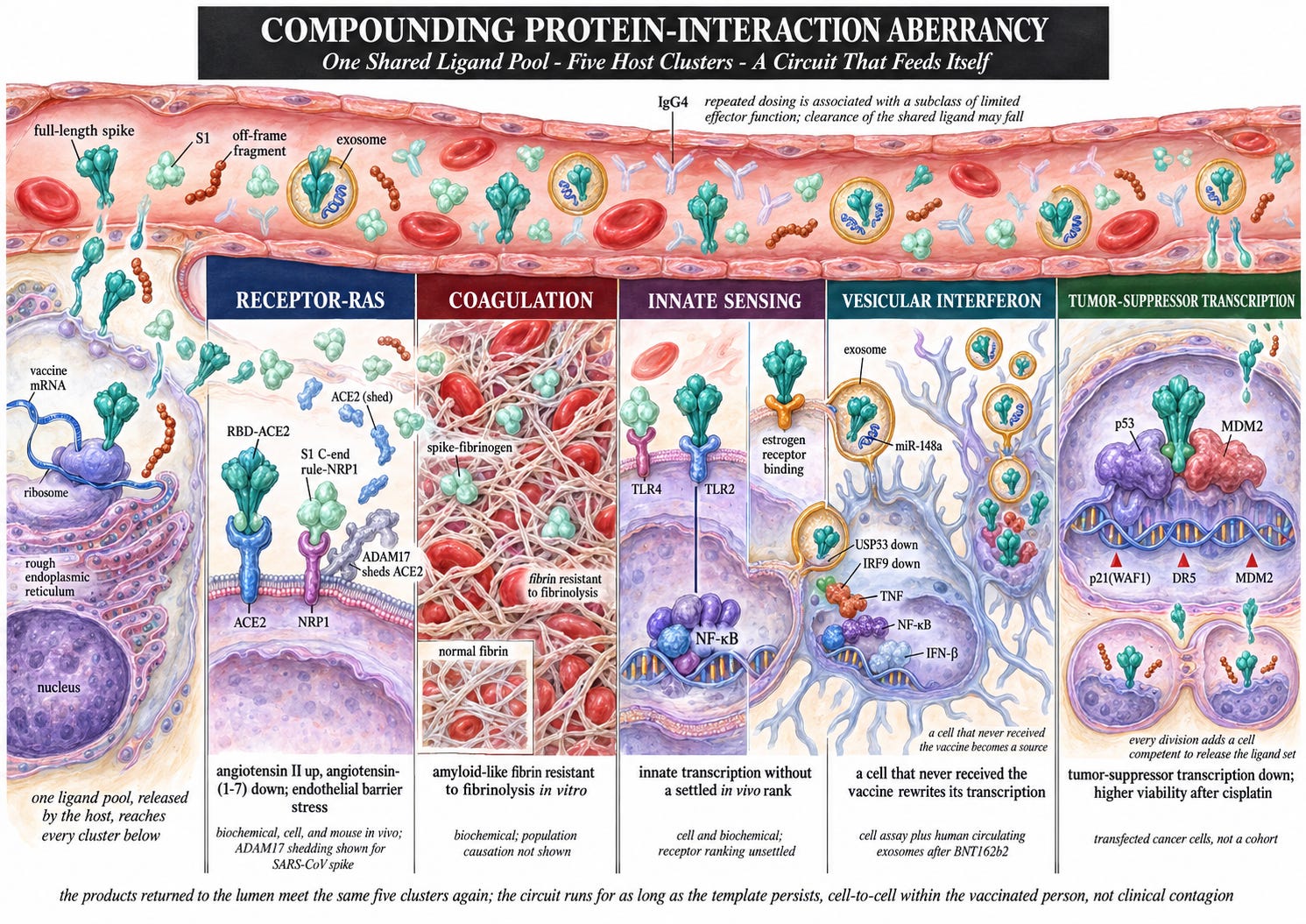
The possibility of sustained cellular disruption and human-to-human exposure of mRNA vaccine material demands immediate testing. In the meantime, a HALT to mRNA technology is warranted to protect innocent bystanders from potential shedding.
Epidemiologist and Foundation Administrator, McCullough Foundation
Support our mission: mcculloughfnd.org
Please consider following both the McCullough Foundation and my personal account on X (formerly Twitter) for further content.
They poisoned all of us. What happened to "my body, my choice"?
Everything these monsters posturing as "experts" were telling people was the exact opposite of the truth. They intentionally stirred up fear of the "unvaccinated" as if they were a threat to truly "vaccinated" people (false definition on both sides), when the people jabbing up are the real & continuing threat to the unjabbed through shedding.