


We have completed the first population-level study to-date directly examining childhood COVID-19 vaccination in relation to autism and other neurodevelopmental outcomes, using official U.S. government data to compare vaccinated and unvaccinated American children.
Our study is titled, “Neurodevelopmental Outcomes in COVID-19-Vaccinated Versus Unvaccinated U.S. Children: Analysis of the National Health Interview Survey, 2022–2024.” It’s authored by Nicolas Hulscher, MPH (myself); M. Nathaniel Mead, MSc, PhD; Carol Taccetta, MD, FCAP; John A. Catanzaro, NMD, PhD; Robyn A. Honea, PhD; and Peter A. McCullough, MD, MPH.

The data come from the National Health Interview Survey (NHIS), one of the nation’s principal sources of information on the health of the U.S. civilian population. NHIS is conducted by the National Center for Health Statistics (NCHS), part of the U.S. Centers for Disease Control and Prevention (CDC), and is designed to produce nationally representative estimates through continuous household interviews.
Using the 2022–2024 NHIS data, we analyzed a nationally representative sample of 21,990 U.S. children. One child per household is randomly selected for the survey, and a parent or guardian provides information on vaccination status, diagnoses, healthcare use, mental health, and other health characteristics.
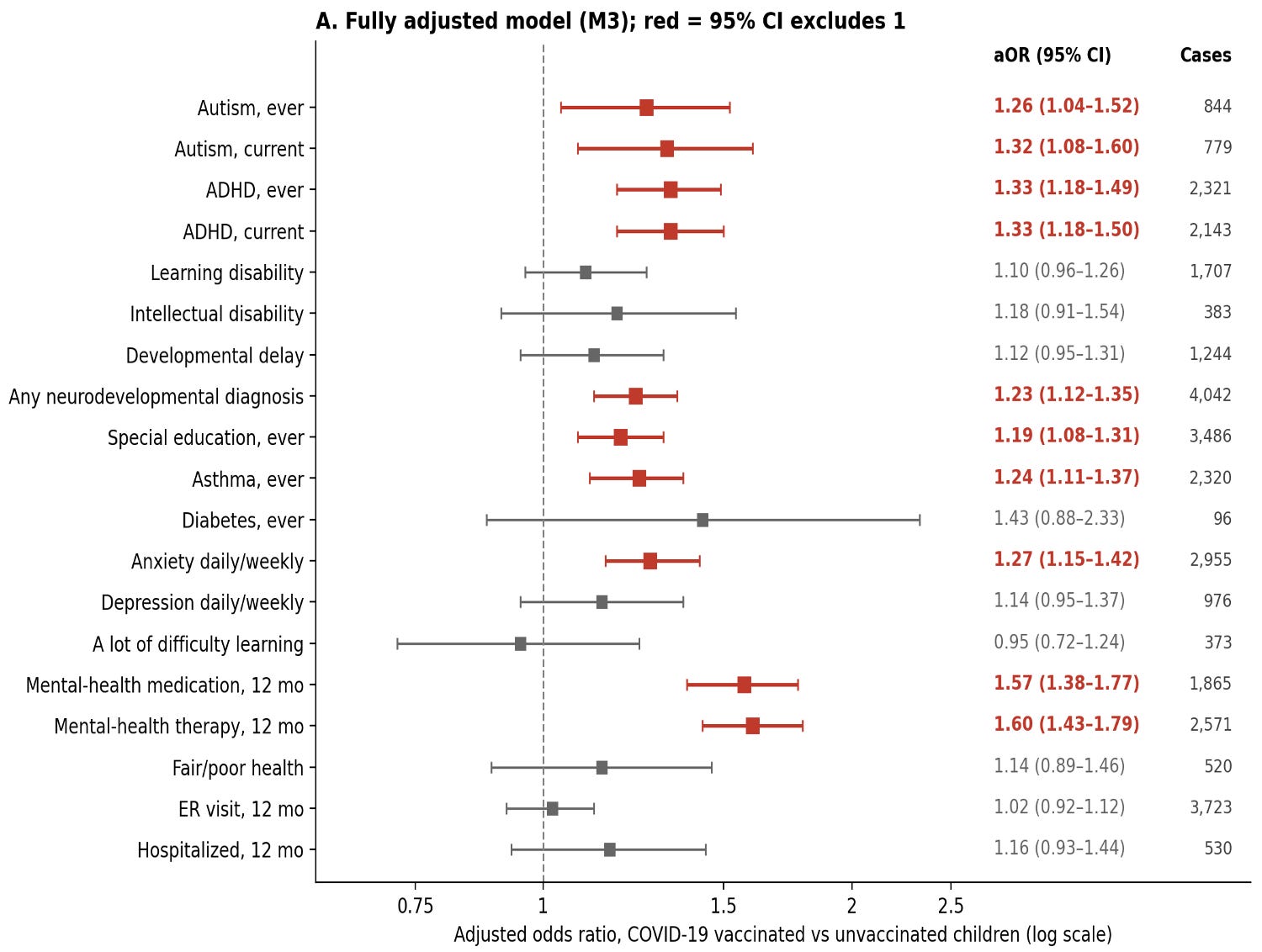
Compared with COVID-unvaccinated children, COVID-vaccinated children had significantly higher odds of:
AUTISM: +32%
ADHD: +33%
ANY NEURODEVELOPMENTAL DISORDER: +23%
SPECIAL-ED USE: +19%
ASTHMA: +24%
ANXIETY: +27%
MENTAL-HEALTH DRUG USE: +57%
MENTAL-HEALTH THERAPY: +60%
These estimates came from models adjusted for age, sex, survey year, race/ethnicity, family income, parental education, insurance, region, wellness visits, and usual source of care.
The strongest autism signal appeared in young children
The most alarming autism finding emerged among children ages 5–7. In this age group, children who had received 3 or more COVID shots had 154% higher odds of current autism compared with children who had received zero doses.
This age range is especially important because ages 5–7 remain a critical period for brain, language, behavioral, social, and educational development—and also overlap with the period in which many children receive an autism diagnosis.
The manuscript additionally found that among children ages 5–8 who were first vaccinated at age 5 or younger, at least one year before interview, those receiving 3+ doses had 2.46 times the adjusted odds of current autism compared with never-COVID-vaccinated children.
The signals strengthened with more COVID shots
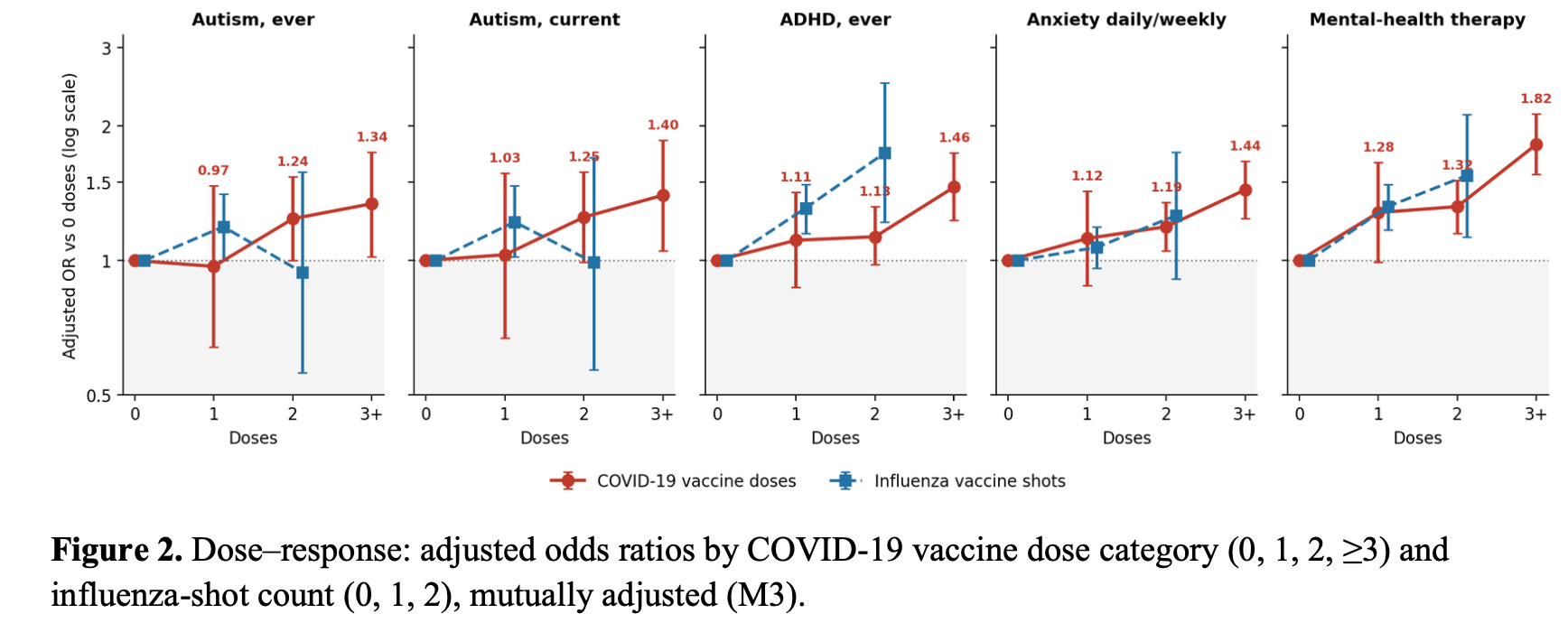
One of the most important findings was the presence of a dose-response pattern. The odds of multiple conditions increased with more COVID shot doses—including autism, ADHD, anxiety, neurodevelopmental disorders, asthma, and mental-health therapy.
Influenza vaccination as a negative-control exposure
We also examined influenza vaccination as a negative-control exposure. Influenza vaccination was associated with several of the same outcomes, including autism, ADHD, and asthma, which means residual healthcare-engagement confounding cannot be fully ruled out.
However, in direct comparison, children who had received a COVID vaccine but not a recent influenza vaccine had higher odds of autism than children who had received an influenza vaccine but not a COVID vaccine.
The strongest autism estimates were also seen among children who had received both COVID and influenza vaccines, raising the possibility that the observed signal may reflect not only COVID vaccination itself, but cumulative vaccine exposure.
The association survived extensive attempts to explain it away
Children who receive vaccines can differ substantially from children who do not. That is why we subjected the autism signal to multiple adjustment and sensitivity analyses.
The association persisted after accounting for age, sex, race/ethnicity, income, parental education, insurance, region, healthcare access, wellness visits, ER use, hospitalization, prescription use, and influenza vaccination.
It also remained after restricting the analysis to physically healthy children without asthma, diabetes, or fair/poor general health.
Most importantly, propensity-score overlap weighting was used to balance vaccinated and unvaccinated children across the measured covariates. This eliminated measured imbalance in factors including age, income, parental education, insurance, and influenza vaccination. The autism association remained:
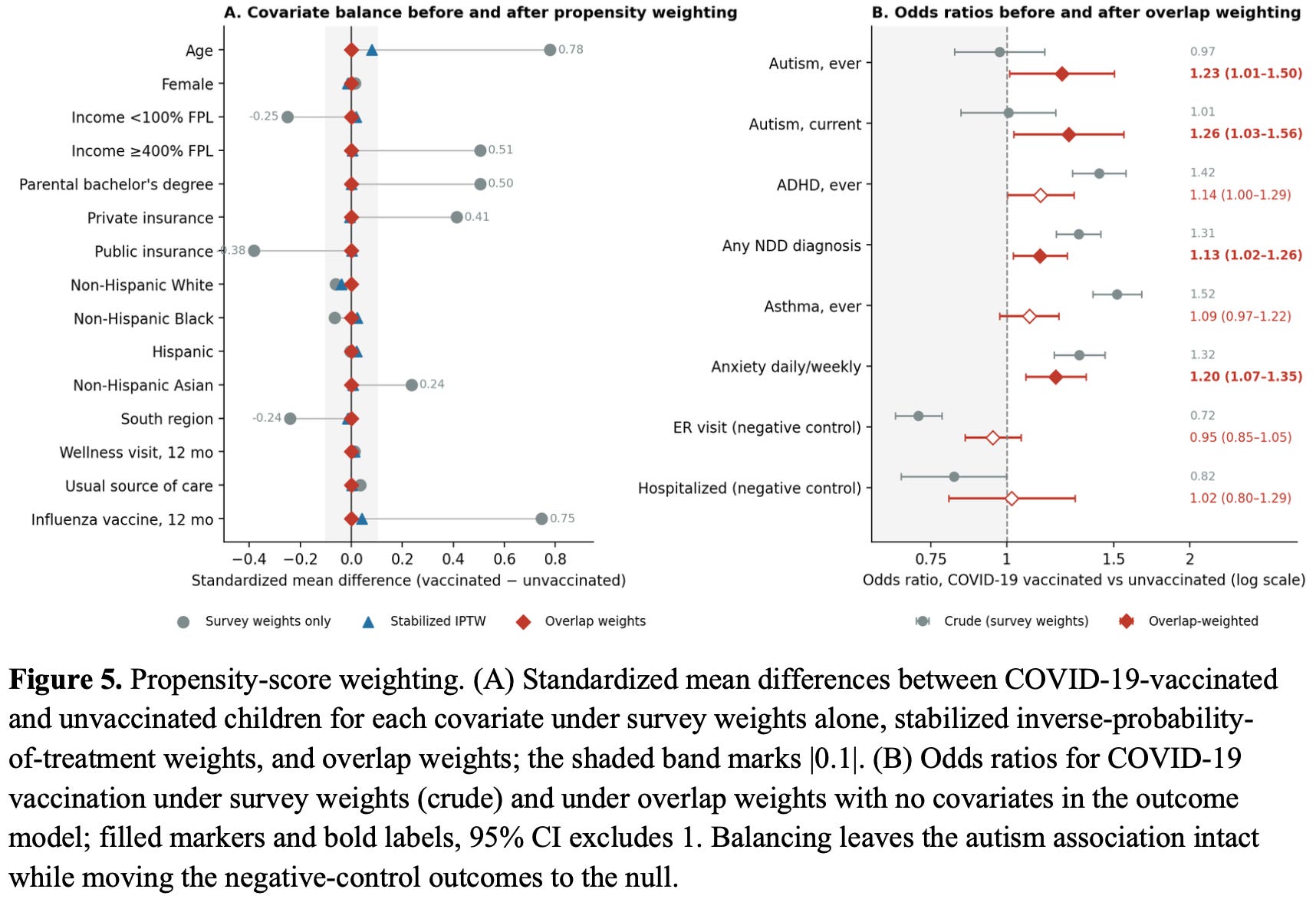
At the same time, the negative-control outcomes of emergency-department visits and hospitalization moved toward the null.
The manuscript’s E-value analysis estimated that an unmeasured confounder would need to be associated with both vaccination and autism by a risk ratio of roughly 2.0 to fully explain away the primary autism estimate.
In total, 26 of 27 autism point estimates across the paper’s various specifications exceeded 1, with 13 excluding the null.
This question was never adequately studied
Perhaps one of the most troubling aspects of this issue is that pediatric COVID vaccine trials were not designed to answer this question in the first place.
Pediatric authorization relied on immunobridging trials involving only a few thousand children, generally with relatively short follow-up, and none were powered for or systematically collected neurodevelopmental or psychiatric outcomes.
Post-marketing surveillance similarly focused largely on acute outcomes such as myocarditis, anaphylaxis, and seizures rather than long-term neurodevelopmental endpoints.
Is there a plausible biological mechanism?
Yes. Vaccine-derived spike protein has been shown to circulate systemically after vaccination for months to years and has been found in brain vasculature in human studies. Experimental work has found that the S1 subunit can disrupt blood-brain-barrier integrity and trigger inflammatory effects in brain endothelial cells.
Animal work involving prenatal spike-protein exposure has also reported autism-like behavioral changes, neuroinflammation, neuronal changes, altered cytokine signaling, and reduced brain-derived neurotrophic factor.
The developing brain has extraordinarily high metabolic demands during synaptogenesis, circuit formation, cortical development, and activity-dependent pruning. An inflammatory or metabolic insult during those windows could result in alterations to brain development.
Limitations
This study identifies a population-level signal. It does not, by itself, prove that COVID-19 vaccination causes autism or the other reported outcomes. The largest limitation is that NHIS is cross-sectional and does not provide exact dates of diagnosis. That means the study cannot establish whether vaccination preceded diagnosis in every child.
NHIS does not capture the full childhood vaccination schedule or which routine vaccines may have been given alongside COVID-19 vaccination. Therefore, the observed associations could reflect the COVID-19 vaccine itself, other vaccines received around the same time, or the combined effects of cumulative vaccine exposure.
The next step should be a large linked birth-cohort study beginning before age 3, using complete vaccination records linked to longitudinal medical records and clinically validated neurodevelopmental diagnoses.
Conclusion
Official U.S. government data from 21,990 children revealed a consistent association between childhood COVID-19 vaccination and higher odds of autism, ADHD, anxiety, special-education use, and mental-health treatment.
The autism association persisted across numerous adjustment strategies, strengthened with increasing dose count, and reached its largest estimate in some of the youngest multiply vaccinated children. Among ages 5–7, 3+ COVID shots were associated with 154% higher adjusted odds of current autism.
This is a safety signal that must not be ignored. Endangering the developing brain is a RED LINE. COVID-19 “vaccination” of children should CEASE IMMEDIATELY.
Epidemiologist and Foundation Administrator, McCullough Foundation
Support our mission: mcculloughfnd.org
Please consider following both the McCullough Foundation and my personal account on X (formerly Twitter) for further content.
This is the murder and destruction of society by evil! Poor children that are sacrificed!
All vaccines cause harm — but they’re protected by historical propaganda. Once we can understand this, we can shed the lights on these harmful products: https://unorthodoxy.substack.com/p/the-complete-vaccine-harm-profile