


For decades, ivermectin and mebendazole have been widely used to treat parasitic infections. Both appear on the World Health Organization’s Model List of Essential Medicines, while the discovery of ivermectin was recognized with the 2015 Nobel Prize in Physiology or Medicine. Yet a growing body of scientific research has revealed that these inexpensive, off-patent compounds also interact with an extraordinary range of molecular pathways involved in cancer growth, survival, metastasis, and treatment resistance.
Our new investigation builds upon our earlier real-world study of 197 cancer patients prescribed combination ivermectin–mebendazole therapy. Among the 122 patients who completed six-month follow-up, 84.4% reported clinical benefit, including 32.8% reporting no evidence of disease, 15.6% reporting tumor regression, and 36.1% reporting stable disease. That study raised an important question: What biological mechanisms might explain the large clinical benefit signal?
Now, the research team at the McCullough Foundation and The Wellness Company has synthesized decades of scientific evidence from more than 100 studies in the most comprehensive review to date examining the anticancer potential of combination ivermectin and mebendazole.
Our new 44-page paper, titled “Combination Ivermectin and Mebendazole: A Comprehensive Review of Anticancer Mechanisms, Preclinical Activity, and Clinical Evidence as Adjunctive Treatment in Cancer Patients,” was authored by Nicolas Hulscher, MPH (myself); James A. Thorp, MD; Kelly Victory, MD; Peter Gillooly, MSc; Peter A. McCullough, MD, MPH; and Harvey Risch, MD, PhD.
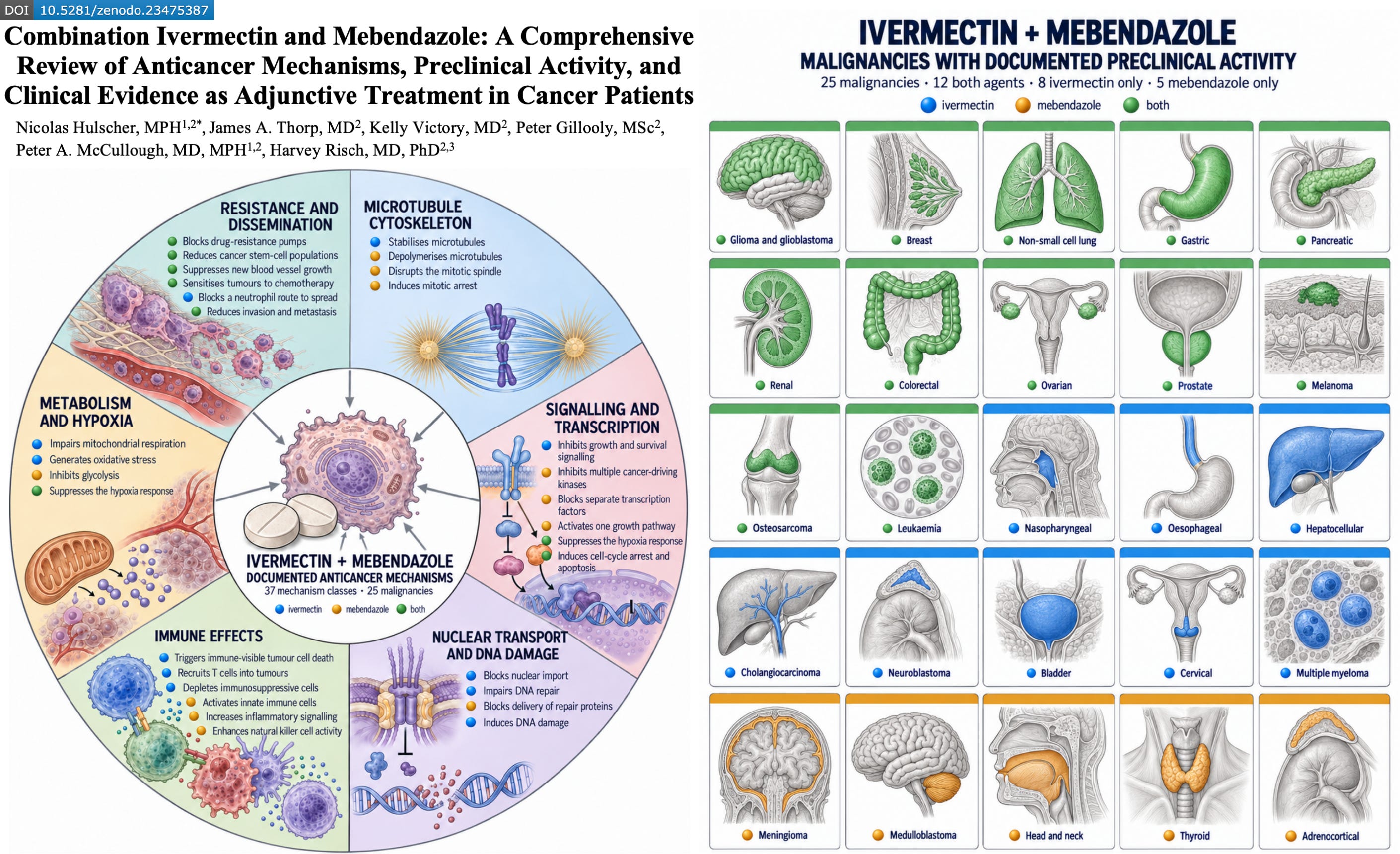
We examined published mechanistic, laboratory, and clinical evidence through October 2026, bringing together findings that had largely been investigated separately.
Major Findings
29 distinct anticancer mechanisms for ivermectin, spanning oncogenic signaling, mitochondrial dysfunction, nuclear transport, immune regulation, and treatment resistance.
26 distinct anticancer mechanisms for mebendazole, including microtubule disruption, angiogenesis inhibition, kinase targeting, immune activation, and chemotherapy sensitization.
37 distinct anticancer mechanism classes across both compounds, after accounting for overlapping molecular targets and pathways.
Preclinical anticancer activity across 25 human cancer types, including breast, colorectal, lung, prostate, pancreatic, ovarian, brain, and hematological malignancies.
Complementary molecular actions: The drugs influence different aspects of cancer biology while sharing activity involving cancer stem-like cells, hypoxia signaling, DNA damage responses, and multidrug resistance.
Promising randomized clinical findings: In a 40-patient metastatic colorectal cancer trial, adding mebendazole to conventional treatment produced a 65% tumor response rate versus 10% in controls, alongside median progression-free survival of 9.25 versus 3.00 months.
Clinical evidence classifications: Of 6 studies reporting efficacy outcomes for ivermectin and/or mebendazole, 3 were positive, 2 were neutral, and 1 had incomplete interim results that could not yet be classified.
An important research gap: Despite extensive evidence for each drug individually, no published preclinical study has directly tested the ivermectin–mebendazole combination, leaving its potential synergy or antagonism unresolved.
What makes these findings particularly noteworthy is not simply the number of anticancer mechanisms identified, but their remarkable biological diversity. Across laboratory and animal studies, ivermectin and mebendazole have demonstrated multiple overlapping and complementary anticancer mechanisms:
• Disrupt cancer-cell division
• Trigger programmed cancer-cell death
• Interfere with tumor energy production
• Inhibit tumor blood-vessel formation
• Suppress cancer-cell growth signaling
• Target cancer stem-like cells
• Interfere with metastatic spread
• Modulate antitumor immune responses
• Disrupt cancer-associated DNA repair pathways
• Counter multidrug-resistance mechanisms
• Enhance sensitivity to certain chemotherapies
• Influence pathways involved in radiation resistance
This is a remarkable breadth of anticancer mechanisms for two inexpensive, off-patent drugs—spanning nearly every major hallmark of cancer biology.
Importantly, both compounds have decades of human use, established manufacturing infrastructure, well-characterized pharmacology, and low generic-drug costs.
Together, these findings reveal an exceptionally broad repertoire of anticancer mechanisms, providing an urgent scientific rationale for investigating the two drugs in combination.
The data can no longer be ignored. Given the extraordinary breadth of evidence, we believe institutions such as the National Cancer Institute should immediately launch large randomized clinical trials to determine whether these anticancer effects translate into meaningful improvements in patient outcomes.
In the meantime, cancer patients will continue exercising their “right to try.”
Epidemiologist and Foundation Administrator, McCullough Foundation
Support our mission: mcculloughfnd.org
Please consider following both the McCullough Foundation and my personal account on X (formerly Twitter) for further content.
Of course, actually solving cancer issues, isn't in the Big Medicine playbook.... b/c of profits and all.
What is the difference between mebendozole and Fenbendazole ?