


President Trump has signed a sweeping Executive Order restructuring Federal childhood vaccine recommendations and directing agencies to maximize parental choice, reassess vaccine safety, and bring the U.S. schedule more closely in line with practices used by peer developed nations.
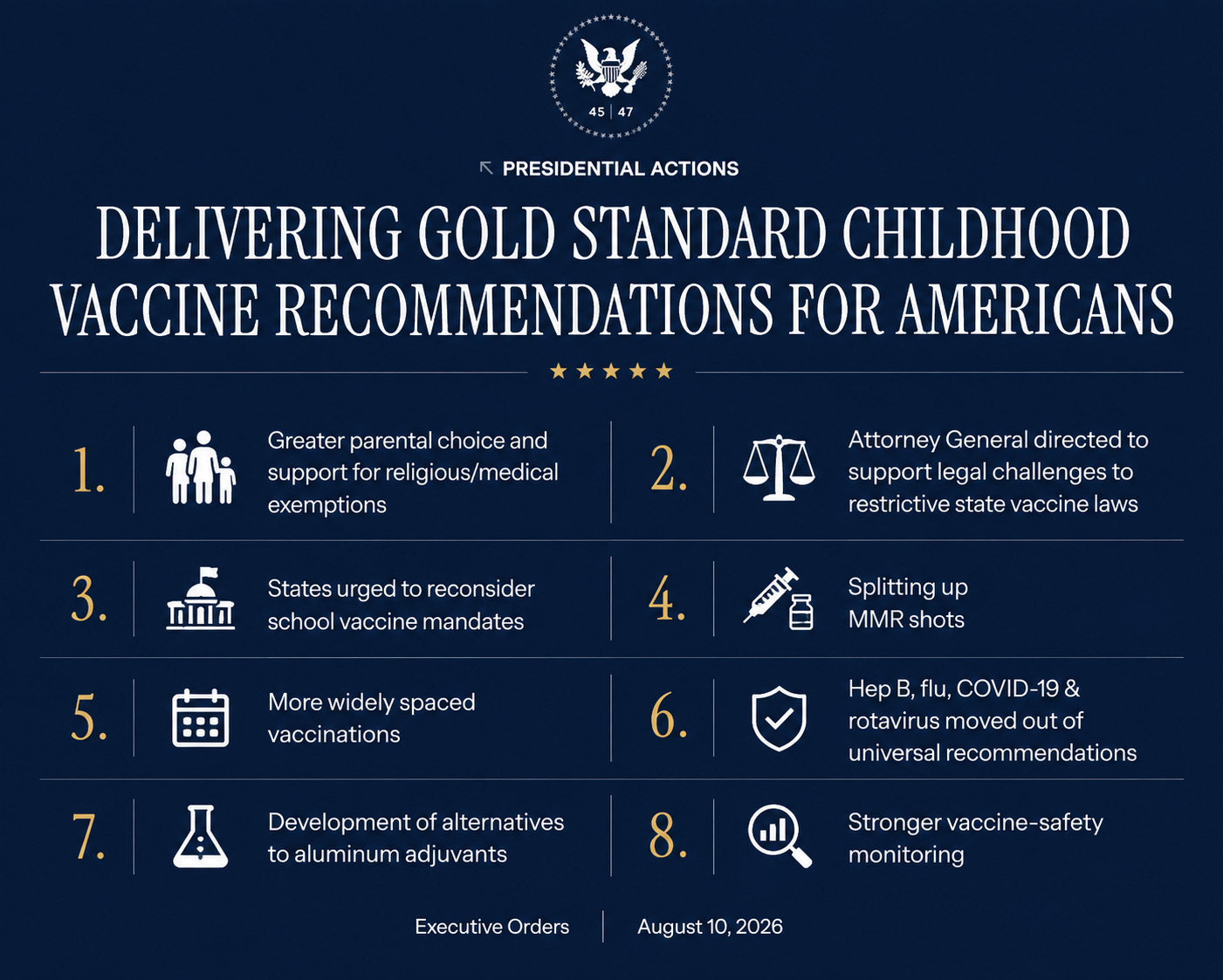
The new Executive Order establishes three categories of childhood immunization recommendations:
Hep B, Flu, COVID, and Rotavirus Removed From Universal Recommendations
Under the new framework, influenza, COVID-19, rotavirus, hepatitis A, hepatitis B, and meningococcal disease are placed under shared clinical decision-making rather than being universally recommended for every child.
Hepatitis A and B are also recommended for certain high-risk populations, alongside meningococcal vaccination, dengue vaccination, and RSV monoclonal antibodies.
It’s quite unfortunate that lethal COVID-19 mRNA gene-transfer injections remain available to any human being.
Vaccines Still Universally Recommended
The new “Gold Standard Childhood Vaccine Recommendations” retain universal recommendations covering:
Measles
Mumps
Rubella
Diphtheria
Tetanus
Pertussis
Polio
Haemophilus influenzae type B
Pneumococcal disease
Human papillomavirus
Varicella
While many of the vaccines that remain universally recommended are still hazardous to human health, this Executive Order represents a major improvement over the previous childhood vaccine framework.
Executive Order Calls for Separate MMR Shots
The Executive Order states that the combined measles-mumps-rubella vaccine should eventually be accompanied by separate single-disease vaccine options once those products become domestically available.
It further states that, “to the maximum extent feasible,” childhood immunizations should be administered at separate medical visits.
Within 90 days, HHS is directed to develop plans for making single-antigen alternatives available, beginning with measles, mumps, and rubella, while maintaining access to combination vaccines.
This is particularly important given that our recent study found MMR and MMRV vaccines are linked to 2,657% more U.S. deaths than measles infection since 1995.

HHS Ordered to Study Alternatives to Aluminum Adjuvants
One of the provisions directs the HHS Task Force on Safer Childhood Vaccines to pursue: Alternative adjuvants to aluminum and comparative safety and efficacy studies.
This is important because injecting aluminum into small infants has been linked to a broad range of health problems:

However, solely replacing aluminum will most likely not make these vaccines much safer, and autism/chronic disease risks will still be present.
Executive Order Strengthens Parental Choice
This one is big. The Executive Order declares it Federal policy to support “maximal parental choice over childhood vaccines” consistent with Federal law, personal autonomy, and informed consent.
States and territories are encouraged to reconsider vaccine requirements for school attendance in light of the revised Federal recommendations.
The Attorney General is also directed to take appropriate action supporting meritorious legal challenges involving parental authority, religious liberty, disability protections, equal protection, and applicable religious or medical vaccine exemptions.
A Major Shift in U.S. Vaccine Policy
For decades, Federal childhood vaccine policy largely moved in one direction: more products, more doses, and broader universal recommendations.
This Executive Order begins moving policy in the opposite direction: fewer universal recommendations, more individualized decision-making, greater parental choice, scrutiny of vaccine ingredients, reassessment of timing and sequencing, and stronger emphasis on safety research.
However, substantial concerns remain regarding the safety, necessity, cumulative burden, timing, and long-term effects of vaccines that continue to be universally recommended.
Whatever additional reforms may still be necessary, this represents a major improvement in U.S. childhood vaccine policy and one of the most consequential Federal vaccine-policy shifts in decades.
Epidemiologist and Foundation Administrator, McCullough Foundation
Support our mission: mcculloughfnd.org
Please consider following both the McCullough Foundation and my personal account on X (formerly Twitter) for further content.
I’d like to know where his Executive Order is on banning the mRNA covid shot — by far the biggest failure in the history of medicine. Now responsible for more injuries, adverse events and deaths on only the last 4 years than ALL vaccines COMBINED in the last 40 years. Fact.
Looks to me like they are trying (desperately) to save the vaccine program. Hopefully, this effort will fail as badly as the vaccines have.