


A newly published two-part scientific study raises major alarms about an issue that has received remarkably little scrutiny: What happens when blood from COVID-19-vaccinated donors is transfused into another person?
Blood banks routinely screen donations for recognized infectious threats. Yet the current blood supply is not routinely screened for vaccine-derived mRNA, spike protein, plasmid DNA, amyloid, fibrin-microclot complexes, or other relevant vaccine-associated constituents.
Our newly published two-part series investigates this blind spot from two complementary directions. The two studies were authored by James A. Thorp, MD; Claire Rogers, MSPAS, PA-C; R. Clinton Ohlers, PhD; M. Nathaniel Mead, PhD; Nicolas Hulscher, MPH (myself); Kirstin Cosgrove, CCRA; Sierra Hamm, RN; David Speicher, PhD; and Steven Hatfill, MD, M Med.
Part I: Serious Post-Transfusion Complications in Nine Unvaccinated Patients
Potential Implications of COVID-19 Vaccination for Blood Donation: A Retrospective Case Series and Literature Review—Part I of II
Part I presents a retrospective, hypothesis-generating case series of nine individuals who had not received a COVID-19 vaccine and subsequently experienced serious medical events after receiving blood transfusions.
Reported complications included thromboembolic disease, progressive clotting disorders, myocarditis, pericardial disease, disseminated intravascular coagulation, multi-organ system failure, and death.
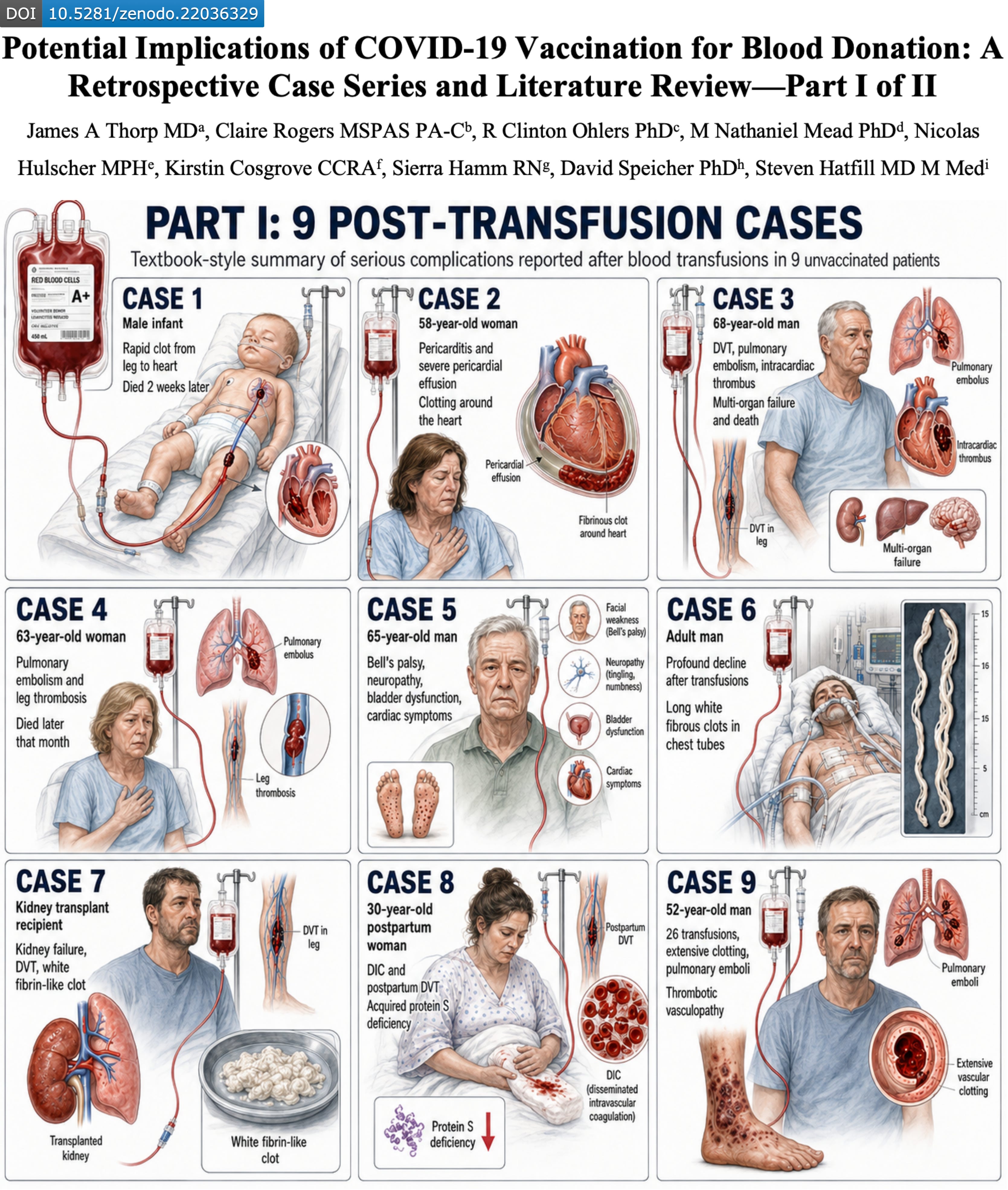
We concluded that these cases, together with the existing literature, raise sufficient concern to warrant direct investigation of whether biologically active vaccine-derived constituents may be present in donated blood:
This study suggests that blood donated by COVID-19-vaccinated individuals may contain biologically active vaccine-derived constituents that could cause adverse clinical outcomes. The case reports and cited studies identify questions that warrant further investigation. All the pathogenic components of the COVID-19 vaccine or byproducts from it, have been found in several studies to be circulating in the blood of vaccinated donors. Healthcare providers must honor the ethical principles of patient autonomy and non-maleficence and support patients’ requests for autologous and directed designated donor blood. Screening blood donations for the presence of spike protein, amyloid, fibrin-microclot complexes, vaccine-derived mRNA, and plasmid DNA using quantitative assays and PCR-based methods should be considered for further evaluation by relevant public health and regulatory authorities, including the CDC and FDA.
Part II: Extraordinary Blood, Clotting, and Neurological Safety Signals
Potential Implications of COVID-19 Vaccination for Blood Donation: Part II—Analysis of VAERS and Review of the Literature
Part II expands the investigation to the CDC/FDA Vaccine Adverse Event Reporting System, analyzing reports from January 1, 1990 through June 26, 2026 and comparing COVID-19 vaccines with influenza vaccines, DPT-containing vaccines, and all non-COVID vaccines combined.
The analysis identified statistically significant safety signals across every investigated endpoint, including reported rate ratios reaching:
Hemorrhage: up to 101-fold
Hemorrhage in pregnancy: up to 108-fold
Blood transfusion: up to 62-fold
Post-transfusion complications: up to 30-fold
Hypercoagulable biomarkers: up to 452-fold
Thrombotic events: up to 1,221-fold
Parkinson’s disease: up to 282-fold
Creutzfeldt-Jakob disease: up to 1,333-fold
Prion disease: 60-fold
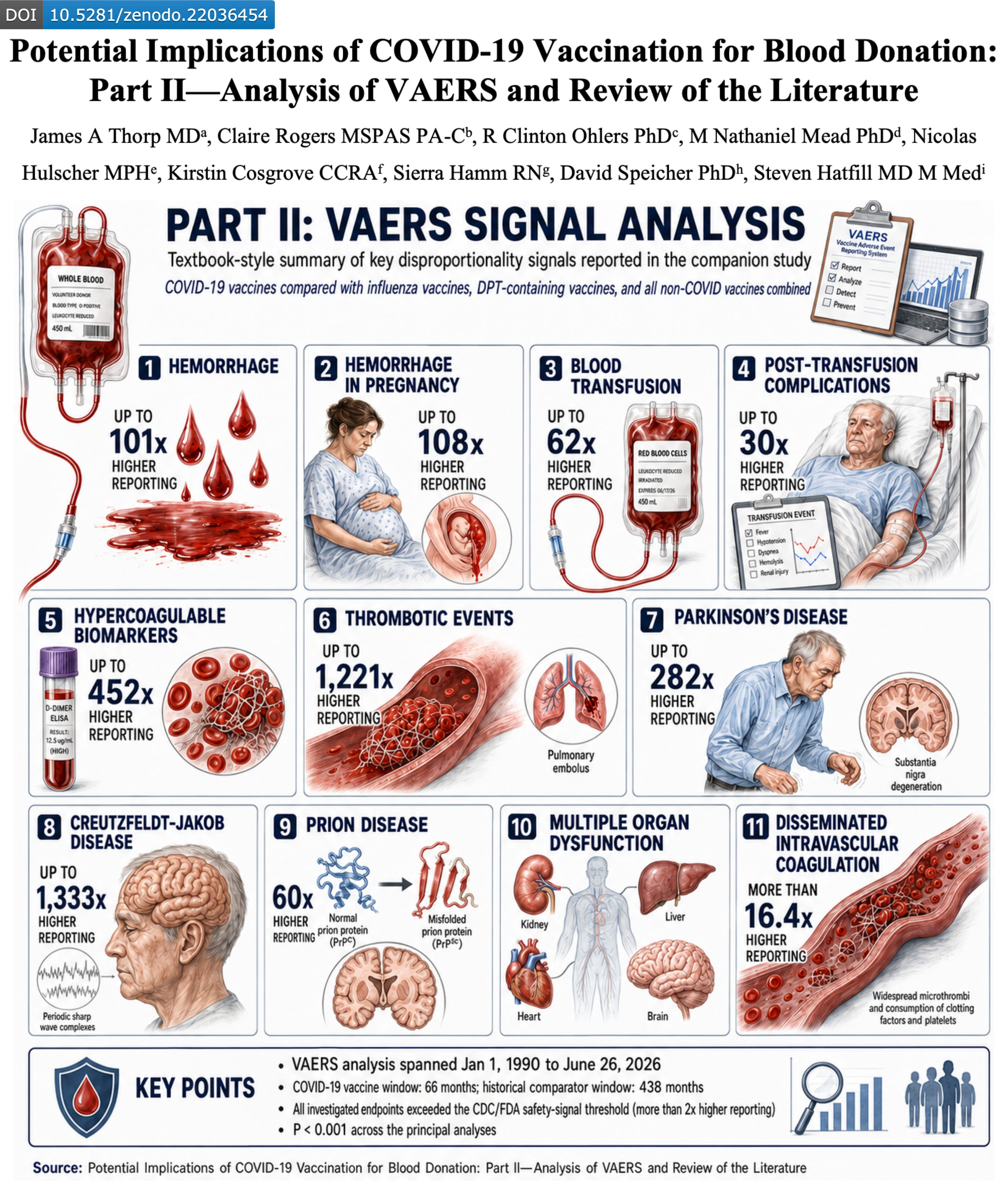
These signals are particularly important because they overlap with many of the same clinical patterns observed in Part I, including thrombosis, hemorrhage, DIC, and multi-organ dysfunction.
Part I identifies a series of serious post-transfusion events that demand investigation. Part II identifies striking pharmacovigilance signals involving many of the same biological systems, particularly clotting, hemorrhage, transfusion complications, and multi-organ dysfunction.
To preserve global blood-supply integrity, regulatory frameworks should move rapidly to implement direct quantitative spike-protein screening and high-sensitivity digital PCR testing for vaccine-derived genetic material across donor networks, while also investigating whether these constituents remain biologically active after donation, storage, processing, and transfusion.
Epidemiologist and Foundation Administrator, McCullough Foundation
Support our mission: mcculloughfnd.org
Please consider following both the McCullough Foundation and my personal account on X (formerly Twitter) for further content.
Sorry and literally nauseous to read this Mr. Hulscher....this is just unbelievably shocking. Medical doctors are among the most ignorant people in the world. Their giant egos prevent them from taking in knowledge. They are too bloated with their own importance.
I will never enter a hospital again....especially if I am ill. I would rather die peacefully without the aid of a "ventilator"....or a toxic "transfusion"
I sent a tweet to the Red Cross about this exact topic and I had to send it 2x before they replied. Of course they said there was no risk involved with receiving blood donated by a C19 vaccinated person. Heaven help us all, pray that you never need a transfusion because our blood supply is contaminated.