


By Peter A. McCullough, MD, MPH
This summer has brought one infectious disease threat after another, and disappointedly, our government agencies look flat-footed.
🦠 Legionnaires’ Strikes New York: Why Your Medicine Cabinet Is the New Front Line of Public Health
As cooling towers on the Upper East Side pump Legionella into the summer air, the difference between a treatable infection and a fatal outcome increasingly comes down to one question: do you have the right antibiotics on hand?
📊 The Outbreak Unfolding Right Now
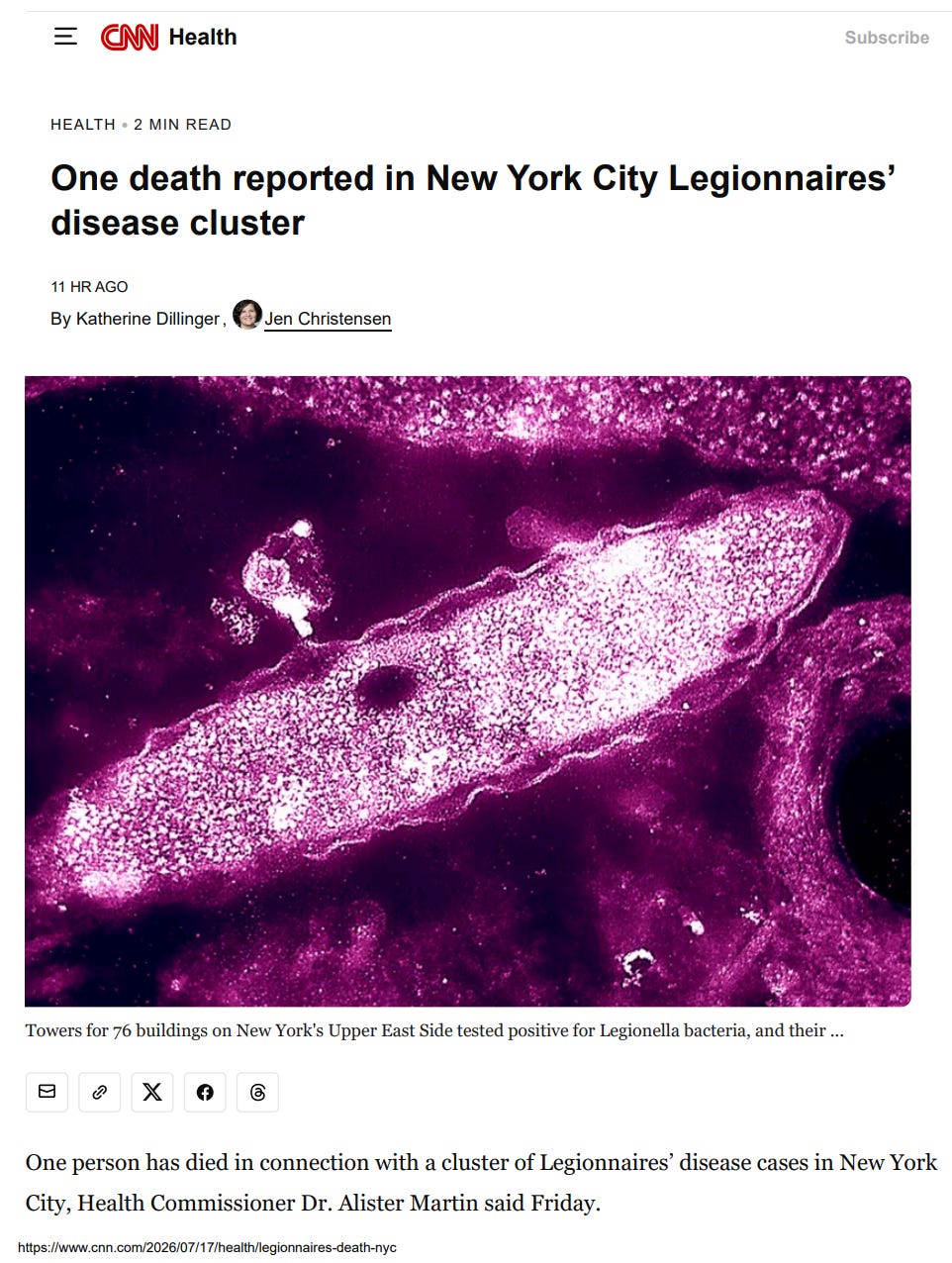
New York City is in the grip of a Legionnaires’ disease cluster that has already claimed its first life. As of mid-July 2026, the numbers are stark:
67 confirmed cases across Manhattan’s Upper East Side
55 hospitalizations—12 people currently admitted, 43 discharged after treatment
One confirmed death, with Health Commissioner Dr. Alister Martin confirming the fatality on Friday
76 buildings with cooling towers testing positive for Legionella bacteria, all ordered to drain, clean, and disinfect
And this comes just one year after a Harlem cluster sickened 92 people and killed seven. The CDC puts Legionnaires’ mortality at roughly 10%—a number that should terrify anyone over 50, anyone who smokes, anyone with a chronic lung condition, and anyone on immunosuppressive medications. That’s tens of millions of Americans walking around with elevated risk and no idea that the air they breathe could be carrying a gram-negative bacterium with a taste for alveolar macrophages.
🔬 What Makes Legionnaires’ So Dangerous—and So Treatable
Legionella pneumophila is a gram-negative bacillus that thrives in warm, stagnant water. Cooling towers, hot tubs, shower heads, decorative fountains—anywhere water aerosolizes, Legionella can hitch a ride straight into your lungs. It is not contagious person-to-person. You cannot get it from drinking contaminated water. The infection occurs exclusively through inhalation of contaminated mist or vapor.
Once inside the lungs, the bacteria invade and multiply within alveolar macrophages—the very immune cells meant to destroy them. The resulting pneumonia presents with fever, chills, muscle aches, cough, and often extrapulmonary symptoms including confusion, headache, and diarrhea. Standard empiric antibiotic regimens for community-acquired pneumonia may not cover Legionella adequately if the wrong agents are chosen.
This is where the rubber meets the road. A patient walks into an ER with fever, cough, and shortness of breath. It takes hours to be seen and get a chest x-ray. If that first azithromycin dose is delayed, underdosed, or omitted from the empiric regimen, the patient deteriorates while the lab runs its urine antigen test—a test that, critically, only detects L. pneumophila serogroup 1, missing roughly 30–40% of Legionella infections caused by other serogroups and species.
The urine antigen test takes hours to days. The culture on buffered charcoal yeast extract agar takes three to five days. PCR is faster but not universally available. By the time the diagnosis is confirmed, a patient on inadequate empiric therapy may already be decompensating.
💊 The Treatment Triad: Azithromycin, Doxycycline, and Fluoroquinolones
The CDC, and every infectious disease authority agree on the treatment hierarchy for Legionnaires’ disease:
🥇 Inpatient Respiratory Fluoroquinolones
Levofloxacin or moxifloxacin are the preferred agents—particularly for hospitalized patients, immunocompromised patients, and severe disease. They achieve excellent intracellular penetration, high bioavailability allowing oral step-down therapy, and bactericidal activity against Legionella. A typical course runs 7–14 days, extending to 3 weeks for the severely immunocompromised.
🥈 Outpatient Azithromycin
Azithromycin is highly effective and is the macrolide of choice. It achieves concentrated intracellular levels, has a long half-life allowing once-daily dosing, and for mild-to-moderate disease in immunocompetent patients, a 5–10 day course gets the job done. Clarithromycin and erythromycin are inferior alternatives—less well-tolerated, more drug interactions, and frankly, azithromycin has largely rendered them obsolete for this indication.
🥉 Alternative: Doxycycline
For mild pneumonia in immunocompetent patients who cannot tolerate macrolides or fluoroquinolones, doxycycline is a reasonable alternative. It achieves adequate intracellular levels and covers Legionella, though it is generally considered second-tier compared to azithromycin and the respiratory fluoroquinolones.
🎯 The Wellness Company Medical Emergency Kit: Pre-prescribed Antibiotics, One Box, Zero Excuses
Here is what The Wellness Company’s Medical Emergency Kit contains that directly applies to a Legionnaires’ outbreak:
Legionnaires’ treatment: Azithromycin Generic Z-Pak First-line macrolide; 5–10 day course for mild-moderate disease Doxycycline Broad-spectrum tetracycline alternative for mild pneumonia in immunocompetent patients Ciprofloxacin fluoroquinolone active against Legionella (though levofloxacin is preferred; ciprofloxacin still provides fluoroquinolone-class coverage)
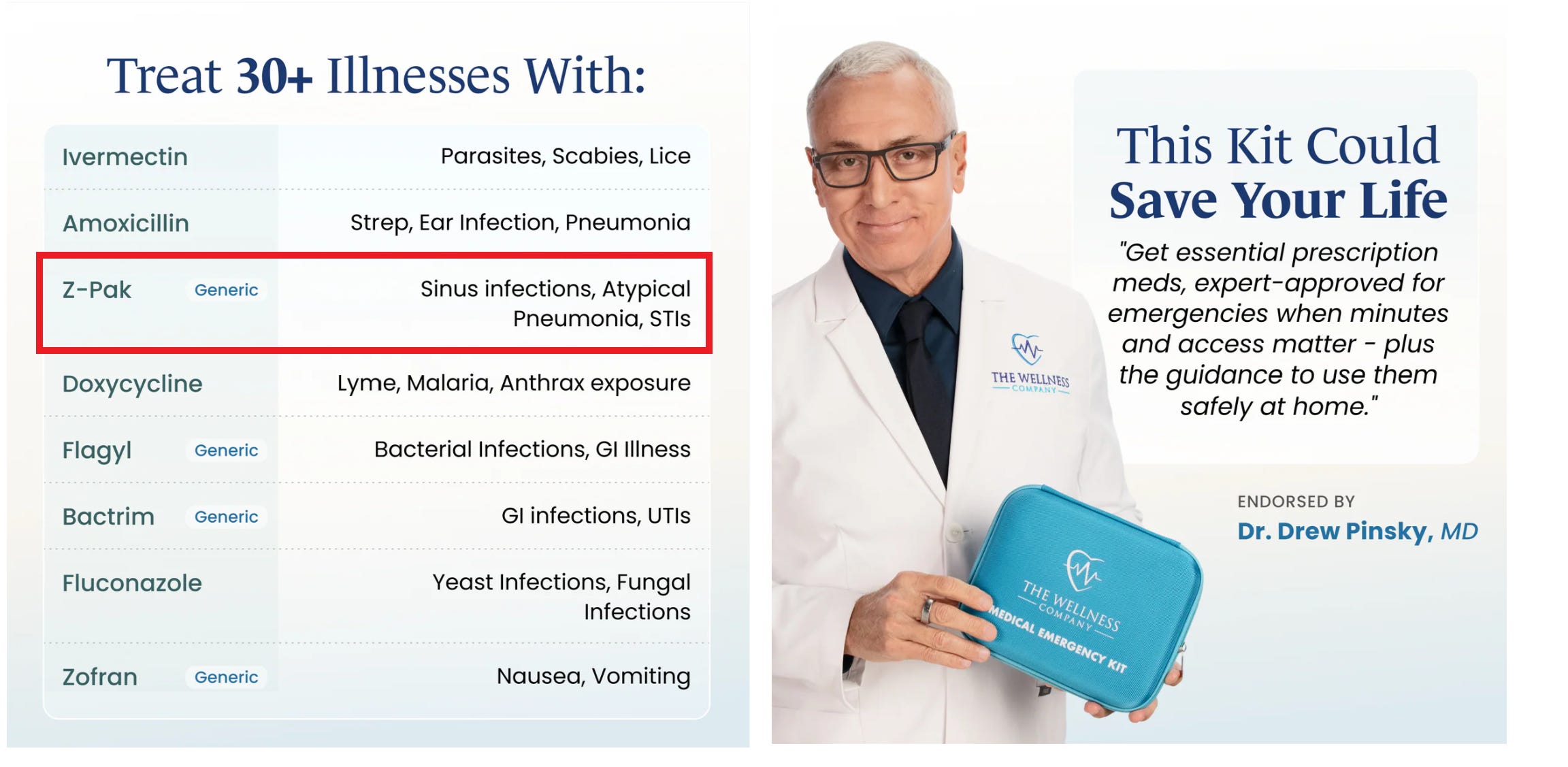
The kit also includes amoxicillin-clavulanate, cephalexin, and TMP-SMX—not directly indicated for Legionella, but critical for the broader landscape of bacterial infections that someone might face while the healthcare system is overwhelmed with an outbreak.
Let’s be blunt about what this means in practical terms. You are a 55-year-old man living on the Upper East Side. You smoke. You wake up with a fever of 102°F, chills, a hacking cough, and muscles that feel like you’ve been beaten with a baseball bat. You’ve just heard on the news that 76 buildings in your neighborhood have Legionella-positive cooling towers. You call your doctor. The earliest appointment is three days out. You go to urgent care. They swab you for flu and COVID, both negative, and send you home with instructions to rest and hydrate. You get sicker.
Without the kit: You wait. The pneumonia worsens. You end up in the ER, hypotensive, hypoxic, and the admitting team starts broad-spectrum antibiotics that may or may not include Legionella coverage. The urine antigen test is ordered but won’t result until tomorrow. You’ve now joined the hospitalization statistics.
With the kit: You recognize the symptom constellation—fever, cough, myalgias, known local Legionella outbreak. You start azithromycin immediately. Within 48 hours, your fever breaks. You complete a 7-day course. You never see the inside of a hospital room.
This is not hypothetical. This is the difference between a $299.99 kit and a $45,000 hospital admission. This is the difference between recovering in your own bed and being one of the 10% who don’t survive.
🏛️ The Absurdity of Our Public Health Spending Priorities
Let’s talk about what American taxpayers pour into the infectious disease apparatus every single year:
NIAID budget (FY 2026): $4.175 billion—down 36.4% from the prior year, but still over four billion dollars
CDC discretionary budget (FY 2026): $4.243 billion, with an additional $5.485 billion requested for FY 2027
Emerging and Zoonotic Infectious Diseases division alone: roughly $927 million in FY 2027 projections
NIH infectious disease research: billions more flowing through RPG grants, research centers, and R&D contracts
State, tribal, local, and territorial health departments: the CDC funnels the majority of its annual funding to these entities
Add it all up and the American taxpayer is funding a multi-billion-dollar infectious disease bureaucracy spanning dozens of agencies, employing tens of thousands of people, occupying sprawling campuses in Atlanta, Bethesda, and Washington, D.C.
And yet this summer—summer 2026—what have those billions delivered?
A cyclospora outbreak sickened over 5,000 people in Michigan alone, hospitalized more than 100, and spread across 34 states because the CDC had stopped tracking cyclosporiasis a full year earlier and the FDA took weeks to trace contaminated lettuce back to a single lettuce supplier in Mexico. Public health messaging omitted PCR testing on stook and immediate treatment with TMP-SMX. Patients suffered for weeks with explosive diarrhea while the multi-billion-dollar surveillance apparatus twiddled its institutional thumbs.
Now, a Legionnaires’ cluster has killed at least one person, hospitalized 55, and forced the disinfection of 76 buildings in one of the wealthiest zip codes in America—and the official public health guidance is essentially “building owners should maintain their cooling towers” and “seek medical attention if you have symptoms.” No proactive distribution of antibiotics. No public awareness campaign about what Legionnaires’ looks like and what to do if you suspect it. No acknowledgment that the diagnostic pipeline for Legionella is slow, incomplete, and leaves patients vulnerable during the critical window when early antibiotics could prevent severe deterioration.
Meanwhile, The Wellness Company—a private entity operating entirely outside the government bureaucracy—has put together a Medical Emergency Kit containing azithromycin, doxycycline, and ciprofloxacin, the precise trio of antibiotics that cover Legionella pneumophila, and made it available to any American with the foresight to spend less than the cost of a single urgent care co-pay.
The contrast is almost too perfect. Billions in taxpayer funding. Dozens of agencies. Thousands of employees. Endless congressional justifications filled with buzzwords like “data modernization,” “laboratory capacity,” “frontline readiness,” and “biothreat radar.” And when actual pathogens start sickening and killing Americans, the most practical, life-saving intervention available to the average person is a Medical Emergency Kit purchased from a private company that had the audacity to ask a simple question: what if people could just have the right medications at home?
The public health establishment hasn’t just taken a back seat to The Wellness Company this summer—it’s been left at the curb while Americans who took responsibility for their own preparedness drove themselves to safety. The cyclospora outbreak and the Legionnaires’ cluster are not anomalies. They are previews of a future where the gap between institutional promise and institutional performance grows wider every year, and where the people who thrive are the ones who stopped waiting for the CDC to save them and started saving themselves.
Please subscribe to FOCAL POINTS as a paying ($5 monthly) or founder member so we can continue to bring you the truth. AlterAI may be used to assist in searches, synthesis, and review.
Peter A. McCullough, MD, MPH
Chief Scientific Officer, The Wellness Company
https://www.twc.health/pages/focal-points
Can you please comment on what the ramifications of widespread distribution and use of the wellness kits would be on antibiotic resistance of bacteria to which we are exposed? Should users be concerned, or is it a non-issue so long as they complete the full course of antibiotics each time they use them? I've always thought that this is one key reason why antibiotics generally require a prescription.
Down here in Florida swamp, the window shaker AC unit stays on all the time for 5 months and gets kinda funky in the extreme swamp humidity. I clean it by spraying white vinegar in the air intake side and wash the coils down until they come shiny. Makes the house smell like salad dressing for a while, but very effective at cleansing the AC. You can do it on big units too. Vinegar works great, is non toxic, and is cheap and plentiful.