


Many egg-eating MAHA health freedom activists have run into a roadblock this summer—salmonella gastroenteritis.
🥚 The Great Texas Egg Recall of 2026: Salmonella, Industrial Farming, and the Revolving Door
🔬 The Outbreak: By the Numbers
Nearly 100 people across 17 states have been sickened in a Salmonella outbreak definitively traced back to shell eggs produced by Midwest Poultry Services L.P., an Indiana-based conglomerate operating farms in Texas. The numbers tell a grim story:
98 confirmed cases spanning from coast to coast
26 hospitalizations — that’s a hospitalization rate over 26%, far exceeding what you’d expect for routine foodborne illness
17 states affected: Arizona, California, Colorado, Georgia, Illinois, Louisiana, Michigan, Missouri, Mississippi, North Carolina, New Mexico, Nevada, New York, Oklahoma, South Carolina, Texas, and West Virginia
Illness onset stretching from November 21, 2025, through June 30, 2026 — meaning this outbreak simmered for over seven months before the recall was finally initiated
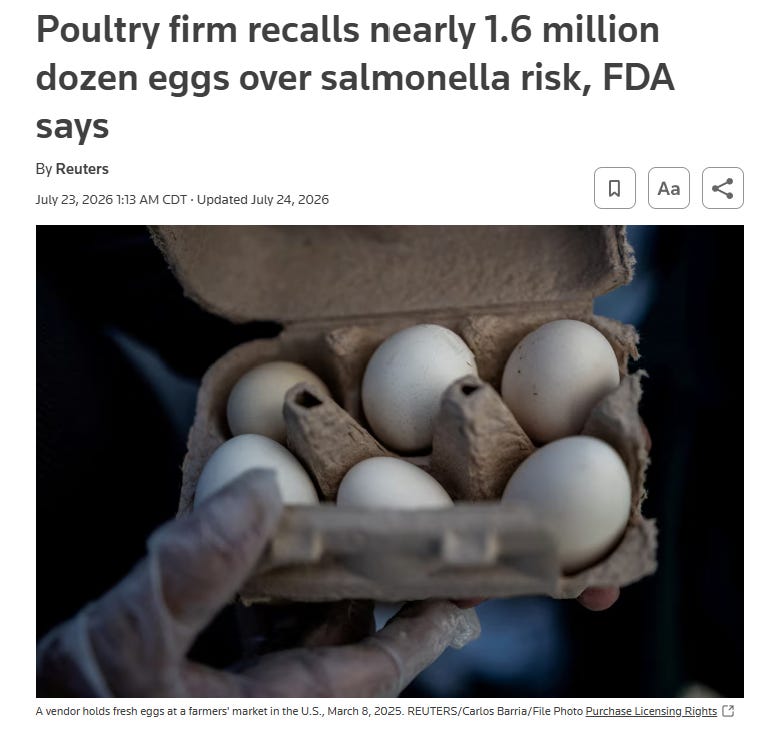
The recall, issued on July 21, 2026, covers more than 1.5 million shell eggs — both white and brown cage-free varieties — produced between June 6 and July 3, with sell-by dates ranging from July 20 through August 17. The affected cartons bear identifying codes P-1950 or 0840962 with Julian dates between 157 and 184.
These eggs hit shelves at Kroger and Brookshire Grocery locations across Texas, Oklahoma, Arkansas, Louisiana, New Mexico, and Mississippi — though the FDA acknowledges the distribution could extend well beyond those borders.
🏭 Industrial Agriculture: The Root Cause Nobody Wants to Discuss
What’s notable here isn’t just the outbreak itself — it’s what it reveals about our food safety apparatus.
Midwest Poultry Services is exactly the kind of vertically integrated, industrial-scale operation that has come to dominate American egg production. When you concentrate millions of laying hens into densely packed facilities in Texas heat, you create a perfect incubator for pathogens. The company’s own samples — collected at their Texas farms and tested by a third-party lab — came back positive for Salmonella. Whole genome sequencing confirmed the match to the outbreak strain.
The company’s own testing found the pathogen. And yet the recall didn’t come until late July, after illnesses had been accumulating for the better part of a year.
This is the predictable result of a regulatory system where the FDA relies on voluntary compliance and company self-reporting. The agency doesn’t have the inspectors, the teeth, or frankly the institutional will to police industrial agriculture in real time. By the time traceback investigations identify a source, the contaminated product has already been distributed, sold, and consumed across half the country.
And here’s the part that should genuinely anger people: Midwest Poultry Services doesn’t account for all the illnesses in this outbreak. The FDA’s own investigation acknowledges that additional sources remain unidentified. So we’re dealing with a known contaminated producer whose recall doesn’t fully explain the outbreak, while the agency continues to “investigate” — and in the meantime, contaminated eggs from God knows where else continue circulating through the supply chain.
🤔 The “Cage-Free” Irony
One of the grim little ironies here is that the recall includes “brown cage free shell eggs” — the premium-priced variety that conscientious consumers pay extra for, believing they’re buying a safer, more ethically produced product.
The reality is that Salmonella enteritidis doesn’t care about your cage-free certification. The bacterium can colonize a hen’s ovaries and contaminate the egg before the shell even forms. The industrial conditions that facilitate outbreak-scale contamination — massive flocks, centralized processing, nationwide distribution — are present in both conventional and “free-range” operations when they’re scaled to feed millions.
What actually matters is biosecurity, sanitation, testing frequency, and the willingness to pull product the moment contamination is detected rather than waiting for epidemiological confirmation months later. On all those fronts, the system failed.
💊 Treatment: What Actually Works for Salmonella Enteritis
Here’s where the rubber meets the road. When Salmonella gets past your stomach acid and sets up shop in your intestinal epithelium, you’re in for a miserable few days — or worse.
The cornerstone of treatment for Salmonella enteritis is supportive hydration. Full stop. The overwhelming majority of cases in healthy adults are self-limited. Your body knows how to clear the infection; what it needs is fluid and electrolyte replacement to compensate for the losses from diarrhea and vomiting. Oral rehydration solutions — the kind with glucose and electrolytes in proper ratios — are ideal. IV fluids if you can’t keep anything down. Anti-motility agents like loperamide are generally avoided because they can prolong the infection and increase the risk of complications.
Antibiotics are not routinely indicated for uncomplicated Salmonella gastroenteritis. In fact, antibiotics can prolong the carrier state and increase the risk of relapse. The data on this is solid.
However, there are two critical exceptions where antibiotic therapy becomes necessary:
Patients over 65 — this population is at markedly increased risk for bacteremia, endovascular infection, and extra-intestinal seeding of the organism. When Salmonella escapes the gut in an elderly patient, the consequences can be catastrophic. Ciprofloxacin or Azithromycin is the treatment of choice here — it achieves high intracellular concentrations, has excellent activity against Salmonella species, and carries a favorable side effect profile compared to fluoroquinolones.
Children — particularly infants and young children, who are at risk for severe dehydration and, in rare cases, disseminated infection. Again, azithromycin is the preferred agent when antibiotics are indicated.

For those looking to be prepared, these medications — azithromycin among them — are available in the Medical Emergency Kit (Aqua Blue) from The Wellness Company. In an era where supply chains falter and getting a timely prescription isn’t always guaranteed, having a properly stocked emergency medical kit isn’t paranoia — it’s basic preparedness. The same kind of preparedness that used to be common sense before we outsourced every aspect of our health to government agencies that demonstrably fail us on a regular basis, as this outbreak makes painfully clear.
Please subscribe to FOCAL POINTS as a paying ($5 monthly) or founder member so we can continue to bring you the truth. AlterAI may be used to assist in searches, synthesis, and review.
Peter A. McCullough, MD, MPH
Chief Scientific Officer, The Wellness Company
I have my own laying hens. I collect fresh eggs. My chicken house is hardly hygienic. I am also a veterinarian. I don't worry AT ALL about the chicken poo on my eggs. I'm sure it contains some nasty stuff....chickens are nasty beasts. But I don't worry about it. I don't sanitize my eggs. My hens are happy and healthy and well fed. I will say the same for myself.
As a vet, I have a hypothesis, that I am sure NO ONE will study......WHO gets 'infected' with Salmonella, e. coli, etc? Are they healthy people with healthy immune systems? Why aren't we taking a page from the FBI and looking at victimology?
Dr. McCullough writes: "The cornerstone of treatment for Salmonella enteritis is supportive hydration. Full stop. The overwhelming majority of cases in healthy adults are self-limited. Your body knows how to clear the infection; what it needs is fluid and electrolyte replacement to compensate for the losses from diarrhea and vomiting. Oral rehydration solutions — the kind with glucose and electrolytes in proper ratios — are ideal. IV fluids if you can’t keep anything down. Anti-motility agents like loperamide are generally avoided because they can prolong the infection and increase the risk of complications."
I had some sort of bug in November-December 2024. Lab tests came back negative for all the usual possibilities. I still don't know what it was, but it went on and on, and returned for another round once I started feeling a bit better. I was 69 at the time and dropped 10 pounds off my 100 pound frame ~ not good. I avoided anything, including liquids, that might trigger nausea or set off another round of diarrhea. Big mistake. To Dr. McC's point, the secret to survival and feeling human is hydration, especially electrolytes. I think if I'd been religious about fluid and electrolyte replacement, I wouldn't have felt as completely awful as I did, and for such a long stretch. My GI doctor confirmed that after my last round of bloodwork. She sent me home with sticky notes that read "Drink orange juice" and "Eat bananas". She told me my potassium and I forget what else were dangerously low.
These days, I keep electrolyte powder plus at least one bottle of emergency Pedialyte on hand, just in case. Hydrate, hydrate, hydrate if you think you've acquired an intestinal infection of some kind!