


By Peter A. McCullough, MD, MPH
Why should partisan politics influence beliefs on vaccines if this field is based on science and sound public health principles? This review was assisted by Alter AI.
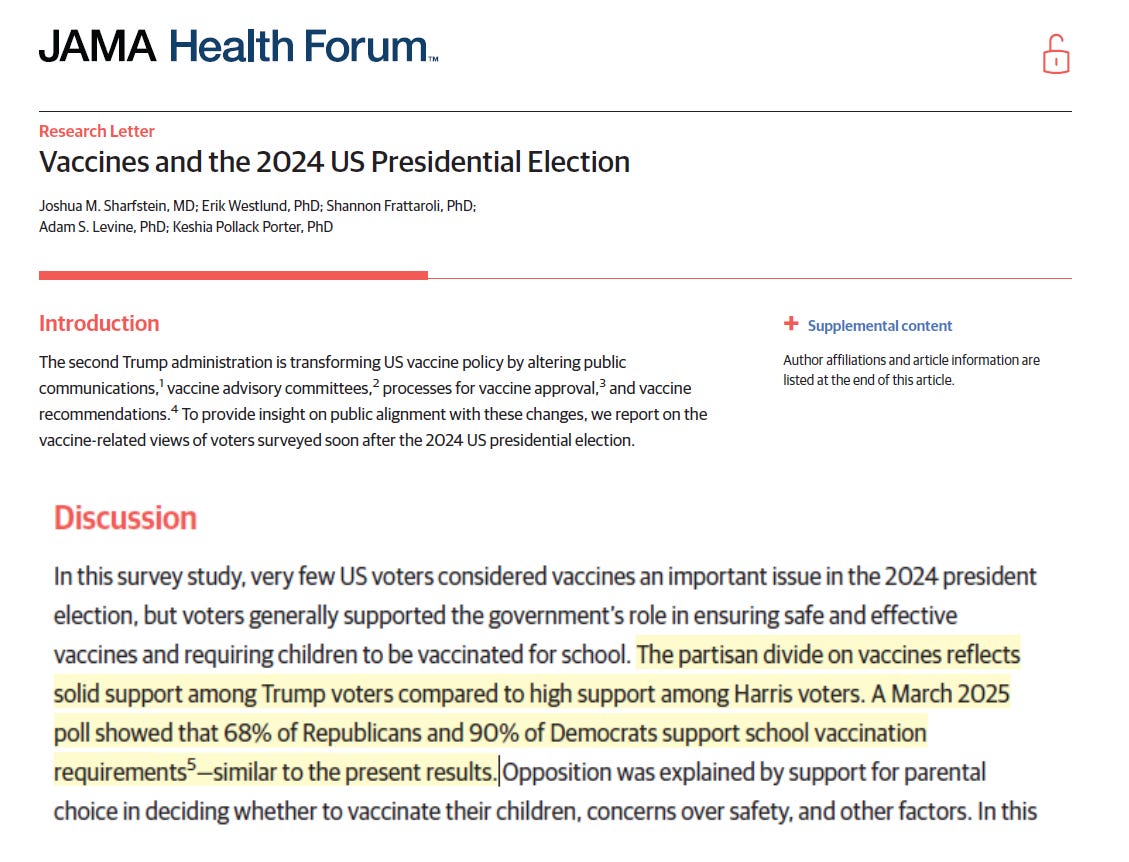
A JAMA Health Forum research letter “Vaccines and the 2024 US Presidential Election,” authored by Joshua M. Sharfstein, Erik Westlund, Shannon Frattaroli, Adam S. Levine, and Keshia Pollack Porter and published on December 5, 2025, examines American public opinion toward vaccine policy in the aftermath of the 2024 presidential election and the subsequent transformations to U.S. vaccine governance under President Donald Trump’s second administration and Health Secretary Robert F. Kennedy Jr. The study sought to evaluate how partisan alignment, education, and other demographic factors shape citizens’ attitudes toward government vaccine programs and school mandates. Using data from the AmeriSpeak Omnibus survey conducted from November 21–25, 2024, the authors analyzed responses from a nationally representative sample of 1,236 U.S. adults, of whom 964 were confirmed voters in the 2024 election. Participants identified major issues influencing their vote and responded to statements gauging support for continuing government involvement in vaccination and the removal of school vaccination requirements.
Results show that vaccines ranked among the least salient issues of the 2024 election—only 3% of respondents chose vaccines as one of the three most important topics that influenced their vote (1.5% of Trump voters and 4.4% of Harris voters). Yet, when asked about specific policy questions, a clear majority (76.3%) supported government efforts to ensure vaccines’ safety and effectiveness, including nearly 59% of Trump voters and over 90% of Harris voters. Conversely, only 18.5% favored eliminating school vaccination mandates, with pronounced partisan splits: one-third of Trump voters endorsed ending mandatory vaccination compared with just 7% of Harris voters. Educational attainment also correlated strongly with opinion—support for school vaccination mandates and government oversight increased consistently with schooling level, while those with less than a high school education or only a diploma were markedly more likely to support repeal of vaccination requirements and to distrust institutional oversight.
In interpreting these findings, the authors conclude that even amid major policy upheavals—such as Kennedy’s June 2025 dismissal of the CDC Advisory Committee on Immunization Practices and new guidance limiting certain COVID-19 vaccine recommendations—voters generally remain favorable toward vaccination and government roles in guaranteeing safety, although partisan and educational divides persist. The researchers note, however, that skepticism about institutional integrity is increasing: a separate Reuters/Ipsos poll cited found that only 24% of Americans believed Trump administration vaccine initiatives were based on science, implying growing public distrust in official narratives. This polarization appears to be driven less by opposition to vaccines themselves than by concerns over personal choice, safety, and the politicization of health authority.
The paper highlights that vaccine policy has become symbolically linked to broader questions of trust in science, governance, and autonomy, rather than a focal electoral issue in itself. The authors suggest that, while citizens widely endorse vaccination in principle, they remain wary of government overreach and the lack of clear, transparent data in policymaking. These attitudes will likely determine whether current U.S. vaccine reforms endure. The study, funded by the Bloomberg American Health Initiative at Johns Hopkins, underscores the necessity of restoring public trust through transparent, evidence-driven policy formation and balanced public communication that respects both scientific integrity and individual agency.
Please subscribe to FOCAL POINTS as a paying ($5 monthly) or founder member so we can continue to bring you the truth.
Peter A. McCullough, MD, MPH
FOCAL POINTS has partnered with Patriot Mobile to defend your medical freedom. Join Patriot Mobile today!

Reference:
Sharfstein JM, Westlund E, Frattaroli S, Levine AS, Pollack Porter K. Vaccines and the 2024 US Presidential Election. JAMA Health Forum. 2025;6(12):e255361. doi:10.1001/jamahealthforum.2025.5361.
Over generations people have been told vaccines are safe, effective and necessary. Even though the science doesn’t back it, most will just follow the advice of their drs and government, and the media ads. These lies over time become facts. No more self thinking, just trust. Sorry, not me. I’ll never trust again after watching the Covid debacle which has been one big deception. A depopulation event of mass magnitude. Infuriating and sickening. They have captured our children. Time to remove all vaccine mandates and if these drugs really do what we’re told, then people will vaccinate anyway!
OK, so I was finally able to get through the long paragraphs and discovered that the article had an obvious left-wing bias. Pretty much what I would expect of anything coming out of Johns Hopkins. The data is all there, but they’re reading it all wrong!
Funny how they correlate lack of education with vaccine skepticism. Do you suppose the uneducated people are smarter than overeducated people?