


By Peter A. McCullough, MD, MPH
Depression is one of the most common psychiatric conditions that commonly leads to prescription drugs which can have serious side effects. AlterAI assisted with this review.
🧠 Flow Neuroscience’s Home Brain‑Stimulation Headset for Depression: A Non‑Drug Breakthrough
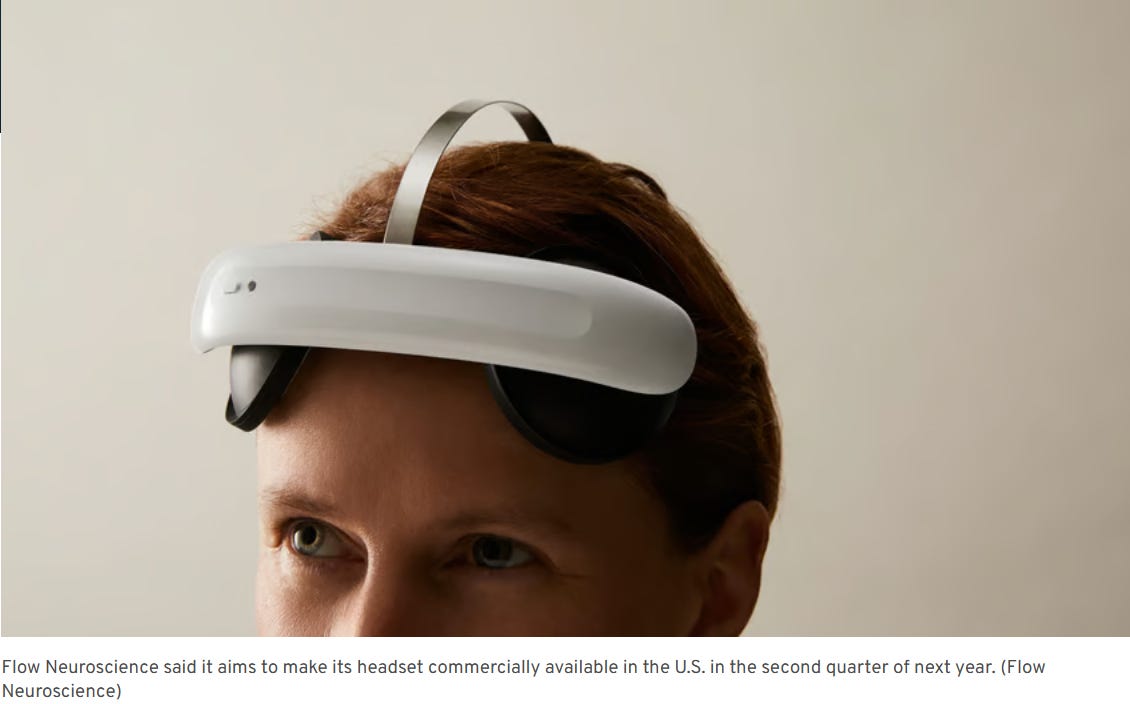
The Flow Neuroscience headset represents a paradigm shift in at‑home depression care. Approved by the U.S. Food and Drug Administration (FDA) in late 2024 and market entry expected in 2026 as the first non‑drug, at‑home treatment for Major Depressive Disorder (MDD), the device combines transcranial direct current stimulation (tDCS) with digital behavioral therapy through a companion app, creating a dual‑action system that targets both physiological and psychological factors linked to depression.
📡 How It Works
The Flow headset delivers very low‑intensity electrical currents (around 2 mA) through electrodes placed on the scalp, specifically targeting the left dorsolateral prefrontal cortex (DLPFC) — an area consistently underactive in people with MDD. The gentle current modulates neuronal excitability, promoting neuroplastic changes thought to rebalance activity between emotion‑regulating regions of the brain.
Unlike electroconvulsive therapy (ECT), Flow’s tDCS is non‑invasive, painless, and does not induce seizures or require anesthesia. The treatment sessions typically last about 30 minutes per day, five times a week for six weeks, after which patients can use maintenance sessions as required. The companion Flow app provides behavior change modules grounded in cognitive behavioral therapy (CBT) frameworks — helping users establish better sleep, exercise, and thought‑management habits to reinforce neurochemical recovery.
⚙️ Clinical Evidence & Safety
Flow Neuroscience’s research has shown statistically meaningful reductions in depression scores among users compared with control conditions. The technology builds on decades of academic work validating tDCS as a safe and effective adjunct or alternative to antidepressants. Woodham et al, in a small RCT (n=174) mean age 38 years, found after three weeks the primary outcome, depressive symptoms showed significant improvement when measured using the Hamilton Depression Rating Scale: active 9.41 ± 6.25 point improvement (10-week mean = 9.58 ± 6.02) and sham 7.14 ± 6.10 point improvement (10-week mean = 11.66 ± 5.96) (95% confidence interval = 0.51–4.01, P = 0.012). As a reference, antidepressants generally result in an average improvement of approximately 2 points (ranging between 1.8 and 2.1 points) more than seen in placebo groups.
The FDA’s clearance, granted under the De Novo classification pathway, recognizes Flow as the first medically approved tDCS device for at‑home use in treating depression in adults diagnosed with MDD. At a $500 price tag, this product likely will develop a cash pay market while the company works it’s way through CMS reimbursement applications.
Sweden-based Flow Neuroscience previously launched its headset in the U.K. in 2019, pricing it at about $500 U.S. and pairing it with a behavioral therapy app, which included videos and advice about depression and methods for managing symptoms through sleep, nutrition, fitness and meditation.
Reported side effects are minimal — mainly mild tingling or redness where electrodes contact the skin — contrasting with common pharmacological side effects such as sexual dysfunction, weight gain, or withdrawal syndromes. Importantly, unlike prescription antidepressants, tDCS does not alter systemic biochemistry, making it attractive for individuals seeking drug‑free, personalized treatment.
🏠 Implications for Mental Health Care
Depression affects over 280 million people globally, and many face barriers to accessing psychiatrists or medication regimens. A self‑administered medical‑grade device, with guided therapy built in, democratizes treatment while lowering long‑term costs. With proper monitoring, it may also reduce polypharmacy — the overreliance on psychiatric drugs that often burdens patients with complex side effects.
Still, effectiveness varies. Like all neuromodulation techniques, tDCS does not produce uniform results: optimal electrode placement, current density, and adherence influence outcomes. The company continues to collaborate with clinics and researchers to refine protocols and expand ongoing studies into bipolar disorder, postpartum depression, and cognitive enhancement. The broader implication is clear: digital bioelectronic medicine — blending neuroscience, patient autonomy, and software — is poised to redefine how mood disorders are managed.
The company said its headset has been used by more than 55,000 people across the EU, the U.K.’s National Health Service, Switzerland and Hong Kong. It previously received a breakthrough designation from the FDA and more recently claimed a regulatory green light in Australia.
“For more than six years since the device’s launch in Europe, we’ve been building an evidence base globally with clinical trials, peer-reviewed research and real-world case reports. The approval of FL-100 in the U.S. will now offer millions of patients an accessible and effective non-drug treatment option,” said Daniel Månsson, Flow’s co-founder and chief scientific officer.
In short, Flow Neuroscience’s FDA‑cleared headset represents a major milestone: a safe, home‑based, non‑pharmacologic intervention empowering patients to take an active role in their recovery from depression without dependence on medication.
Please subscribe to FOCAL POINTS as a paying ($5 monthly) or founder member so we can continue to bring you the truth.
Peter A. McCullough, MD, MPH
FOCAL POINTS has partnered with Patriot Mobile to defend your medical freedom. Join Patriot Mobile today!

🔗 References
Flow Neuroscience – Official Site: https://flowneuroscience.com
Fierce Biotech (2024): FDA approves its 1st non‑drug home treatment for depression – Flow Neuroscience’s brain headset
Brunoni et al., New England Journal of Medicine, 2017 – “Transcranial Direct‑Current Stimulation for Depression: A Randomized Clinical Trial.”
Nitsche & Paulus, Clinical Neurophysiology, foundational tDCS research on excitability modulation.
Safe and effective alternatives to pharmaceuticals are always welcome, but it is important not to forget that depression is not a disease: it is a symptom. A symptom is a signal of a disturbance to the mind/body self-regulatory process, the causes of which need to be understood if treatment is to be successful. Even non-pharmaceutical anodynes that fail to address root causes are likely to suppress and distract from solving the problem. Depression may be related to psychological trauma, deficiencies (such as Vitamin D deficiency), spiritual dislocation, side effects to medications, microbiome disturbances, endocrine disorders, dietary influences, toxic exposures.... The list continues. Just treating the symptom while ignoring the cause of that symptom is not, in my view, good treatment. That being said, I am all for symptom relief whilst pursuing actively an investigation of and treatment for the underlying causes of the symptom(s).
Wonderful. A marketed, electronic gizmo that might, ot might not have programming installed to make us more compliant. Or whatever. Surely we don’t trust such things to be to our benefit in a culture that is trending toward transhumanism. This looks to be a step in that direction. There are other ways to deal with depression and the many mental and emotional imbalances this society causes in us. Stop taking drugs stop watching TV. Change your diet to wholesome, organic foods. Learn some meditation techniques stop believing there is a simple way to body, mental and spiritual health. I’ve been there as have many of my patients. We aren’t there anymore. And we most certainly do not need some electronic gizmo which will wind up unbalancing the body and mind as much as drugs currently do. But open people up to suggestion and programming. Nit good.