


Author’s Note: I wrote the original draft of this two years ago, but I believe it is worth reviewing its content. It seems to me that our nation remains a divided house, with many of our people harboring anger about various hot button issues.
As a people, we have (it seems to me) developed a pernicious habit of being too quick to get angry at others instead of trying a lot harder to see things from their perspective.
The greatest mark of a grownup is his ability to temper his anger instead of giving free rein to it. This may be achieved by contemplating the lives of those at whom we feel anger. One might ask the questions:
What is this person going through?
Are there things about his life—things he’s struggling with—that I don’t know about?
Are there things in his past—things that make him feel afraid or unappreciated—that I don’t know about?
Am I making assumptions (about this person) that may not be true?
Have I misinterpreted something that he said (or wrote) as a result of my own presuppositions?
Often we may discover that those who have wronged or insulted us are themselves having a hard time, and that whatever they did wasn’t personally directed at us. Maybe they were just tired and having a bad day.
Anger (and it’s ugly stepbrother, resentment) are terrible emotions that are often harder on those who feel these emotions than those who are the objects of them. Thus, the antidote emotions of forgiveness and gratitude are invariably liberating.
President Lincoln proclaimed Thanksgiving an official holiday in October 1863, a few months after the Union victory at Gettysburg that came at such a dreadful cost.
I once had a lively conversation with a Lincoln scholar in which I opined that Lincoln should have let the secessionists go. Instead of sending the army to suppress the secession, he should have focused efforts on cultivating what was left of the Union, preventing the western territories from joining the Confederacy, and encouraging the British to purchase their cotton from Egypt.
Parliament abolished slavery in 1834, so purchasing Egyptian cotton instead of southern U.S. cotton wasn’t a difficult choice for British mills, provided they were properly incentivized to do so.
The Lincoln scholar agreed with me. However, he then pointed out that war in the 19th century was not, generally speaking, perceived to be the calamity that some of us perceive it to be today. It was only after the Civil War got underway with terrible losses that Lincoln—along with everyone else—realized the true horror of it. The horror of it weighed on his soul and etched itself into his face, as is evidence of these photos taken just before and towards the end of his time in office.
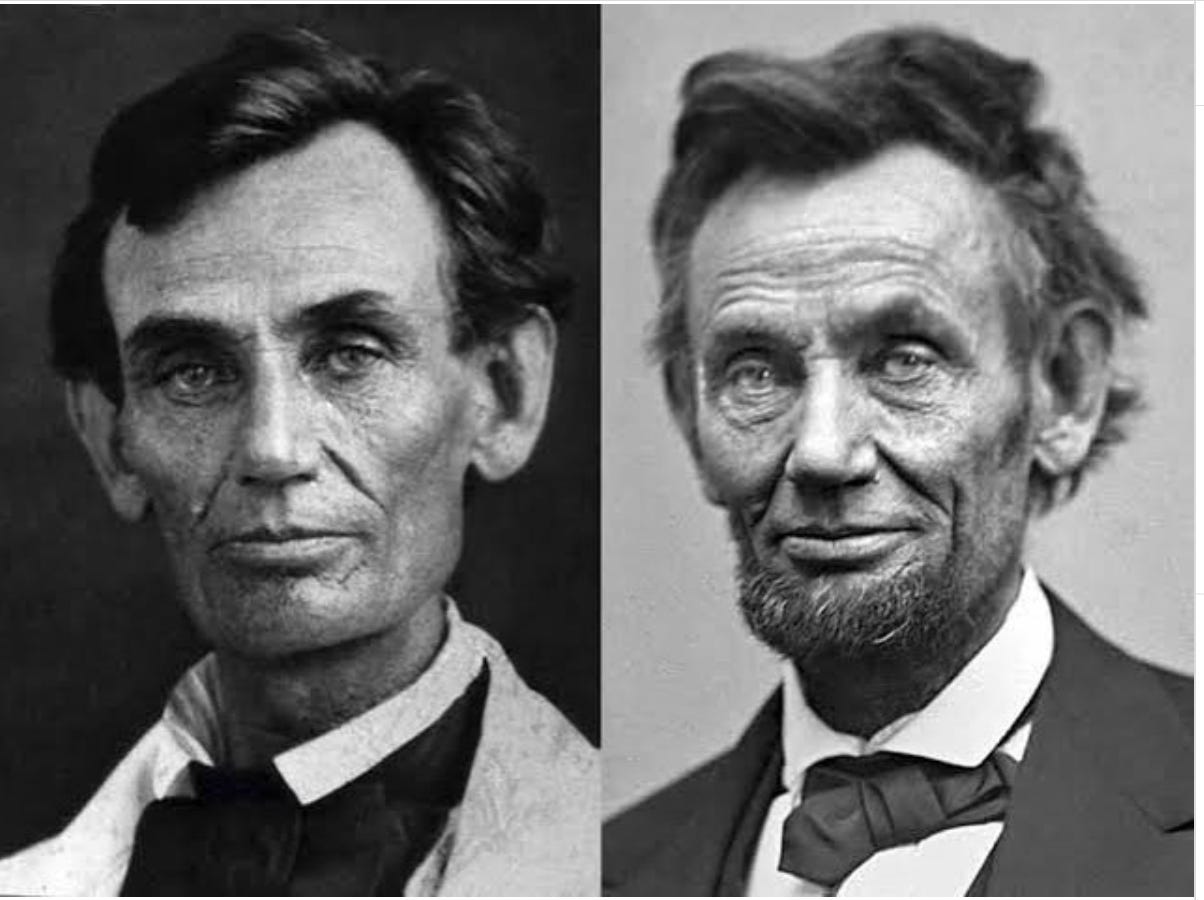
Apparently at the urging of Sarah Josepha Hale in Boston—editor Godey's Lady's Book, and author of Mary Had a Little Lamb—Lincoln concluded that despite the terrible civil war, the citizens of our country still had much to be grateful for.
I think it’s fascinating that he conceived the holiday not only as one of gratitude (in the long tradition of Thankfulness Harvest Festivals going back to Europe). He also thought of it as a day of penitence for allowing our violent passions to divide us. As he put it:
I do therefore invite my fellow citizens in every part of the United States, …to set apart and observe the last Thursday of November next, as a day of Thanksgiving... And I recommend to them that while offering up the ascriptions justly due to Him …, they do also, with humble penitence for our national perverseness and disobedience, commend to his tender care all those who have become widows, orphans, mourners or sufferers in the lamentable civil strife in which we are unavoidably engaged, and fervently implore the interposition of the Almighty Hand to heal the wounds of the nation and to restore it as soon as may be consistent with Divine purposes to the full enjoyment of peace, harmony, tranquility and Union.
Dr. McCullough and I wish our Substack readers a Happy Thanksgiving. We are extremely grateful that you have honored us with your readership and support. Though ever-fleeting time doesn’t allow us to respond to your comments, we carefully read them and are very grateful for your feedback, even when it is highly critical.
Happy Thanksgiving to you and yours as well. I'm grateful for your writing and sharing of your historical knowledge.
Nice article. I strive to practice GRATITUDE daily. When my head hits the pillow, I make sure I have 3-5 things that happened that day to be grateful for that occurred.
Sometimes HEALING is reinterpreting what you believe happened to you!