


My daily review of the avidity, truculence, stupidity, vulgarity, ignorance, and sheer villainy of our ruling class in the West—including that of Great Britain and Western Europe—sometimes leaves me feeling dispirited. This evening, while seeking evidence that man is not a hopeless case, I reviewed the abdication speech of the Spanish Habsburg Emperor Charles V.
Charles held over 70 titles in Europe and in the Americas, including Holy Roman Emperor, King of Spain (as Charles I), King of Italy, Archduke of Austria, and Duke of Burgundy. His titles spanned various kingdoms, duchies, and counties across the Netherlands, Spain, and Italy.
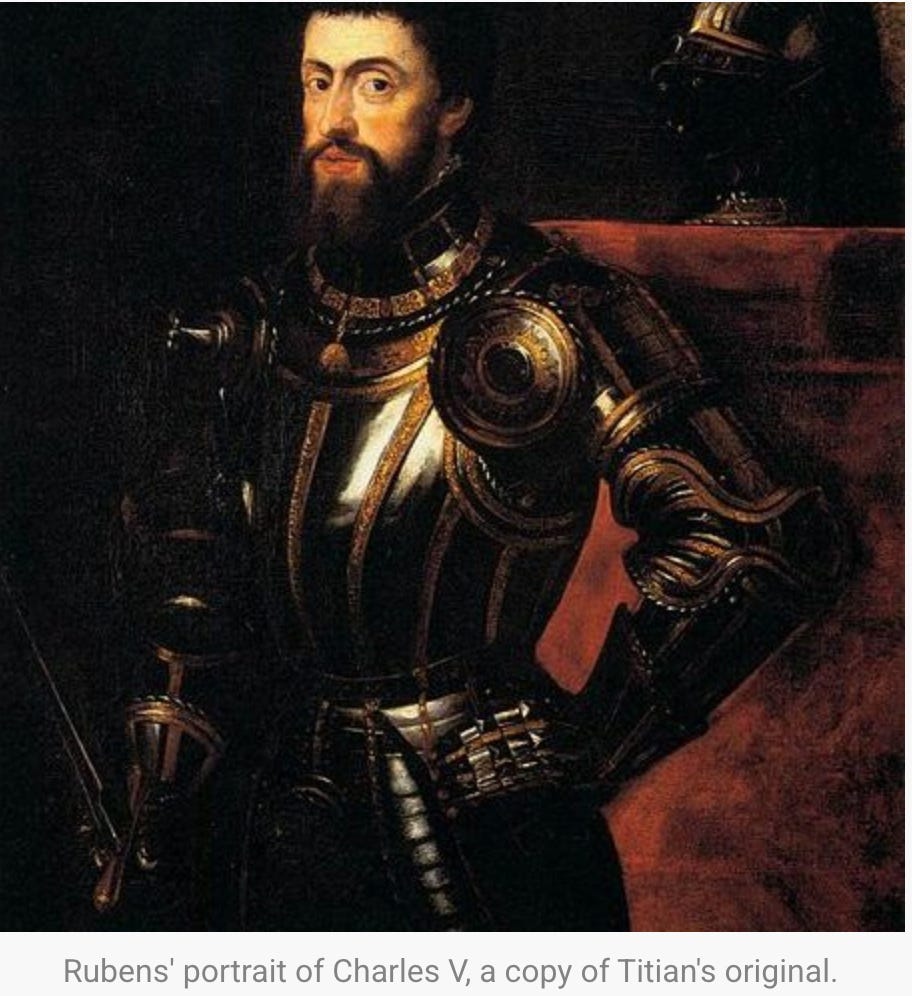
For some reason I’ve been thinking about him a lot lately. He felt an enormous responsibility to all the peoples he governed, and he constantly had to contend with plots and intrigues against him. A few years ago I read a recently decrypted letter that he wrote in cipher to his ambassador to France, Jean de Saint-Mauris, in 1547, in which he refers to his concern about being assassinated by Piero Strozzi, an Italian mercenary in the service of the French King Francis I. Even with the most powerful military and bodyguard in Europe, Charles understood that treachery is a constant feature of human affairs.
Charles was exactly my age (55) when he decided to abdicate and retire to a monastery to concern himself with thoughts of God and his relationship with God instead of expending his efforts in trying to manage the resolute folly of humanity.
Charles delivered his abdication speech in his native French on October 25, 1555, in the Great Hall of the Coudenburg Palace in Brussels, thereby officially transferring the rule of the Netherlands to his son, Philip, who sat in the audience. Judging by his speech, he was a class act of the sort that doesn’t exist in politics today.
Some of you will remember that on the 5th of January of this year, exactly forty years had passed since the day when, in this same hall, at the age of fifteen, I received the rule over the Belgian provinces from my paternal grandfather, Emperor Maximilian. Soon thereafter, the death of my maternal grandfather, King Ferdinand the Catholic, brought to me the rule over an inheritance that my mother was too ill to administer.
Thus, at the age of seventeen, I sailed over the sea to take possession of the Kingdom of Spain. When I was nineteen, upon the emperor’s death, I undertook to be a candidate for the Imperial crown, not to increase my possessions but rather to engage myself more vigorously in working for the welfare of Germany and my other provinces, namely the Belgian provinces, and in the hopes of thereby bringing peace among the Christian peoples and uniting their fighting forces for the defense of the Catholic faith against the Ottomans.
It was partly the German heresy and partly the envoy of rival powers that prevented me from fully achieving the goal of my efforts. With God’s help, I have nonetheless never ceased resisting my foes or striving to fulfill my mission. The campaigns I undertook, some to begin wars, some to make peace, took me nine times to Germany, six times to Spain, seven times to Italy, four times to France, twice to England, and twice to Africa in a total of four great journeys, not to mention the less important visits I paid over the years to my individual realms.
I have crossed the Mediterranean Sea eight times and sailed the Atlantic Ocean twice, not to speak of the journey I made from Spain to the Netherlands for the very serious reasons about which you know. My frequent absence from these provinces forced me to hand their administration over to my sister, Mary, who is present today. The States-General know as well as I do how faithfully she has performed her duties.
Although involved in many wars, I have never gone happily to battle, and as I take leave of you, nothing is more painful than my inability to leave you in a firm, secure state of peace. Already before my last campaign in Germany, my pitiful state of health prompted me to consider the idea of divesting myself of the burdens of state, but the troubles which then beset Christendom forced me to give up this plan in the hopes that peace could be restored.
Because I felt stronger then than I do now, I held it for my duty to sacrifice my remaining strength and my life for my peoples’ welfare. I had almost reached my goal, when the attack by the French king and some German princes called me once more to arms. Against my enemies I accomplished what I could, but success in war lies in the hands of God, Who gives victory or takes it away, as He pleases. We thank Divine Providence that We have experienced no very great mutation of things bearing permanent consequences. On the contrary, many battles have been won that Our children can celebrate.
As I withdraw, I beg you to be loyal to your princes and to maintain a firm understanding among yourselves. Above all, avoid those new sects that plague our neighboring lands, and when heresy seeps over your boundaries, do not delay in wiping it out, or it will go badly for you. I must for my part confess that I have often misled myself, either from youthful inexperience, from the pride of mature years, or from some other weakness of human nature.
I nonetheless declare to you that I never knowingly or willingly acted unjustly or with unjust force, nor did I ever command or empower another to do so. If actions of this kind are nevertheless justly laid to my account, I formally assure you now that I did them unknowingly and against my own intention. I therefore beg those present today, whom I have offended in this respect, together with those who are absent, to forgive me. [ . . . ]
[To Prince Philip, his Son and Heir.] If you were to have come into possession of these provinces through my death, such a wonderful inheritance would well have secured me a just claim on your gratitude. Now, however, as I give them to you by my own will to be yours before the moment when my time is over, I expect that you will fully repay the debt you owe me by means of the love and care you devote to your people.
Other kings account themselves happy when, at the hour of death, they can set their crowns on their children’s heads, but I wished to experience this joy while yet alive, and to see you rule. What I am doing will hardly be imitated in future, as it has rarely been done in the past, but I will be praised for it, if you justify my trust by ruling with the wisdom you have heretofore displayed, and if you continue to be a zealous defender of the Catholic faith, of the law, and of justice, which are the bulwarks of rulership. May you, too, be granted a son, to whom you can transfer your authority as I give mine over to you.
It occurs to me that one aspect of inherited power as in monarchical systems is that occasionally you get someone whose sole drive was not power, but something else; the reluctant ruler, if you will. The phrase "power corrupts" may have been applicable in older centuries but today, corruption is a prerequisite to power. Quite literally. To name one small example -- Eric Holder covered up the FBI murder of an innocent man mistaken for John Doe #2 from the Oklahoma City Bombing, which was a messy coverup including the murder of a whistleblower police officer, and as a result, Holder ascended. From Deputy Attorney General to Attorney General. Possibly, in the days when people simply ascended to roles by birthright, we occasionally, by accident, got good people in positions of power. An odd and uncomfortable thought.
Has Trump thus far knowingly acted unjustly?
"The campaigns I undertook, some to begin wars, some to make peace,..."
So says Charles.
Trump can say the same.
Why idolize the former and detest the latter? Trump literally dodged a bullet, and his first response was to spring back fiercely. Says it all about the man, right there. You can rip him to shreds for all the political mud he wears on his suits, but he's in the gutter of government doing what he believes to be right and just.
Can that be acknowledged?