


In a recent conversation with SARS-CoV-2 origin researcher Jim Haslam, he told me something I’d never heard before and that struck me as remarkable—namely, that when Wuhan Institute of Virology scientist Shi Zhengli published the genome for SARS Coronavirus RaTG13 on February 3, 2020, Ralph Baric told Matthew Frieman of the University of Maryland:
Zhi’s [sic] paper was not approved by the Chinese govt and she may be arrested for it.
He added:
Thats not a good look for anyone.
At that time Shi published the RaTG13 genome, it was the closest known relative of SAR-CoV-2. The genomes of the two viruses display a 96.1% match.
The most significant biological difference between the two viruses is that the spike protein of SARS-CoV-2 contains a four-amino-acid (12-nucleotide) insertion, PRRA (proline–arginine–arginine–alanine) at the junction between its S1 and S2 subunits.

This insertion creates the polybasic cleavage motif RRAR, which can be recognized by the host enzyme furin. This cleavage site facilitates activation of the spike protein and influences viral entry into certain cell types.
It was precisely this “furin cleavage site” that raised concerns about SARS-CoV-2 being of lab origin for the following reasons.
Furin cleavage can increase the efficiency of spike activation and affect viral entry and transmission. Researchers have experimentally introduced cleavage sites into viral proteins to study such effects.
The insertion was absent from known sarbecoviruses. RaTG13 and other closely related bat and pangolin coronaviruses lacked the same polybasic site. Researchers therefore had no identified immediate evolutionary precursor containing it.
The nucleotide sequence contained an unusual codon combination. Two consecutive arginine residues in the insertion are encoded by CGG-CGG. This double-CGG sequence attracted attention because that codon is uncommon in coronaviruses and can be used in synthetic genetic constructs.
I was already aware of these concerns when I discussed them with Jim Haslam. I also knew about RaTG13 and its similarity to SARS-CoV-2.
However, it was only when Jim related Baric’s remarks to Frieman that I was prompted to ask the question: did Shi Zhengli and Ralph Baric mention RaTG13 in their 2018 DEFUSE proposal?
For readers who are unfamiliar with DEFUSE: Peter Daszak submitted it on March 24, 2018 to the Defense Advanced Research Projects Agency (DARPA). The full name of the grant proposal is “Project DEFUSE: Defusing the Threat of Bat-borne Coronaviruses,” and it sought funding of $14,209,245.
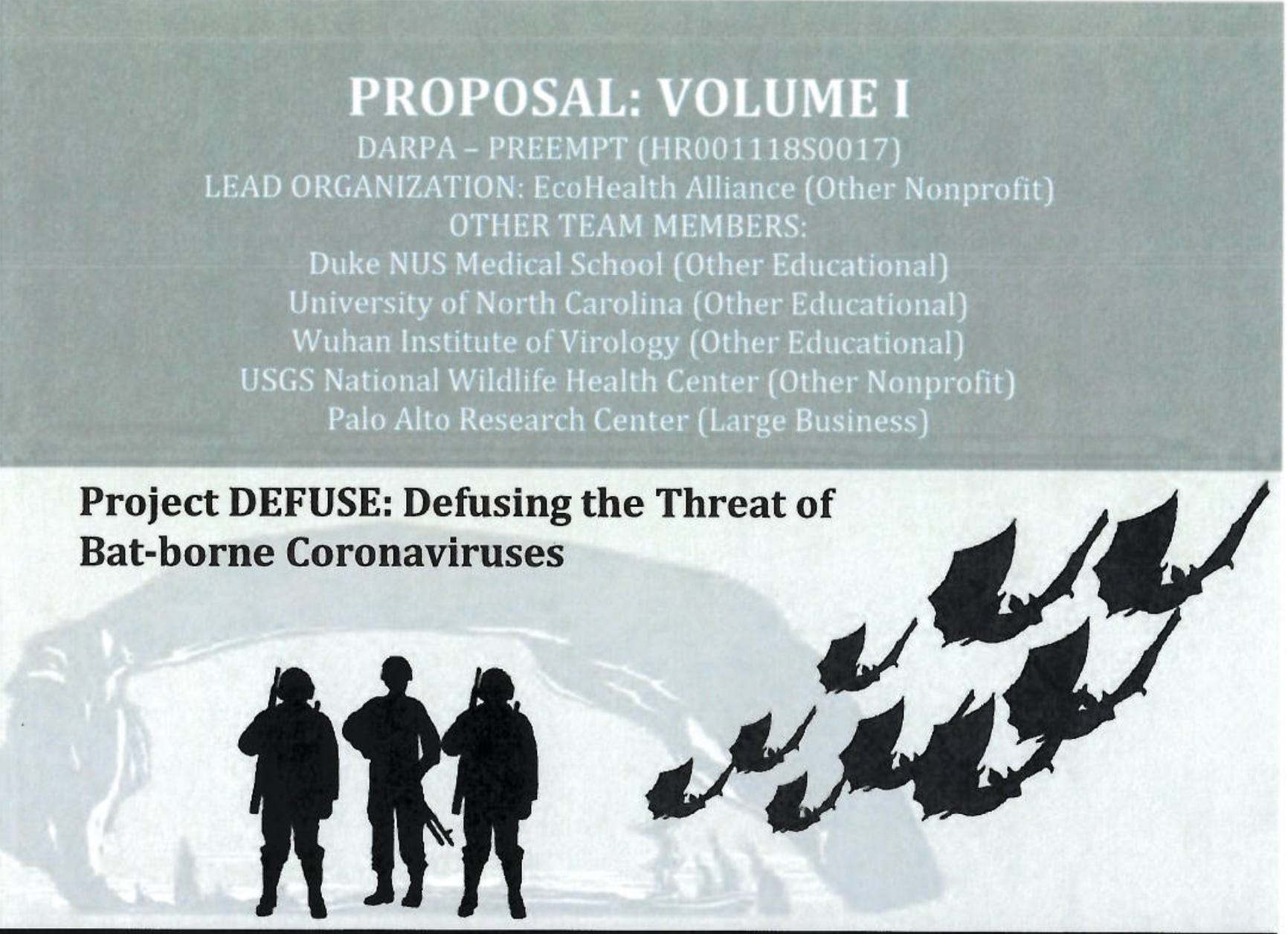
The reviewers at DARPA turned down the request because it proposed to do dangerous gain-of-function work on bat coronaviruses. Especially alarming was the proposal’s statement:
We will analyze all SARS-CoV gene sequences for . . . the presence of potential furin cleavage sites. SARS-CoV with mismatches in proteolytic cleavage sites can be activated by exogenous trypsin or cathepsin L. Where clear mismatches occur, we will introduce appropriate human specific cleavage sites and evaluate growth potential in Vero cell and HAE cultures.
Here it is important to understand that, in terms of defusing the threat of Bat-borne Coronaviruses, RaTG13 was an obvious known natural candidate for the proposal’s stated purpose—NOT because it was known to cause human disease, but because it possessed a spike protein that could interact with the human ACE-2 receptor, albeit inefficiently.
The following timeline plot’s the discovery and characterization of RaTG13.
2013 — Sample collected
Bat sample 4991 collected from the Mojiang mine where six workers developed serious respiratory illnesses in 2012, three of whom died.
2016 — Partial sequence published
A 370-nucleotide fragment of the viral RNA-dependent RNA polymerase gene was published.
2017-2018 — Genome sequenced
WIV obtained almost the entire RaTG13 genome, according to its subsequent clarification, but did not publish it.
2018 — DEFUSE Proposal Submitted to DARPA
February 3, 2020 — RaTG12 genome published in Nature.
February 3, 2020—Ralph Baric expresses consternation about publication and opines that Shi could be arrested for doing so.
I just reviewed the DEFUSE proposal, and to my astonishment, Baric and Shi do NOT once mention RaTG13 in the document.
In my twenty years of doing true crime investigations, I have often found that what is omitted from documents often speaks louder than what is included in them.
Given that it was almost certainly Baric who wrote the technical language in the DEFUSE proposal, it strikes me as very strange that he didn’t once mention RaTG13 as a shining example of a SARS Bat Coronavirus of concern for the work he proposed. It was a naturally occurring virus with some affinity to the human ACE-2 receptor, found in a mine in which 6 men had fallen ill with pneumonia.
Jim Haslam has raised the suspicion that Shi published the RaTG13 genome (closely related to SARS-CoV-2, only without the decisively import furin cleavage site) as a insider’s message to Baric—something along the lines of, “My team at the WIV did NOT insert the furin cleavage site, so don’t even think about blaming us.”
What, if virus do not exist at all ?!?!?!?!?!
How can people write papers on splicing genes when it can't even be proved that viruses exist? If one can't even show photographic evidence of a virus, or other evidence, how are we then meant to accept that even smaller units - genes - are being spliced and diced?!
It's all still a belief system!