


For many years I have marveled at how war propaganda always works like a magic spell. I’ve long thought that this must be rooted in our ancestry as highly social beings living in small tribes, constantly contending with scarcity, hostile elements, and pressure from adversarial tribes.
At a conference back in January, I had the privilege of meeting Bret Weinstein, with whom I had an illuminating conversation about this theme. Bret is now gravely concerned that if humanity does not soon learn to override its ancient, atavistic instincts, we will suffer a global calamity if not extinction.
Since then I have delved deeper into the literature of human evolution and how it could explain the astonishing effectiveness of war propaganda.
For about 95–99 percent of our species’ history (from the emergence of Homo sapiens about 300,000 years ago until the development of large-scale agriculture about 10,000 years ago), humans likely lived in small hunter-gatherer bands of 20–150 people.
Survival depended on close, tribal cooperation for hunting and defending the tribe from competing tribes. Natural selection favored psychological traits that promoted “coalitional” psychology—that is, fierce loyalty to “us” and hostility toward “them,” adherence to group norms, and allegiance to shared symbols, ideas, and gods.
These are not idiosyncratic cultural preferences. Evidence that we have inherited these characteristics from our pre-historic ancestors is expressed in brain imaging that reveals strong amygdala activation when one is shown the faces of people who are identified as members of the “out-group.”
Psychologists have performed countless experiments that show our strong favoritism for what we perceive as our “in-group” and derogation of people we perceive as belonging to an “out group.”
Within our own tribe (now modern nation) we maintain the ancient practice of glorifying great warriors. For tens of thousands of years, such apex male warriors played a decisive role in not only defending the tribe, but augmenting its status, wealth, territory, and access to women.
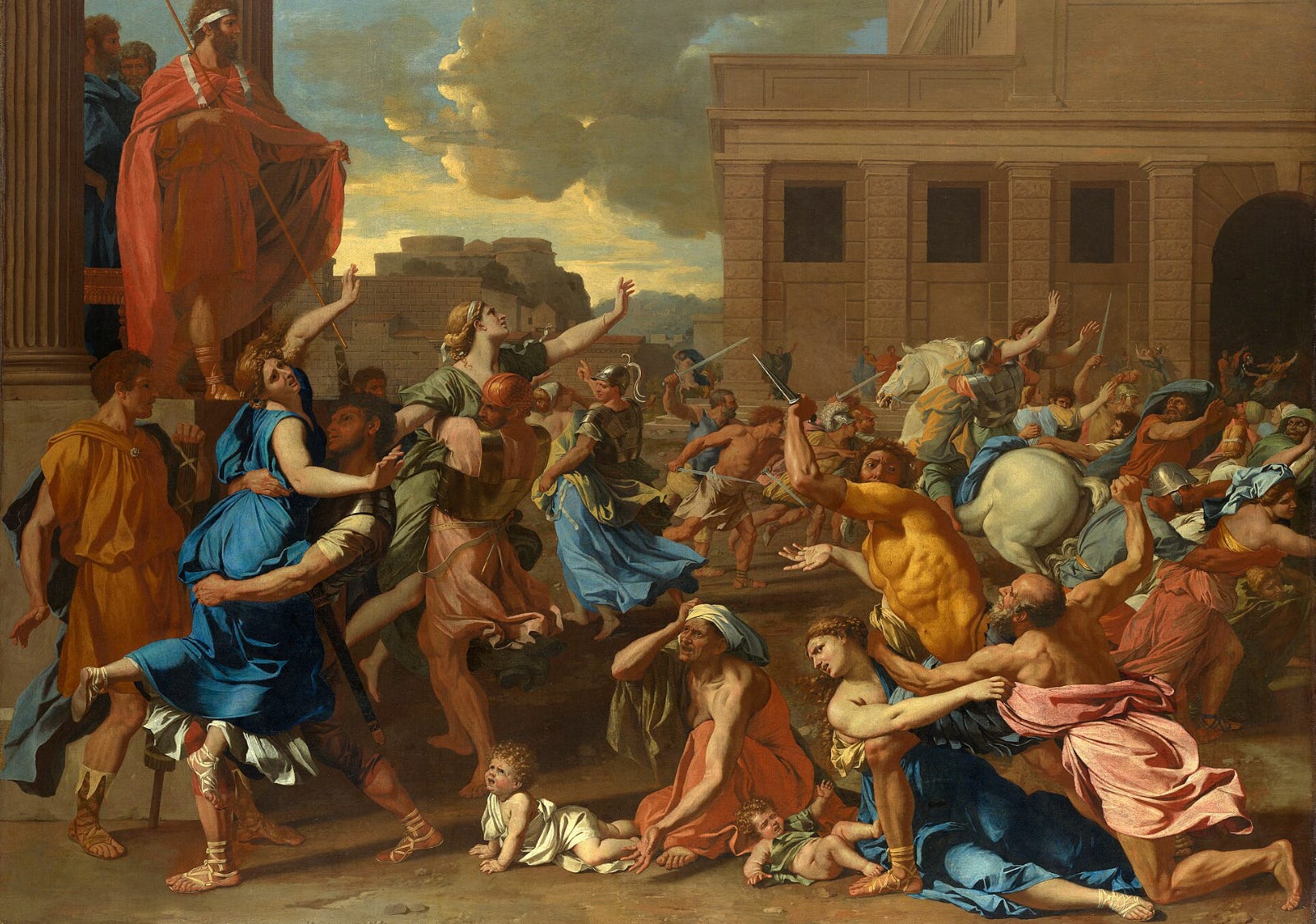
Indeed, the so-called “Rape of the Sabine Women” is a foundational myth of ancient Rome that tells of first-generation Roman men, under Romulus, abducting young women from neighboring Sabine families to take as wives. In this context, the word "rape" derives from the Latin raptio, meaning mass kidnapping or abduction. The myth has been depicted in multiple paintings, including the following by Nicolas Poussin.
Recent genetic studies have shown that Icelandic women are largely descended from Gaelic (Irish/Scottish) ancestors on their maternal side, and Norse Vikings on their paternal side. This suggest that the island nation was settled by a band of Viking men who abducted the women from Ireland.
This anecdote seems to support the theory that a given tribe may eventually have to contend with the problem of apex warrior males taking all of the attractive females for themselves, thereby obliging other males in the tribe to go out and abduct women from other tribes.
Since World War I, government propaganda agencies have figured out how to manipulate these atavistic instincts. Propagandists portray the enemy as subhuman, barbaric, or existential threats. This activates our tribal circuitry to suppress our inhibitions about killing people.
Propaganda is a “tribal call to arms,” accentuating the “us vs. them” drama to promote tribal cohesion and prepare the tribe to destroy the enemy. Militarism binds us together through shared symbols (flags, anthems and slogans), and produces dopamine rewards for imagery and reports of destroying the enemy. The same process expunges empathy for innocent civilians who are destroyed as “collateral damage.”
In other words, war propaganda works like magic because it hijacks survival circuitry that evolved when the destruction of one’s tribe meant certain death for everyone in it.
The Nazi propagandist, Joseph Goebbels, was infamous for refining what psychologists call the “illusory truth effect”—that is, endlessly repeating a claim until it is widely perceived as the entire truth of the matter, even if there is little evidence to support it. A statement heard frequently soon feels familiar and therefore credible. Wartime environments amplify this through relentless messaging via television and social media.
Emotional appeals bypass the need for proof. Propaganda targets primal fears, hatred, pride, and the desire for security and belonging. The enemy people is dehumanized by portraying them as depraved monsters. Outrage is stoked with stories of the enemy’s alleged atrocities, often with fragmentary, fabricated, or exaggerated evidence. This triggers feelings of horror and repugnance.
Propaganda systematically conceals the factual record of how one’s own tribe has contributed to the conflict. In the current war with Iran, we constantly hear about the atrocities of the Iranian regime and its proxies, but nothing about how the CIA overthrew the Iranian government in 1953 and replaced it with a military dictator elevated to nobility who enforced his will with secret police who frequently used torture.
We also hear nothing about how the U.S. armed the Iraqi dictator Saddam Hussein with every nasty weapon under the sun, including chemical and biological weapons such as anthrax and bubonic plague, and encouraged him to attack Iran for eight years between 1980 and 1989.
During World War I and II, stories of enemy atrocities rapidly spread and were simply believed. Fear and anger short-circuited critical thinking, causing people to demand action with little or no concern for verification.
Within a tribe that feels threatened, dissenters face social ostracism and other severe penalties, including death. It’s likely that Socrates would not have been put to death for his heterodox ideas if the ruling class of Athens had not felt highly stressed by setbacks in their war against Sparta.
Likewise, it’s unlikely that Pontius Pilate would have agreed to put Jesus to death if he hadn’t been under great pressure from Rome to prevent insurrections in Judea. The threatening atmosphere of war (or civil war) motivates people to take actions that they wouldn’t consider taking during times of peace.
Most people express their allegiance to the propagandist’s narrative because everyone around them appears to accept it. As we saw during the COVID-19 pandemic, members of a tribe that felt threatened were relentlessly called upon to demonstrate their tribal cohesion by adhering to mask mandates and lining up to receive the experimental gene therapy shots.
Members of a frightened tribe must also contend with limited information (imposed by censors) about what is actually going on and search for an explanation. Simple narratives—stripped of all complexity and nuance—placate the anxiety of uncertainty. Dramatic accusations of the enemy’s depravity, and celebration of one’s own moral righteousness offer clarity and purpose.
When barraged with propaganda, few people feel any motivation to verify it, which requires time, effort, and a great deal of education and research skill. It’s far easier to accept the unifying narrative.
Man’s atavistic, tribal, warlike nature would not pose an existential threat to humanity if it weren’t for the fact that our weapons have become so immensely destructive. This was the theme of Stanley Kubrick’s film, Dr. Strangelove, which he was inspired to produce from his study of the Cuban Missile Crisis in which humanity came to the brink of annihilation.
Right now, hundreds of billions of dollars of property and energy infrastructure in the Persian Gulf are being blown to smithereens, and this will likely subject all of humanity to an array of stressors and destabilizing forces.
Europe is likely facing yet another massive refugee crisis from Lebanon and Iran. The war machine keeps telling us about the danger of Muslims while doing everything in its power to drive them to seek refuge in the West.
Though I am not predicting it, I am gravely concerned that this war is going to drag on for far longer, and be far more destructive, than our U.S. government is acknowledging.
I write this with the awareness that I am going to enrage many of my readers. However, since Dr. McCullough and I founded this newsletter almost four years ago, we have been dedicated to telling the truth as best as we can ascertain it, even if makes a lot of people unhappy with us.
We see little substantial difference between the propaganda we are being subjected to now and the propaganda that barraged us in 2020-21. We are being told by our government that we are being menaced by an existential threat that requires extreme countermeasures.
This morning, someone sent me a report of guys in the Trump administration proclaiming the slogan “short term pain for long term gain.” This reminds me of the slogans “two weeks to flatten the curve,” “pandemic of the unvaccinated,” and “build back better.”
Though I have no doubt there are elements of truth in what we are being told about the war and its rationale, I am also confident that we are being told many lies about how this is likely going to play out.
The greatest strategic problem facing the Trump administration is the fact that no regime has ever been changed, and no constructive political outcome has ever been achieved, by aerial bombardment alone. Air Force General Curtis LeMay—our greatest proponent of bombing our enemies into the stone age—frankly admitted this in an interview at the end of his life.
Historians point to Japan as exception after Tokyo was firebombed and Hiroshima and Nagasaki were atomic bombed. This narrative overlooks three facts.
Starvation was setting into the population from the naval blockade and a terrible rice harvest in the fall of 1944.
In 1945, the Japanese were afraid that Stalin was planning to invade Japanese territory and they greatly feared Red Army occupation.
The U.S. signaled it would leave the Emperor Hirohito in power if the Japanese would surrender.
The American people should remember that war propaganda works both ways. It’s now very likely that millions of Iranians who hated their regime before the war are now feeling solidarity with their nation because, no matter how much people loathe their government, they are still outraged by their cities being bombed.
One should also bear in mind that American culture and the U.S. government now have a severe credibility problem. The Iranian people know—and their government has been relentlessly emphasizing it—that America’s vaunted liberal democracy has been a basket case for several years. They know that we are a deeply divided nation, mired in an array of severe and sordid social, cultural, and political problems.
They know that—for all the viciousness of their own ruling class—our ruling class in the West is composed largely of selfish and monstrously greedy degenerates, as was revealed in the Epstein Files that were released shortly before Israel and the U.S. attacked Iran.
The independent investigative reporter Max Blumenthal was only half joking when he coined the expression “Operation Epstein Fury.”
Hundreds of millions of people all over the world share his perception that this war is at least partly the expression of an exposed ruling class desperately clinging to power.
"We are governed, our minds are molded, our tastes formed, our ideas suggested, largely by men we have never heard of. In almost every act of our daily lives, whether in the sphere of politics or business, in our social conduct or our ethical thinking, we are dominated by the relatively small number of persons... who understand the mental processes and social patterns of the masses. It is THEY who pull the wires which control the public mind..." Edward Bernays.
One missing point in your propaganda analysis, John, is that the US media are non-stop bashing Trump for this conflict. That is in great contrast to their glowing support for everything Clinton and Obama did. While the world can see the USA is not just John Wayne in a white hat on a global scale, there should still be the understanding that every historical empire of our relative strength has without hesitation set about conquering their entire known world. Warts and all, the USA alone has ever shown restraint in this regard, and by and large, every nation we have ever taken over has ended up enjoying at least the basic level of freedom/opportunity--in particular the free choice to leave--of every citizen of our own country. History is certainly a critical teacher, but the possibility that Trump + team are truly trying to stay a step ahead of their (and our) greatest enemies, the "Globalist Hegemony" or whatever one might call them, should be weighed in before giving in to despair.