


In September 2023, I posted an essay on this newsletter in which I presented evidence that the August 8, 2023 Lahaina, Maui fire was a Predictable & Predicted Disaster. That the lovely, historic town was in grave danger of being incinerated by wildfire was obvious to everyone who noted that a similar fire almost incinerated the town on August 24, 2018.
On that day, a wildfire broke out on the hillside above Lahaina, driven by high winds resulting from the low pressure of Hurricane Lane that passed south of the Hawaiian Islands. The fire destroyed 2,100 acres, 21 houses, and 27 cars, and caused $4.3 million in damage, but stopped just short of incinerating the town.
In response to this near miss, Maui County made little if any investment in preventing the same thing from happening again, which it did exactly five years later under eerily similar meteorological conditions. However, this second fire could not be stopped on the east end of town, but ended up burning all the way to the waterfront and destroying every building in the historic district.
According to FEMA estimates, approximately 1,800 residential structures (homes and apartments) were destroyed, displacing approximately 5,000 permanent residents whose families had lived in Lahaina for generations. As of October 27, 2025 — over two years later—Maui County had issued 478 permits for residential construction in Lahaina.
It is obvious to anyone with a shred of common sense that the administrators of Maui County since 2018 do not care about the residents of Lahaina. If the County did care about these people, it would have taken simple measures to protect the town from wildfire. These measures were proposed in assessments written after the fire in 2018, but the County didn’t implement them.
Further evidence that the County doesn’t care about the displaced residents of Lahaina is to be found in the simple fact that—over two years after the fire—the County had still only issued 478 permits to rebuild the family homes that were lost.
This has aggravated the suspicion that the failure to protect the town was a deliberate gambit to force most of the town’s residents to move to the mainland, thereby freeing Lahaina to be acquired and redeveloped by new owners with different uses in mind for the valuable waterfront property.
If this is indeed the case, the gambit did not entirely work. Though an estimated 1,500 residents and their dependents are thought to have left the island, thousands of others remain, apparently having found lodging in the homes of family and friends.
Who are the displaced residents of Lahaina? Here it is important to understand that, today, only about 10% of the Maui population is of Polynesian ancestry. At the time of first contact with Europeans in 1778, the native Hawaiian population had lived for centuries without any natural selective pressure exerted on it from smallpox, measles, syphilis, and other infectious diseases that had long been endemic to Europe. Death and infertility from these diseases—as well as warfare and other social disruptions, reduced the native Hawaiian population from hundreds of thousands to under 24,000 by the early 20th century.
Thus, the majority of Maui’s longtime resident population does not descend from ancient native Hawaiians, but from immigrant workers — transplanted to the island between the years 1850-1940 from China, Japan, the Philippines, Korea, and Portugal—to cultivate sugar and pineapple.
Though Lahaina was the seat of Hawaiian royal family until 1845 (when it moved to Oahu) the town developed and grew as a result of the whaling industry, and then the sugar industry. Between 1860 and 1999, the hills around Lahaina were the site of a large, heavily irrigated sugar plantation that protected the town from wildfire.
With the phasing out of the plantation economy at the end of the 20th century, tourism became the overwhelming driver of Maui’s economy. Without tourism and all its related businesses, Maui has no economic basis for supporting the ancestors of the plantation workers who now compromise most of the island’s 164,000 resident population.
Today, only 1.4% of the resident population works in farming. The notion of returning Maui to what it was before European contact—a place of subsistence taro agriculture and fishing—is a silly Rousseauian fantasy.
Now comes the news that—after totally botching the protection and then the rebuilding of Lahaina — Maui County administrators are determined to destroy the flourishing vacation rental property economy in the tourist town of Kihei, about 25 miles southeast of Lahaina.
Unlike Lahaina, Kihei (located on the dry and barren south side of the island) never had a large plantation economy, but was a small fishing village until the 1960s, when water was piped in and the town was developed as a tourist destination.
Like the Bolshevik’s 1929 “dekulakization” campaign against highly productive landholding peasants, the administrators of Maui County have put the owners of Kihei’s vacation apartments in the crosshairs.
On December 15, 2025, the Maui County Council gave final approval for Bill 9, which phases out short-term vacation apartment rentals, purportedly to create long term housing for Maui residents displaced by the Lahaina fire. Mayor Richard Bissen signed it into law on the same day.
The new law will phase out 6,000-7,000 existing, legally grandfathered vacation rentals with phase-out timelines of 3-5 years (West Maui by 2029; the rest by 2031). Over 60% of these vacation rentals are located in the tourist town of Kihei.
Bill 9 is the same species of tyrannical bungling for which the communist dictatorships of the 20th century became infamous. The bill targets thousands of vacation apartments on the so-called “Minatoya List,” named after the former County Attorney Richard Minatoya, who authorized these properties, built before 1989, to be used as vacation rentals. Most of them were expressly designed as vacation apartments, and are not suitable as long-term family apartments. Everything from kitchen size to storage space to parking allocation is optimized for occupants on beach holiday.
With the Bill 9 now signed into law, many owners have concluded that they won’t be able to maintain and pay taxes on their property, and therefore have no choice but to sell at a reduced price from what it was worth before Mayor Bissent announced the bill on May 2, 2025.
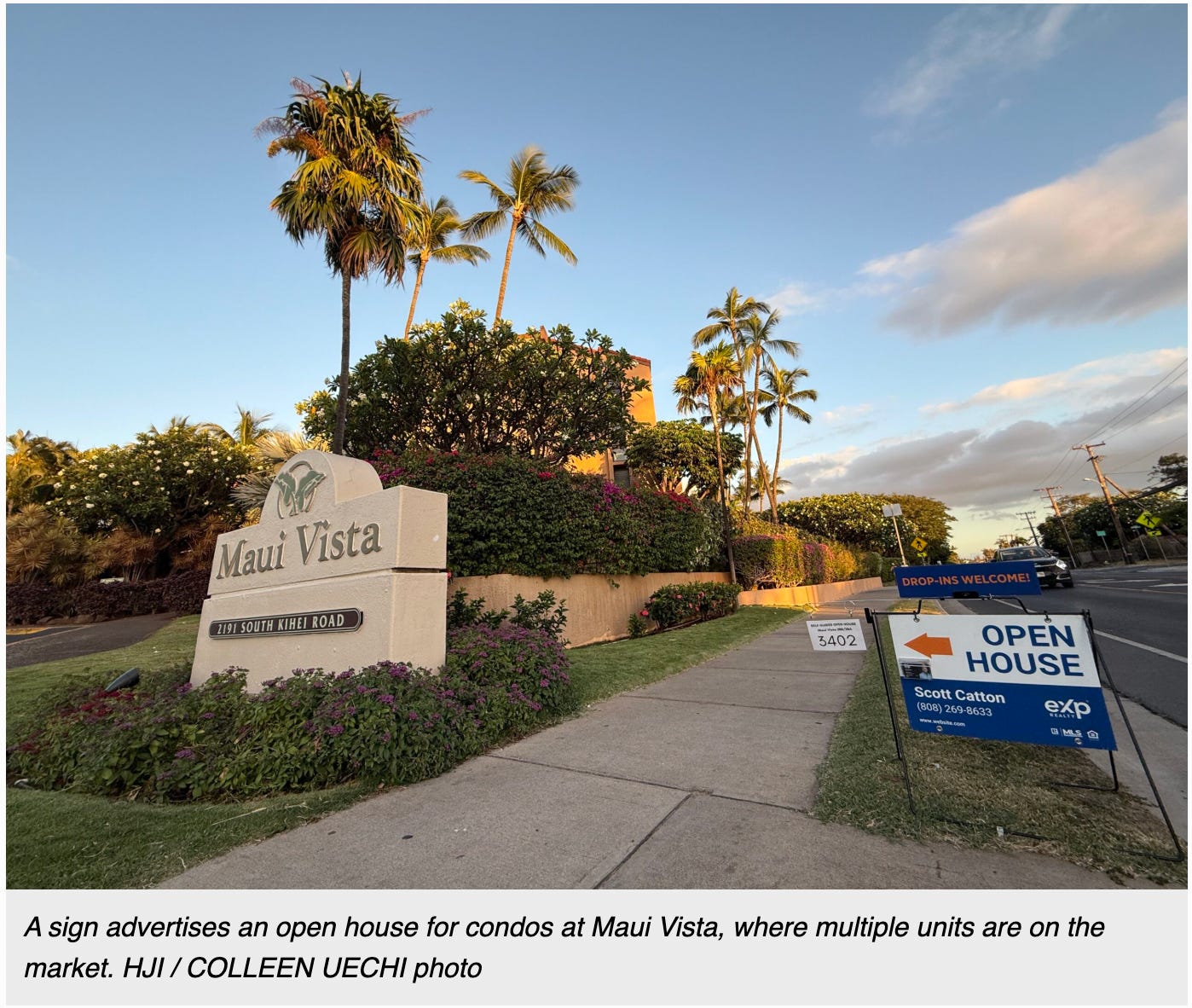
The vacation rental apartments not only provide housing for millions of tourists who support the local economy — spending billions in local restaurants, bars, cafes, retail shops, etc.— they also generate significant tax revenue for Maui County, as vacation property tax rates are significantly higher than permanent resident property tax rates.
Like the Bolsheviks, the Maui County administrators haven’t the foggiest notion of the consequences of their decision to—in effect—confiscate property from owners who were putting it to its best economic use.
What will happen to the tourist economy of Kihei when thousands of vacation rentals are taken out? The Maui Council has recently chattered about establishing new H-3 and H-4 hotel districts to accommodate the tourist industry, but the construction of new hotels will take years to be permitted and executed.
One wonders if highly capitalized hotel interests are wielding influence behind the scenes of Bill 9’s passage, and if they have already acquired property for future hotel development.
If the displaced residents of Lahaina move into these vacation apartments, what will they do for a living? Will they find jobs in Kihei, or will they just receive welfare checks? Will the vacation apartments be torn down to build new, long-term residential apartments? If so, who will pay for them?
I wouldn’t be surprised if, after this bungling revolutionary scheme implodes into dysfunction, BlackRock swoops in like a vulture, acquires the apartments at a deep discount, and uses its influence to overturn Bill 9.
"BlackRock swoops in like a vulture, acquires the apartments at a deep discount, and uses its influence to overturn Bill 9."
Likely the plan from the beginning. If potential motivations behind any government action are stupidity or corruption, the correct answer is always corruption.
Still pushing the FALSE NARRATIVE.......the LIE, that Lahaina was INCINERATED.....to DUST, by 'incompetence'?????
MIND-BLOWING!
Anyone with a functioning brain can clearly SEE that Lahaina was INCINERATED.....TO DUST.....via a DEW!