


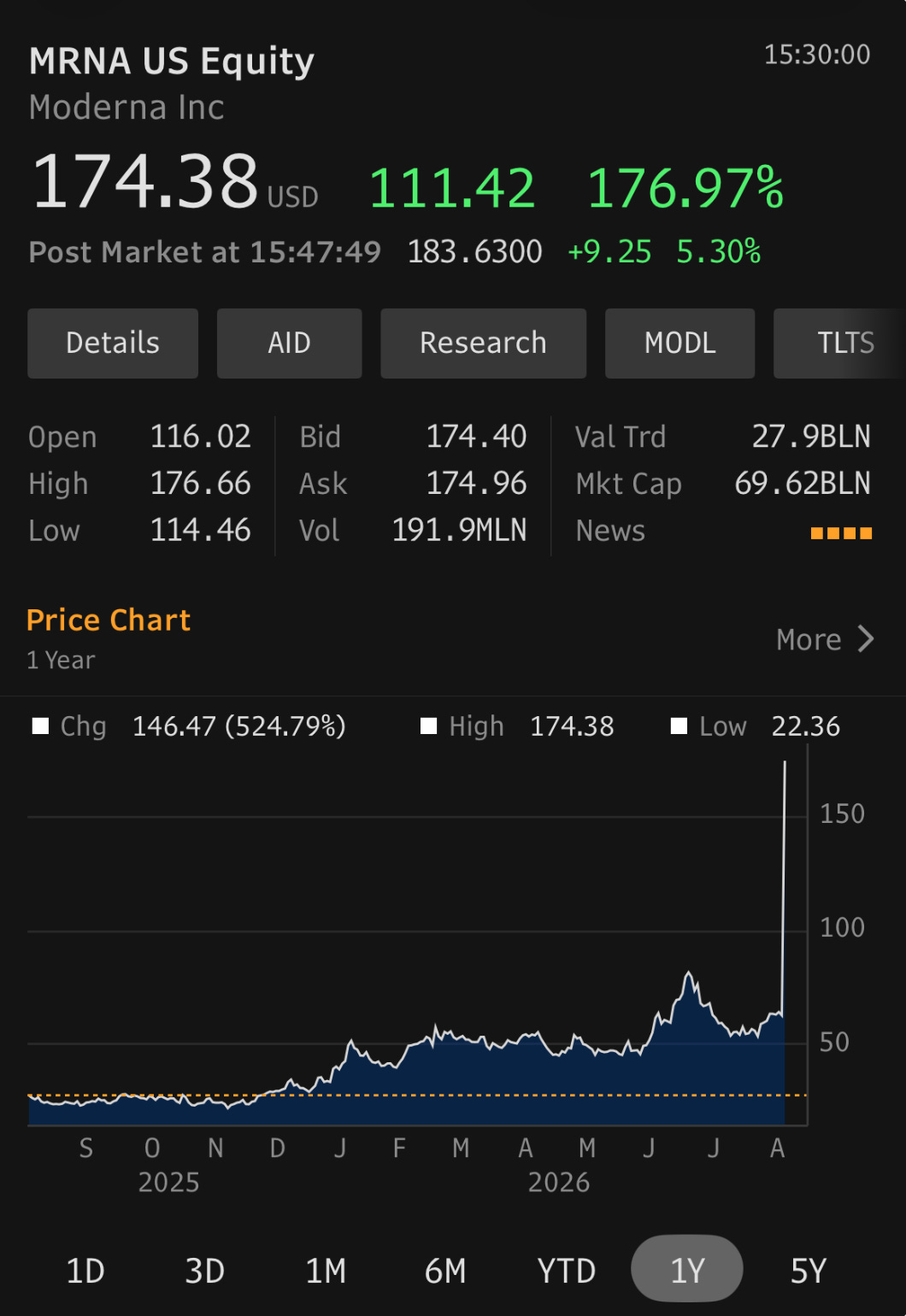
With former NIAID director Anthony Fauci in the Senate hot seat and his senior advisor David Morens Pleading Guilty to Concealing Records of Coronavirus Gain-of-Function Research Grant, NIAID’s commercial partner in developing the mRNA-1273 “Spikevax” against COVID-19, Moderna Inc., just enjoyed one of the best days in its company history, with its stock spiking 177% in today’s trading.
A few weeks ago I posted an essay on this newsletter (Senator Paul Should Ask Fauci Why Moderna’s 2016 Patented Gene Sequence Turned Up in SARS-CoV-2) about what appears to be smoking gun evidence that Moderna and NIAID were part of the cabal that created SARS-CoV-2 or at least a critical part of its genome around the year 2015.
Today, Moderna and its partner Merck announced positive interim results from the Phase 3 INTerpath-001 trial of intismeran autogene (also known as V940 or mRNA-4157), a personalized mRNA-based neoantigen therapy.
Moderna claims this is the first successful late-stage clinical readout for any mRNA cancer vaccine and the first time an individualized neoantigen therapy has demonstrated a clinically meaningful benefit over standard care in a randomized Phase 3 setting.
The therapy targets high-risk melanoma—the deadliest form of skin cancer—specifically in patients with completely resected Stage IIB–IV disease. Melanoma remains a significant public health challenge, with more than 1.5 million people in the United States living with the disease as of 2023.
After surgical removal of the primary tumor, many patients still face a substantial risk of recurrence or metastasis. Moderna claims that Intismeran is designed to address this residual threat by analyzing mutations unique to each patient’s tumor, encoding those neoantigens into an mRNA sequence, and delivering the personalized vaccine (typically up to nine intramuscular doses) so that the patient’s immune system learns to recognize and attack residual cancer cells.
In the trial, the vaccine was given in combination with Merck’s established PD-1 inhibitor pembrolizumab (Keytruda), the current standard of care in the adjuvant setting.
Moderna claims that evidence of effectiveness is compelling., touting that its pre-planned interim analysis of the 1,137-patient trial, the combination met its primary endpoint of recurrence-free survival and a key secondary endpoint of distant metastasis-free survival, both with statistically significant and clinically meaningful improvements over pembrolizumab alone.
Moderna claims its Phase 3 findings build on earlier Phase 2b data (KEYNOTE-942), which showed sustained benefit at five years of follow-up: a 49% reduction in the risk of recurrence or death and a 59% reduction in the risk of distant metastasis or death compared with pembrolizumab monotherapy.
Regarding safety, Moderna claims Phase 3 results indicated that the safety profile of intismeran plus pembrolizumab was consistent with prior studies of the combination, with no new safety signals observed.
Moderna claims of its Phase 2 data that most treatment-related adverse events were low-grade and transient (fatigue being among the most common), grade ≥3 events related to the mRNA vaccine were limited (approximately 10–11% of patients), and there were no grade 4 or 5 events attributed to intismeran itself. Immune-mediated adverse events occurred at rates similar to pembrolizumab alone.
Moderna claims these data highlight intismeran autogene as a potential new standard for adjuvant melanoma treatment. The companies are already discussing regulatory submission. If approved, the therapy could become available as early as 2027, “offering thousands of high-risk patients a more personalized and effective means of preventing disease return.”
Finally, Moderna claims the success also strengthens the broader promise of mRNA technology beyond infectious disease vaccines, opening avenues for similar approaches in other solid tumors.
I suppose we shall see how this plays out. Authors Nicolas Hulscher, MPH, Peter A. McCullough, MD, MPH, and John A. Catanzaro, NMD, PhD just published a paper titled Reanalysis of FDA Clinical Data for mFLUSIVA (mRNA-1010): Unfavorable Risk-Benefit Profile Supports Market Withdrawal in which they concluded that Moderna’s claims about the safety and efficacy of its mRNA influenza vaccine do not stand up to scrutiny.
Considering the abominable safety and efficacy profile of the Moderna-NIAID mRNA COVID-19 vaccine, it is only prudent to regard today’s news of a melanoma vaccine with skepticism.
Today’s stunning stock performance was not only the result of market enthusiasm for the announcement, but also of a major short squeeze, as 14% of its free float (roughly 49.8 million to 52.4 million shares were sold short prior to today’s news.
A witty friend has anointed Moderna the “Rasputin Stock” which made me laugh, as Rasputin has long struck me as one of the most mysterious charlatans in history. For those who are not familiar with his story, Grigori Yefimovich Rasputin (1869–1916) was born a peasant in the Siberian village of Pokrovskoye. For much of his life he was a wandering pilgrim and self-proclaimed holy man. Though never ordained as a monk, he claimed to be a mystic, faith healer, and prophet, blending the occasional appearance of Orthodox piety with magnetic charisma.
He made his way to the Romanov court, where Tsar Nicholas II and Tsarina Alexandra’s only son, Tsarevich Alexei, suffered from hemophilia, a life-threatening bleeding disorder for which contemporary medicine offered little help.
Beginning around 1906–1908, and most importantly during a near-fatal hemorrhage in 1912, Rasputin was summoned to the boy’s bedside. Through prayer, a calming presence, and possibly hypnotic suggestion—or simply by discouraging doctors from administering blood-thinning treatments such as aspirin—he appeared to ease Alexei’s pain and halt the bleeding. The imperial couple became convinced of his divine gift, granting him extraordinary influence as a spiritual adviser and political confidant.
The Tsar’s personal correspondence reveals that he eventually wised up to the fact that Rasputin was an inspired charlatan, but the Tsarina kept her faith in the strange man. In one letter the Tsar wrote to one of his cousins (I don’t remember which one) who advised him to banish Rasputin from court, Nicholas II wrote, “Better one Rasputin than several fits of hysterics per day,” referring to his wife’s constant worry about the sick boy.
One of the strangest features of Rasputin was the mysterious effect he had on women, including aristocratic ladies in Saint Petersburg. Though accounts are probably colored by anti-royalist propaganda, it seems that many women really did find him fascinating. They especially enjoyed his combination of conviviality (he was often drunk) and mysticism. The “monk” is said to have had many lovers and also to have spent much of his time in brothels and bathhouses.
Prince Felix Yusupov concluded that Rasputin’s influence at court had gone way too far and was causing a national security risk by destroying the reputation of the royal family. Thus, on the night of 29–30 December 1916, Yusupov and some of his friends lured Rasputin to the Moika Palace. According to the widely circulated (and self-serving) account of the assassins, they first fed him cyanide-laced cakes and wine. When the poison produced no effect, Yusupov shot him in the chest. Rasputin collapsed, then revived, attacked his host, and fled into the courtyard, where he was shot again—once in the back and once in the head—beaten with a heavy object, and finally bound and thrown through the ice into the Neva River. Legend claims he was still alive and drowned only after struggling beneath the ice.
Forensic examination established three gunshot wounds—one to the left side of the chest, one to the back, and a close-range shot to the forehead that was almost certainly fatal—along with extensive blunt-force trauma to the face and body, a possible knife wound, and other injuries sustained during the attack. Rasputin thus died of gunshot wounds after enduring poisoning attempts that failed, multiple shootings, and a savage beating. The drowning was post-mortem.
Like Moderna’s stock, Rasputin became a figure of mythic resilience who died just before the collapse of the Russian Empire.
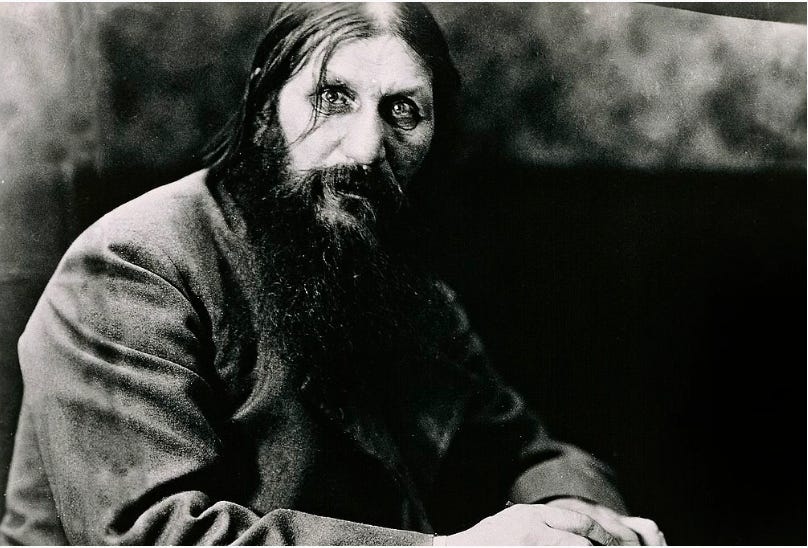
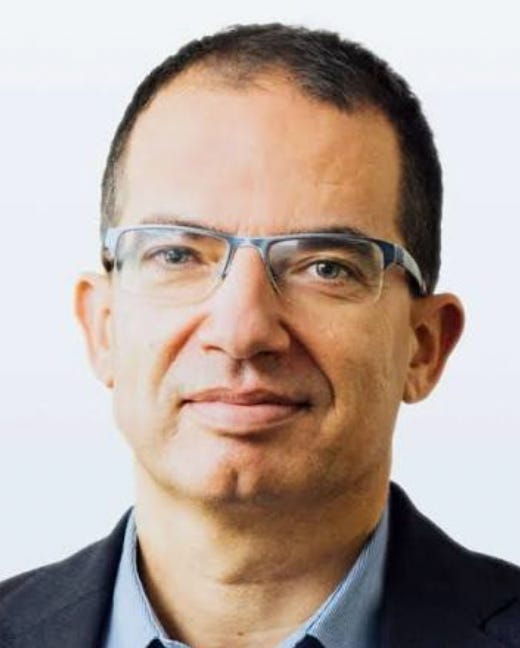
Rasputin looks possessed and he certainly had help from the demons. The Moderna CEO face better I abstain of commenting.
Business as usual, they will not stop working in chimeras, profits and more profits. Greed the prevalent sin of the times.