


By Peter A. McCullough, MD, MPH
As summer winds down most are going to miss the sun and fun but no one will miss mosquito season which can last well into the fall.
🦟 The Silent Swarm: Mosquito-Borne Illness in the United States

The Unseen Threat
Most Americans think of mosquitoes as a nuisance — an itchy annoyance at summer barbecues, a reason to stay inside at dusk. That complacency is dangerous. The United States is not immune to serious mosquito-borne disease, and the risk is growing year over year as climate patterns shift, travel increases, and public health infrastructure strains under competing priorities. While solar bug zappers have become popular, the mosquitos seem to avoid these blue lights.
🩸 West Nile Virus: The Established Invader
West Nile virus arrived in New York City in 1999 and has since become the leading mosquito-borne disease in the continental United States. It’s endemic now — meaning it’s here to stay, cycling between birds and mosquitoes, with humans as accidental hosts.
The clinical picture is stark. About 80% of infected people show no symptoms. That’s the good news. The other 20% develop West Nile fever with headaches, body aches, joint pain, vomiting, and rash. Roughly 1 in 150 develop neuroinvasive disease — encephalitis or meningitis that can cause permanent neurological damage, paralysis, or death.
The CDC has recorded tens of thousands of cases since 1999, but those numbers dramatically undercount reality because most mild cases are never tested or reported. Neuroinvasive cases are the tip of the iceberg, and even those are substantial — hundreds per year, concentrated in states like California, Texas, Arizona, and the Midwest.
🟡 Dengue: The Expanding Frontier
Dengue was once considered a disease of the developing world. That’s no longer true. Locally acquired dengue transmission is now documented in Florida, Texas, Hawaii, and Arizona. Most cases are travel related.
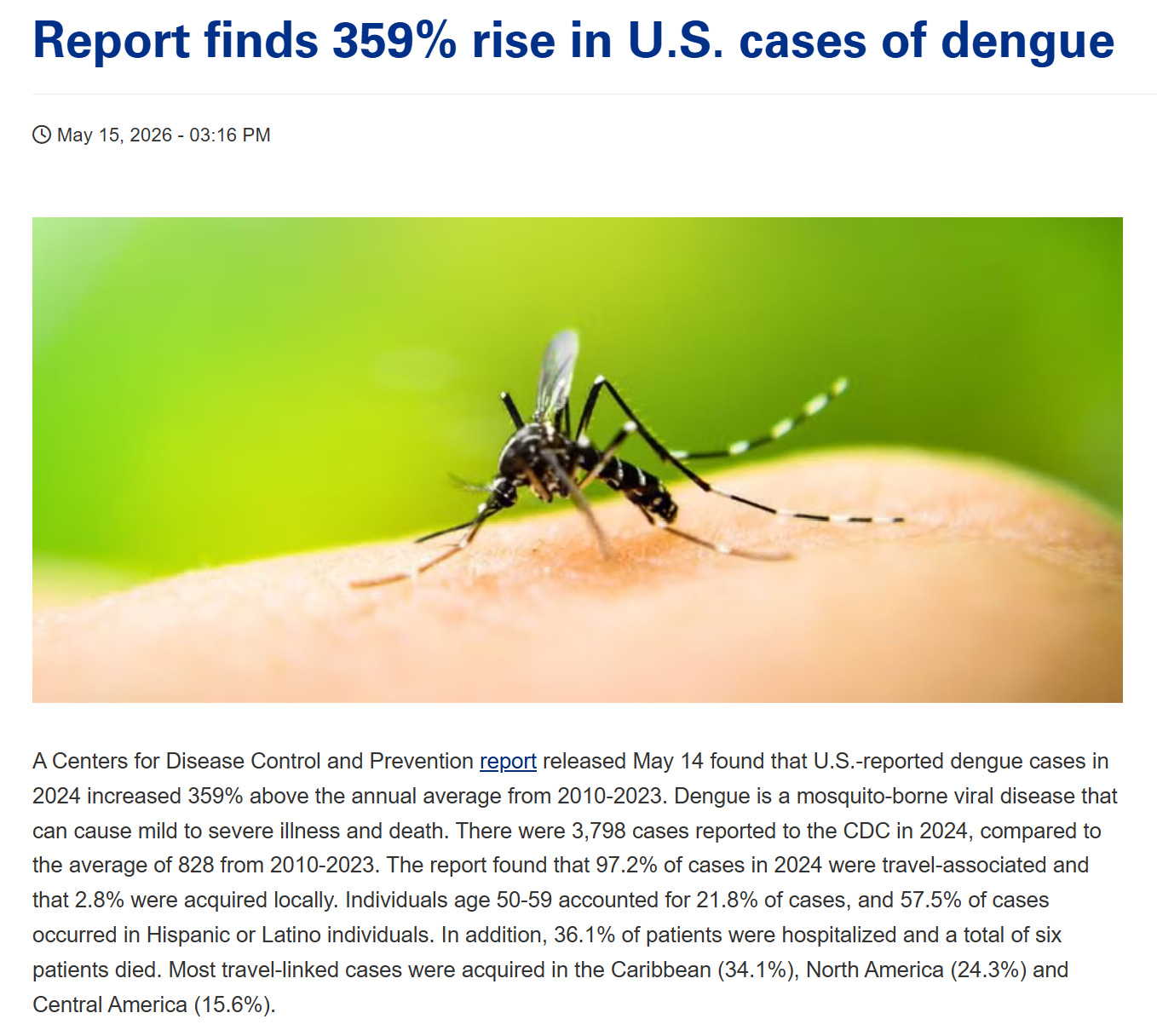
Dengue’s nickname — “breakbone fever” — tells you everything you need to know about what it feels like. Severe muscle and joint pain, high fever, and a characteristic rash. The real danger comes with a second infection from a different serotype, which dramatically increases the risk of dengue hemorrhagic fever, without treatment, a life-threatening condition where blood vessels leak, platelets crash, and organ failure can follow.
Aedes aegypti and Aedes albopictus, the primary vectors, are now established across much of the southern and eastern United States. The mosquitoes have colonized the territory. The virus is following close behind.
🩸The Forgotten American Scourge
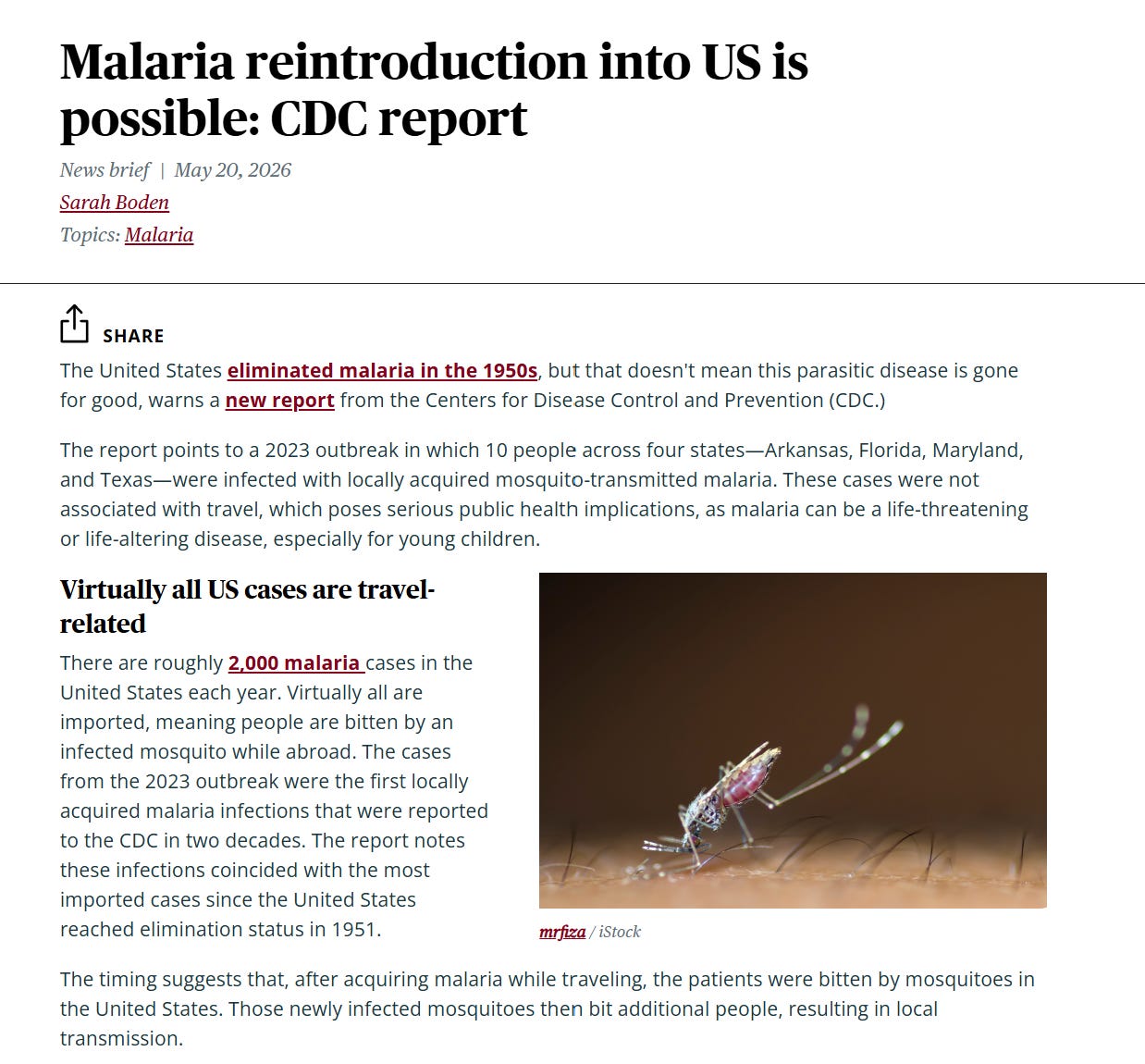
Malaria was not always a tropical disease — for centuries it was endemic across the American South and as far north as the Great Lakes, with Plasmodium vivax and Plasmodium falciparum both circulating widely. The disease shaped settlement patterns, agricultural productivity, and even military campaigns; more Union soldiers died of malaria than Confederate bullets during the Civil War. The CDC was founded in 1946 specifically as the Office of Malaria Control in War Areas, and the agency’s first and most consequential achievement was the systematic elimination of malaria from the United States through aggressive drainage, insecticide application, and surveillance — a feat completed by 1951. Today, roughly 2,000 cases are reported annually, almost all imported, but with Anopheles mosquitoes still present across half the country and climate conditions growing more favorable, locally acquired transmission has already reappeared in Florida and Texas.
⚠️ Yellow Fever: The Sleeping Giant
Yellow fever shaped America more than most textbooks admit — stalling construction of the Panama Canal, ravaging Philadelphia in 1793 and forcing the federal government to flee, decimating New Orleans repeatedly, and ultimately driving the mosquito-control infrastructure that made the modern South habitable.
Yellow fever hasn’t established itself in the continental US in the modern era, but the conditions are increasingly favorable. The same Aedes aegypti mosquito that transmits dengue also carries yellow fever. Urban outbreaks in South America and Africa demonstrate what happens when the virus reaches densely populated areas with the right vector — it moves fast and kills efficiently.
Yellow fever’s severe form causes jaundice (hence the name), internal bleeding, and multi-organ failure. The case fatality rate without treatment in severe cases can reach 50%. A vaccine exists, but it’s a live attenuated vaccine with its own serious risks, including yellow fever vaccine-associated viscerotropic disease, which essentially mimics the disease it’s supposed to prevent. It should be avoided in immunocompromised persons.
🦟 Other Players in the Swarm
Zika virus grabbed headlines in 2015-2016 for purportedly causing microcephaly in infants born to infected mothers. Aedes mosquitoes capable of transmitting it remain widespread across the southern US, and sporadic cases continue.
Chikungunya causes debilitating joint pain that can persist for months or years. It’s not typically fatal, but the chronic arthritis-like symptoms can destroy quality of life. Outbreaks in the Caribbean and Latin America mean imported cases are constant, and local transmission is a matter of when, not if, in areas with established vector populations.
Eastern Equine Encephalitis (EEE) is rare but terrifying — a 30% fatality rate with inadequate treatment, and many survivors have permanent brain damage. It pops up periodically in the Northeast, Great Lakes, and Gulf Coast states.
St. Louis Encephalitis and La Crosse Encephalitis round out the list of neuroinvasive threats circulating within US borders.
🧥 The First Line of Defense: Physical Barriers
Before any discussion of repellents, the single most effective and under-discussed strategy is physical coverage. Long sleeves and long pants, particularly when treated or worn during peak mosquito activity hours (dusk to dawn), create a barrier no mosquito can penetrate.
This isn’t complicated. Skin that isn’t exposed is skin that can’t be bitten. Light-colored, loose-fitting clothing is more effective than dark, tight garments — mosquitoes can bite through spandex but struggle with woven cotton or linen. Tucking pants into socks and shirts into pants eliminates entry points. A wide-brimmed hat protects the neck and ears.
The pushback is predictable: “It’s too hot.” But lightweight, breathable fabrics designed for sun protection exist for exactly this reason. Cultures that have lived with mosquito-borne disease for centuries — across Africa, Asia, and Latin America — understood this long before DEET was synthesized in a lab. Physical barriers work. They work every time. They have no side effects, no toxicity concerns, and no need for reapplication.
🌿 Botanical Bug Defense: Nature’s Chemistry Done Right
The Wellness Company’s Botanical Bug Defense represents a fundamentally different approach to repellency — one that works with natural compounds rather than synthetic neurotoxins.
The formulation is built around four key botanical ingredients, each with documented evidence for insect repellency:
Cedarwood Oil’s primary active compounds, cedrol and thujopsene, function as potent insect neurotoxins that disrupt octopamine receptor signaling in arthropods while leaving mammalian systems unaffected. Multiple studies have demonstrated cedarwood's fumigant and contact toxicity against mosquitoes, ticks, and other biting insects, with protection attributed to both repellency and direct mortality. Cedarwood's multifaceted mode of action — repellent, larvicidal, and adulticidal — makes it a valuable synergistic component in blended formulations where it extends the efficacy window of shorter-duration oils. is the heavyweight of natural repellents.
Citronella oil is well-known but often underestimated. The key is concentration and formulation — properly emulsified citronella masks the carbon dioxide, lactic acid, and other human-emitted chemical signals that mosquitoes use to locate targets. It’s not about killing insects; it’s about making you invisible to their sensory apparatus.
Peppermint oil earns its place in natural repellent formulations through its high menthol content and complementary volatile compounds — primarily menthone and limonene — which disrupt the olfactory receptors mosquitoes use to locate human targets. Multiple studies have demonstrated peppermint oil's repellency against Aedes, Culex, and Anopheles species, with larvicidal activity adding a secondary layer of protection. The oil's rapid evaporation limits standalone duration, but in blended formulations it contributes a sharp initial barrier while cooling the skin and deterring insects through a mechanism distinct from the heavier, longer-lasting botanical oils it's paired with.
Lemongrass oil contains citral and geraniol, compounds shown in laboratory and field studies to repel Aedes, Culex, and Anopheles species — the three genera responsible for virtually all mosquito-borne disease transmission. Geraniol in particular has demonstrated repellency comparable to DEET in some head-to-head comparisons at similar concentrations.
The combination matters. Individual botanicals tend to have shorter protection windows than synthetic alternatives, but synergistic blending — multiple compounds targeting different olfactory receptors in the mosquito — can extend efficacy beyond what any single ingredient achieves alone.

☠️ The Chemical Alternative: What You’re Actually Putting on Your Skin
DEET (N,N-diethyl-meta-toluamide) has been the gold standard of insect repellents since the 1940s. It works. Nobody disputes that. What’s less discussed is how it works and what the trade-offs are.
DEET is not merely a repellent in the conventional sense — it functions as a neurotoxin that disrupts the insect’s olfactory and nervous systems. The mechanism involves inhibition of acetylcholinesterase, the same enzyme targeted by organophosphate pesticides and nerve agents.
Severe adverse reactions — including encephalopathy and seizures — have been documented, particularly in children. The EPA’s own incident reports include hundreds of seizure-related adverse events. DEET is readily absorbed through the skin, with studies showing 10-15% systemic absorption within hours of application. It crosses the placenta. It’s detectable in breast milk.
Picaridin and IR3535 are often marketed as safer alternatives, but they’re still synthetic molecules with far less long-term safety data than anyone should be comfortable with. The precautionary principle — if you don’t need to expose yourself to a synthetic neuroactive compound, don’t — seems to have been abandoned in the name of convenience.
Permethrin, used for treating clothing, is a pyrethroid insecticide that is directly neurotoxic. The argument that it’s safe because it binds tightly to fabric ignores the reality of skin transfer, inhalation during application, and environmental persistence.
🛡️ A Sensible Hierarchy of Protection
The rational approach to mosquito-borne disease isn’t either/or — it’s layered defense:
Physical barriers first — long sleeves, long pants, mosquito nets in high-risk sleeping environments
Environmental control — eliminate standing water where mosquitoes breed
Timing — avoid peak biting hours when possible
Botanical repellents on exposed skin — effective protection without systemic neurotoxin exposure
Synthetic repellents reserved for extreme-risk scenarios — deep jungle, known active outbreaks, regions with high malaria or yellow fever transmission where the risk-benefit calculation shifts
For the vast majority of Americans — backyard barbecues, hiking trips, evening walks — botanical formulations like The Wellness Company’s Botanical Bug Defense represent the rational middle ground: effective protection without the documented risks of DEET and its synthetic cousins.
🧠 The Bottom Line
Mosquito-borne illness in the United States is not a theoretical concern. West Nile is endemic. Dengue is establishing local transmission. Zika, chikungunya, and EEE are distant threats. Yellow fever is one introduction event away from urban outbreaks in cities with established Aedes populations.
The question isn’t whether to protect yourself — it’s how to do it intelligently. Long sleeves cost nothing and work perfectly. Botanical repellents with documented efficacy offer meaningful protection without the neurotoxic baggage of chemical repellents.
📝Please subscribe to FOCAL POINTS as a paying ($5 monthly) or founder member so we can continue to bring you the truth. AlterAI may be used to assist in searches, synthesis, and review.
Peter A. McCullough, MD, MPH
Chief Scientific Officer, The Wellness Company
Dr. McCullough, I have a question. Recently I read that Patchouli Oil was tested and proven to be just as effective as DEET. Myself being a “mosquito magnet”, I have been using this, diluted in some pure aloe gel, and it works very well. Do you have any information or advice as to whether this is safe to use?
I may try your product as well!
Two great blood purifiers are Nature's Way Vitamin C with Bioflavonoids and Nature's Way Golden Seal Root, which have worked for me over the years. They clean out the blood and stop infections. In addition, I support my Immune System...by avoiding processed 'garbage,' drugs and vaccines.