


In my conversation with Tucker Carlson last year, I found myself wandering into the hazardous terrain of metaphysics and religion. Had we had the conversation before 2022, it would never have occurred to me to talk about Gospel accounts of the devil tempting Jesus or Ivan’s parable of the Grand Inquisitor in Doestoevsky’s The Brothers Karamazov.
Before 2022, I always figured there was a natural or physical explanation for human malevolence—that is, archaic emotions like fear, loathing, lust, and greed. However, upon hearing the testimony of New York State attorneys Ralph Lorigo and Beth Parlato—as well as the testimony of family members of deceased patients who were denied ivermectin—I began to ponder the possibility that ancient metaphysical concepts of evil and the devil may indeed be at play in human affairs.
To understand what I mean, read Chapter 28: Begging for the Wonder Drug in our 2022 book, The Courage to Face COVID-19: Preventing Hospitalization and Death While Battling the Bio-Pharmaceutical Complex, which remains the #1 Top Rated book in its genre. Researching the chapter and interviewing witnesses was, without question, the most disturbing experience of my career as a true crime author.
I have posted the chapter at the bottom of this essay. If you find it interesting and informative, please share this essay with your friends, and please buy a copy of the book.
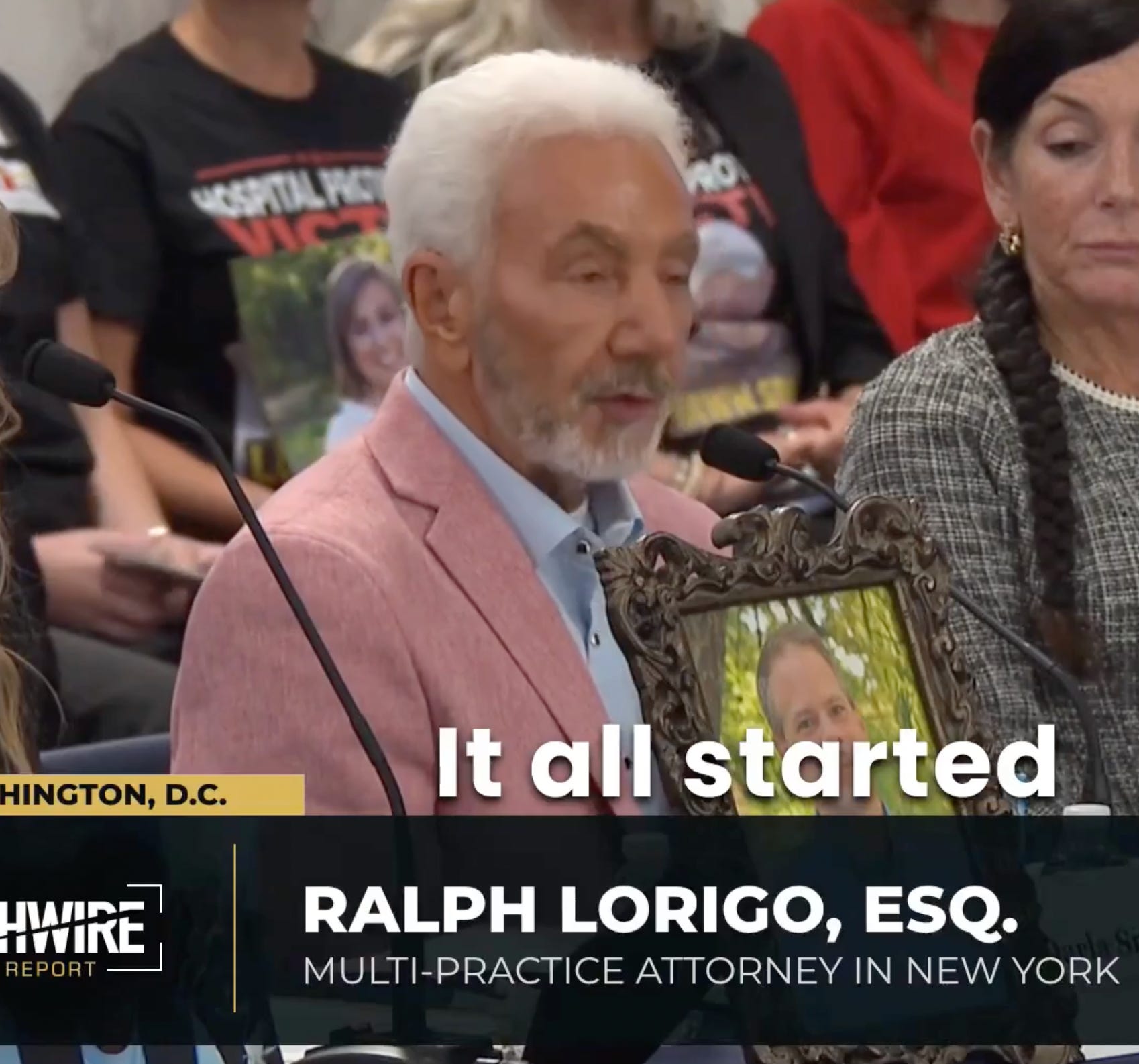
This morning I was gratified to see the following recording of Ralph Lorigo testifyng at Senator Ron Johnson’s roundtable discussion titled "COVID-19 Hospital Protocols: Real Stories from Real People.”
Mr. Lorigo’s testimony reminded me of my long held conviction—supported by an array of evidence detailed in chapters 12, 27, 28, 31, 33, and 40 of our book—that hospital administrators who refused to give ivermectin to dying patients should be tried for murder or at least negligent homicide. This is especially true of administrators who flouted court orders to give the drug to patients whose family members literally begged for it.
If you think I am exaggerating, or if you are an attorney and you don’t believe the evidentiary standard can be met in court, read the chapter below and let me know in the comments what you think.
CHAPTER 28: Begging for the Wonder Drug
As Michael Capuzzo told the story in his long magazine piece “The Drug that Cracked Covid,” Judy Smentkiewicz was an eighty-year-old resident of Buffalo, New York.[i] After working thirty-five years as an office manager for Metropolitan Life and raising two children, she had retired to her small house in the suburbs. A week after Senator Johnson’s second Senate hearing, she began preparing for Christmas, and looked forward to her two children, Michael and Michelle, visiting her for a few days. However, right after Michael and his wife arrived from Florida, she began to feel unwell. On December 22 she tested positive for Covid. Her kids were devastated and cancelled their Christmas celebration as Judy went into quarantine. A week later, she became short of breath and was rushed to the Millard Fillmore Suburban Hospital. On New Year’s Eve she was admitted to the ICU.
It was a terrible moment in which Judy and her children realized they might never see each other again. In the days that followed, the doctors and nurses with whom Michael spoke didn’t offer much hope. They said there were no medications for treating COVID-19 approved by federal health agencies apart from remdesivir. This was administered to Judy, but it seemed to have no beneficial effect. On New Year’s Eve, as her condition deteriorated, her two children and six of their friends gathered on the street below her hospital window and prayed for her.
Shortly after New Year’s Day, Michael received from his mother-in-law a video of Dr. Pierre Kory being interviewed by a reporter for Fox 10 News Now, KSAZ-TV in Phoenix, Arizona. That morning, Dr. Kory had given his Senate testimony on ivermectin. Michael watched it and was moved by Dr. Kory’s passionate intensity and eloquence. Immediately he called the hospital and told Judy’s attending physician that he wanted her to receive ivermectin. The doctor refused on the grounds that it wasn’t approved for COVID-19, but Michael refused to take no for an answer, and finally a hospital administrator approved one, 15-milligram dose. Less than twenty-four hours later, Judy was taken off the ventilator, and the next day she sat upright in a chair for a Zoom call with her son. She still wasn’t out of the woods, and when her heart started racing, she was moved to a cardiac unit, and the hospital refused to give her a second dose of ivermectin. Michael insisted but the hospital refused to budge.
And so, he contacted his friend and attorney Ralph Lorigo, and explained the situation. At the time, Lorigo knew nothing about ivermectin, so he too watched the interview with Dr. Kory, and then sued the hospital. New York State Supreme Court Judge Henry Nowak heard the case and ordered the hospital to commence treating Judy with four more doses of ivermectin, per her family doctor’s prescription.
The hospital refused to obey the judge’s order, which resulted in additional legal wrangling, including another hearing. Finally, the hospital’s lawyer agreed to allow Judy’s family doctor to administer the drug. He was under the impression it was on hand in the hospital’s pharmacy, but when he arrived to carry out his charge, he was told that it would have to be couriered from another facility. This caused another delay. Finally, at 11:00 pm that night, the second dose was administered, and she started to improve. Ten days later she walked out of the hospital.
As word spread about Judy’s happy outcome, Ralph Lorigo was contacted by countless others in the same situation, and soon his law firm had a new area of practice—trying to force hospitals to administer an FDA-approved, Nobel Prize winning, WHO “Essential Medication” to dying COVID-19 patients to whom nothing else was offered.
Mr. Lorigo was well-suited for the task. The energetic, punctilious attorney and Erie County Conservative party chairman has a formidable presence, with strong Italian good looks and a penchant for wearing beautifully tailored suit and power ties. Though he specialized in real estate law, he represented his clients seeking ivermectin with great care. A devoted family man with three children and multiple grandchildren, he empathized with the families who sought his help.
To be sure, it wasn’t an easy job, because the hospitals fought him tooth and nail, bringing multiple attorneys and expert witnesses to hearings. After a few more successes in which he prevailed and the patients recovered after receiving ivermectin, he received more queries than his staff could handle, so he contacted his friend, Beth Parlato, and asked her if she would be interested in taking some of the cases.
The 55-year-old attorney and mother of three had served as a judge in a New York State criminal court. Over the course of her career, she’d seen much of the good, the bad, and the ugly, but none of it had prepared her for the grueling path ahead. What she was about to witness would challenge all of her assumptions about the American healthcare and legal systems, and ultimately about human nature itself.
Most of her clients were referrals from the FLCCC, founded by Drs. Marik and Kory. The typical call would come into her office from a desperate husband or wife, daughter or son. Their stories were always the same. A much-loved family member had been languishing in hospital and was now headed for the ventilator and probable death. And though the doctors and nurses stated that the prognosis was poor, the hospital refused to administer ivermectin.
To patients and their families, the situation was incomprehensible. Many of Beth’s clients posed a variation of the question: “Mom [or dad] is declining and is probably going to die, so what’s the harm in her trying ivermectin?” Beth was at a loss for an answer. The hospital’s policy made no sense, neither as a matter of fact nor law. Many families wondered why “right to try” laws didn’t apply. Hospital attorneys claimed the “right to try” was only for experimental medications that were not yet FDA-approved. Ivermectin was FDA-approved, just not for the treatment of COVID-19.
Patients and their families found this argument perversely legalistic, but many judges—and all judges elected as Democrats—found it persuasive. Beth argued it was a legal, common, and longstanding medical practice to prescribe FDA-approved drugs off-label. Hospital attorneys retorted that the NIH guidelines for the treatment of COVID-19 did not recommend the off-label administration of ivermectin, and because the NIH was the final scientific arbiter of medical matters in the United States, the hospitals were required to follow its guidelines.
The trouble with the one-size-fits-all NIH guidelines for hospitalized COVID-19 patients was that they didn’t work. Almost a year into the pandemic, the United States had the highest COVID-19 death rate of the world’s top ten wealthiest nations and was in the top twenty nations with the highest death rates in the world. Approximately 80% of hospitalized patients who went on mechanical ventilation died. Also significant was the fact that that on January 14, 2021—in response to Senator Johnson’s letter requesting that the NIH review Dr. Kory’s presentation of evidence—the NIH dropped its recommendation against using ivermectin and adopted a neutral stance. Though far from satisfying for Dr. Kory and his colleagues, the NIH neutral stance at least gave doctors greater leeway to exercise their clinical judgement about the drug.
To make matters even more confusing, healthcare professionals were provided with broad legal immunity by the federal PREP Act (Public Readiness and Emergency Preparedness) of 2005. This authorized the Secretary of Health and Human Services to deploy a wide array of “Emergency Countermeasures” in the event of an infectious disease outbreak. When invoked by the Secretary of Health and Human Services, the PREP Act provides immunity for the “manufacture, testing, development, distribution, administration, and use of covered countermeasures.” On February 4, 2020, HHS Secretary Alex Azar declared COVID-19 an emergency and invoked the PREP Act.
The CARES Act of March 27, 2020, also provided immunity for healthcare workers treating COVID-19 patients. Additional immunity was granted by governors’ executive orders in all fifty states. The governor of New York State, in which Beth was practicing, provided the following immunity:
Conduct Covered: Civil liability for injury or death alleged to have been sustained directly as a result of an act or omission by person(s) covered.
Person(s) Covered: Physicians, physician assistants; specialist assistants; nurse practitioners; licensed registered professional nurses; licensed practical nurses.
Conduct Not Covered: Gross negligence.
Many observers who were documenting U.S. healthcare policy with respect to remdesivir wondered if all this liability protection could explain why the new, experimental drug was the hospital standard of care despite numerous red flags raised about its safety. The contrast of this policy with the strict policy against administering ivermectin was stunning.
Additionally, all the patients that Beth represented, and their families, stated in writing that they would indemnify the hospitals of liability for any adverse effects apparently caused by ivermectin, and that their primary care physicians would come to the hospital to administer it. Despite these multiple provisions of immunity, hospitals were still dead set against giving ivermectin to dying patients.
The hearings were brutal affairs in which hospital attorneys and expert witnesses portrayed Beth’s expert witness (on the safety and efficacy of ivermectin) as a delusional quack. Their most common line of attack was that Beth’s witness was a lone, eccentric voice in challenging the overwhelming scientific consensus that informed NIH guidelines. This rhetorical strategy ignored that many of mankind’s greatest scientific insights were the work of individuals who challenged the orthodoxy of their day. The growing body of evidence, including RCTs, cited by Beth’s witness was dismissed by hospital experts with the assertion that the evidence was “low quality.” Thus, the judge was presented with opposing expert witness claims about the evidence, only with the hospital’s witness also claiming he had “scientific consensus” and therefore the NIH on his side.
Beth tried to argue that the patient retained sufficient bodily autonomy to decide if he or she wished to take an FDA-approved drug off-label. The hospitals’ attorneys retorted that hospital patients had never had the right to decide their treatment, and that granting it with ivermectin would set a terrible precedent, opening a Pandora’s Box of future patients demanding treatments after hearing anecdotes about their efficacy. Beth regarded this argument as another legalistic dodge. Her clients weren’t presuming to practice medicine—they were dying men and women, desperately begging for the right to try an FDA-approved drug as a last and only hope when nothing else apart from remdesivir was being offered.[ii]
The hospitals claimed total sovereignty over the patient—a godlike power over all decisions affecting his life and death, with the patient afforded no say. For most gravely ill patients, the decision of this godlike power resulted in death. Thus, to sick patients and their families, the Lords of Healthcare were neither competent nor compassionate.
[i] Capuzzo, Michael. The Drug that Cracked Covid. Mountain Journal, May 2021.
[ii] Author Interview with Beth Parlato. March 2, 2020.
There should be Nurenberg trials for all these Hospital administrators, etc. who refused to give patients ivermectin that might’ve saved their lives.
The DOJ, FBI, CIA, medical bodies, medical associations, hospital boards were all in on the crime. What happened in hospitals was part of an international criminal conspiracy. I'm afraid there is no trustworthy leader who can stand up to the perpetrators.