


Glioblastoma (GBM) remains one of the most aggressive and lethal human cancers, with a median survival of roughly 15 months despite surgery, radiation, and chemotherapy. In a newly published paper in BJC Reports titled, Attenuation of malignant phenotype of glioblastoma following a short course of the pro-oxidant combination of Resveratrol and Copper, researchers found a short, non-toxic oral intervention that simultaneously suppresses tumor proliferation, cancer hallmarks, immune checkpoints, and stemness — while activating intrinsic tumor cell death.
In a small but carefully controlled pre-surgical “window” study, human glioblastoma patients received resveratrol (5.6 mg) plus copper (560 ng) four times daily for an average of just ~12 days before tumor resection. Tumor tissue was then compared with untreated controls.
The results reveal a system-level attenuation of malignant phenotype: near-eradication of tumor-promoting cell-free chromatin particles (cfChPs)—accompanied by a ~31% reduction in tumor proliferation (Ki-67), suppression of nine cancer hallmarks and cancer stemness, simultaneous down-regulation of six immune checkpoints, and activation of intrinsic apoptosis, all within ~12 days.
This was not a marginal signal. It was a coordinated, system‑level biological shift in one of the deadliest cancers known:
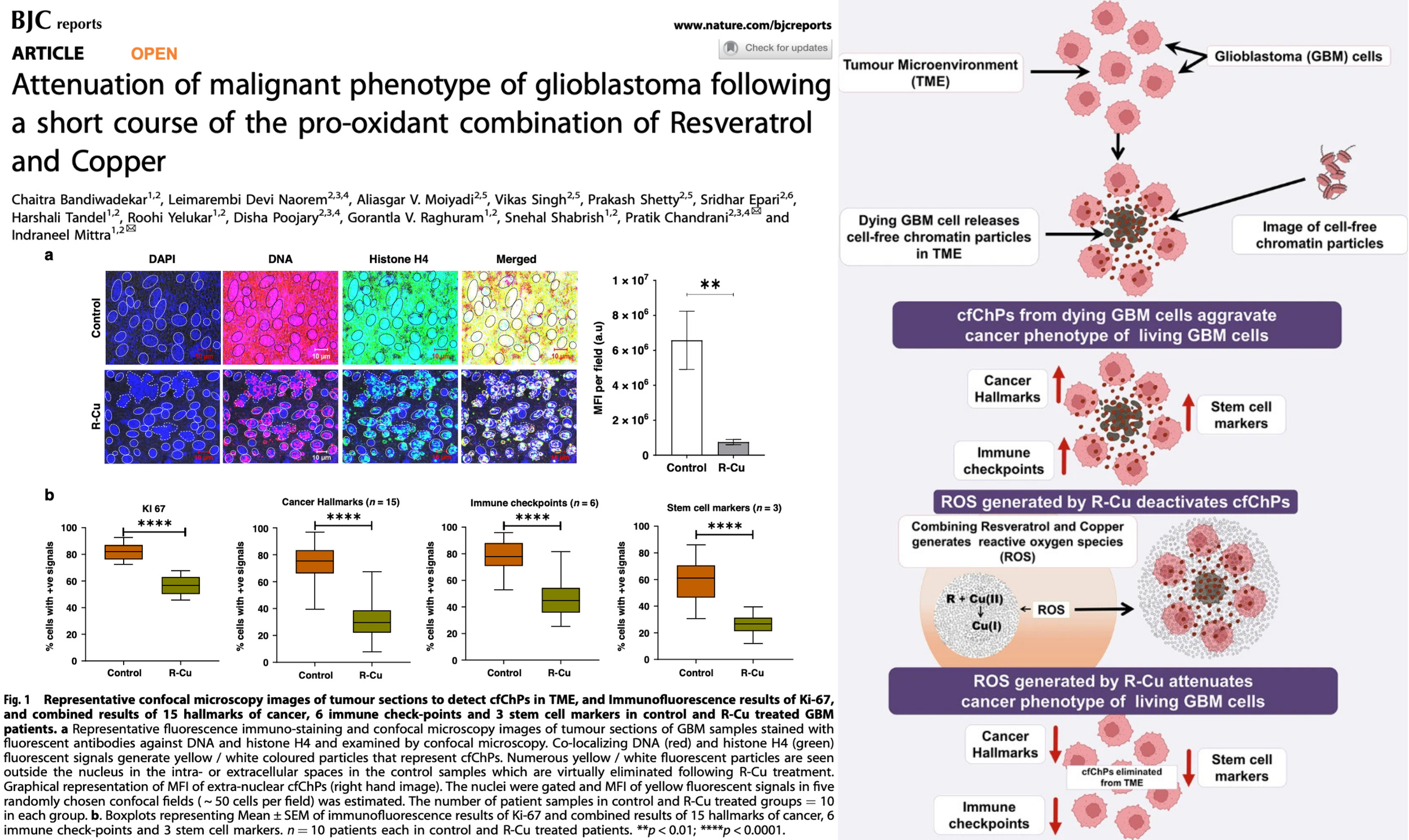
Near‑Elimination of Tumor‑Promoting Cell‑Free Chromatin
Using confocal microscopy, investigators showed that glioblastoma tumors are saturated with extracellular DNA–histone complexes (cfChPs) — debris released from dying cancer cells that can enter neighboring cells and drive DNA damage, inflammation, immune evasion, and malignancy.
After short‑course resveratrol–copper treatment, these cfChPs were virtually absent from the tumor microenvironment. Quantitative analysis showed a highly significant reduction in extranuclear chromatin signal, indicating near‑eradication of this upstream oncogenic driver.
Large Reduction in Tumor Proliferation (Ki‑67)
Ki‑67 is a gold‑standard marker of how aggressively a tumor is dividing.
Control tumors: 82.1% Ki‑67–positive cells
R‑Cu treated tumors: 56.7% Ki‑67–positive cells
p < 0.0001
This represents a ~31% reduction in actively dividing tumor cells after less than two weeks of treatment. A shift of this magnitude suggests a real down‑staging of biological aggressiveness, even in the absence of visible histologic remodeling.
Simultaneous Suppression of 9 Hallmarks of Cancer
The authors examined 15 biomarkers spanning nine canonical hallmarks of cancer (genomic instability, inflammation, angiogenesis, invasion, metabolic reprogramming, etc.).
13 of 15 biomarkers were significantly reduced
Combined hallmark burden dropped by ~50–60%
p < 0.0001 across the composite analysis
This intervention produced broad, coordinated suppression of malignant behavior.
Collapse of Multiple Immune Checkpoints — All at Once
Six immune checkpoints were assessed:
PD‑1
PD‑L1
TIM‑3
NKG2A
CTLA‑4
LAG‑3
All were significantly down‑regulated in treated tumors (p < 0.0001 overall). Importantly, five of these checkpoints were shown to be expressed on tumor‑infiltrating lymphocytes, confirming biological relevance.
Marked Reduction in Cancer Stemness
Cancer stem cells drive recurrence, resistance, and lethality in GBM.
Three stem cell markers were analyzed:
CD133
CD44
SOX2
All showed highly significant reductions (p < 0.0001), with combined stemness burden dropping by roughly 50–60%.
Massive Transcriptomic Reprogramming
RNA‑seq revealed a distinct transcriptional state in R‑Cu–treated tumors:
955 differentially expressed genes
870 genes down‑regulated
Clear clustering separating treated from untreated tumors.
In other words, the treatment didn’t just tweak one pathway — it reprogrammed how the tumor was behaving at the genetic level.
One of the most dramatic changes involved PVRIG-2P, a gene closely related to PD-L1, the immune-evasion signal many cancers use to hide from the immune system. This immune-evasion gene was shut down by millions-fold
Genes control how cancer grows, spreads, hides from immunity, and resists treatment. Seeing this many cancer-related genes switch off at once suggests the tumor’s aggressive programming was being actively dismantled, not merely slowed.
Strong Activation of Intrinsic Tumor Cell Death
Pathway analysis showed robust activation of apoptosis and coordinated cleanup mechanisms:
Hallmark apoptosis: NES = 2.899, FDR = 0
Proteasomal degradation pathways: NES up to 3.68
Increased active caspase‑3
Reduced Annexin V (consistent with efficient debris clearance)
In other words, after treatment:
Cancer cells were signaling themselves to shut down and die
The body’s cellular cleanup machinery was also switched on, breaking down and removing dead cancer cells efficiently
Key markers showed that cancer cells were dying in an organized, controlled manner, not exploding or spilling toxic debris into surrounding tissue
CONCLUSION
After ~12 days of a non-toxic oral intervention (resveratrol plus copper), glioblastoma tumors demonstrated:
Near-elimination of tumor-promoting chromatin debris (cfChPs)
A marked reduction in tumor cell proliferation (Ki-67)
Suppression of nine core hallmarks of cancer
Simultaneous down-regulation of six immune checkpoints
Significant loss of cancer stem cell markers
Large-scale reprogramming of tumor gene expression
Activation of organized, intrinsic tumor cell death with efficient cleanup
Together, these findings indicate that a short, non-toxic intervention can biologically “de-escalate” one of the most aggressive human cancers across multiple independent axes of malignancy.
The authors explicitly note that longer trials are urgently needed to determine whether prolonged treatment could push tumors toward a more benign phenotype or improve clinical outcomes.
Epidemiologist and Foundation Administrator, McCullough Foundation
Support our mission: mcculloughfnd.org
Please consider following both the McCullough Foundation and my personal account on X (formerly Twitter) for further content.
We've come a long way. In 1980, I worked as a radiographic technologist while putting myself through premed courses and undergrad. A lovely young woman presented for CT scan for recent onset of unremitting headache. A mass was seen, and the neurosurgeon opened her up and concluded immediately there was no point in attempting to remove the mass as it was a very invasive astrocytoma. (Glioblastomas are an aggressive form of astrocytoma that were categorized and graded by the WHO just a year earlier than this woman's appearance.)
Long story short, chemo and radiation therapy was started immediately, which in most all patients resulted in nasty sequelae including loss of appetite, nausea, vomiting, weight loss leading to cachexia, and of course, hair loss. She returned to the imaging department a couple of months later wearing a scarf over her now bald head. She was in great spirits. She informed me that her oncologists were surprised she suffered almost no nausea and her appetite remained, although not quite as robust as before treatment. She credited this to co-treatment with an acupuncturist who gave her several concoctions to make a powerful. bitter tea from, plus needle therapy and dietary advice. She said she told the oncologists about this and they said. "oh, that's interesting..."
Aggressive astrocytomas/glioblastomas had a poor survival rate in 1980. My schedule at the hospital changed to swing shift so I could accommodate my college class schedule. I lost track of this sweet, courageous woman who thought out of the box in a way her oncologists found to be perplexing. I found it criminally negligent they didn't immediately ask to discuss the therapy with her acupuncture doctor, and a multi-disciplinary protocol developed. Today there are cancer centers with acupuncturists, oncological naturopaths, and nutritionists on staff. It will be intriguing to see how they incorporate these new findings, if they do at all. After all, when you step into the doors of the Cancer Care Alliance, or the Fred Hutchinson Center, the cash register is still ringing loudly.
Where's the money in treating cancer with this cheap stuff?