


Years ago I got to be pals with a retired CIA analyst who was stationed in Vienna during the Four Powers Occupation (1945-1955). Even after relations between the US and Soviet Union went cold in 1946, he still found some of the Russian guys posted at the Soviet Embassy (whom he knew to be in the MGB) convivial and engaging.
He was astonished at how well some of them could speak American English without an accent, and puzzled by the strange habit some had of wearing white socks with dress shoes.
Part of basic CIA training was to be wary of attractive foreign women who are unusually and unaccountably friendly. A good rule of thumb was expressed in the pithy saying:
If you encounter pretty young girl who really likes you and the situation seems too good to be true, that’s because it is.
I thought of Cold War honey traps yesterday when I saw the news of Jensen Huang’s misadventure with an attractive Chinese woman. The billionaire founder and chief executive of Nvidia has admitted to having an extramarital affair with a Chinese businesswoman suspected of working for Chinese intelligence.
Huang made his admission following investigative reporting by the New York Times, Wall Street Journal, and Financial Times. The big question now is whether Huang—whose company manufactures some of the world's most strategically important artificial-intelligence processors—was honey-trapped by Chinese intelligence with the goal of obtaining sensitive information about his business and products, or to influence American semiconductor export policy.
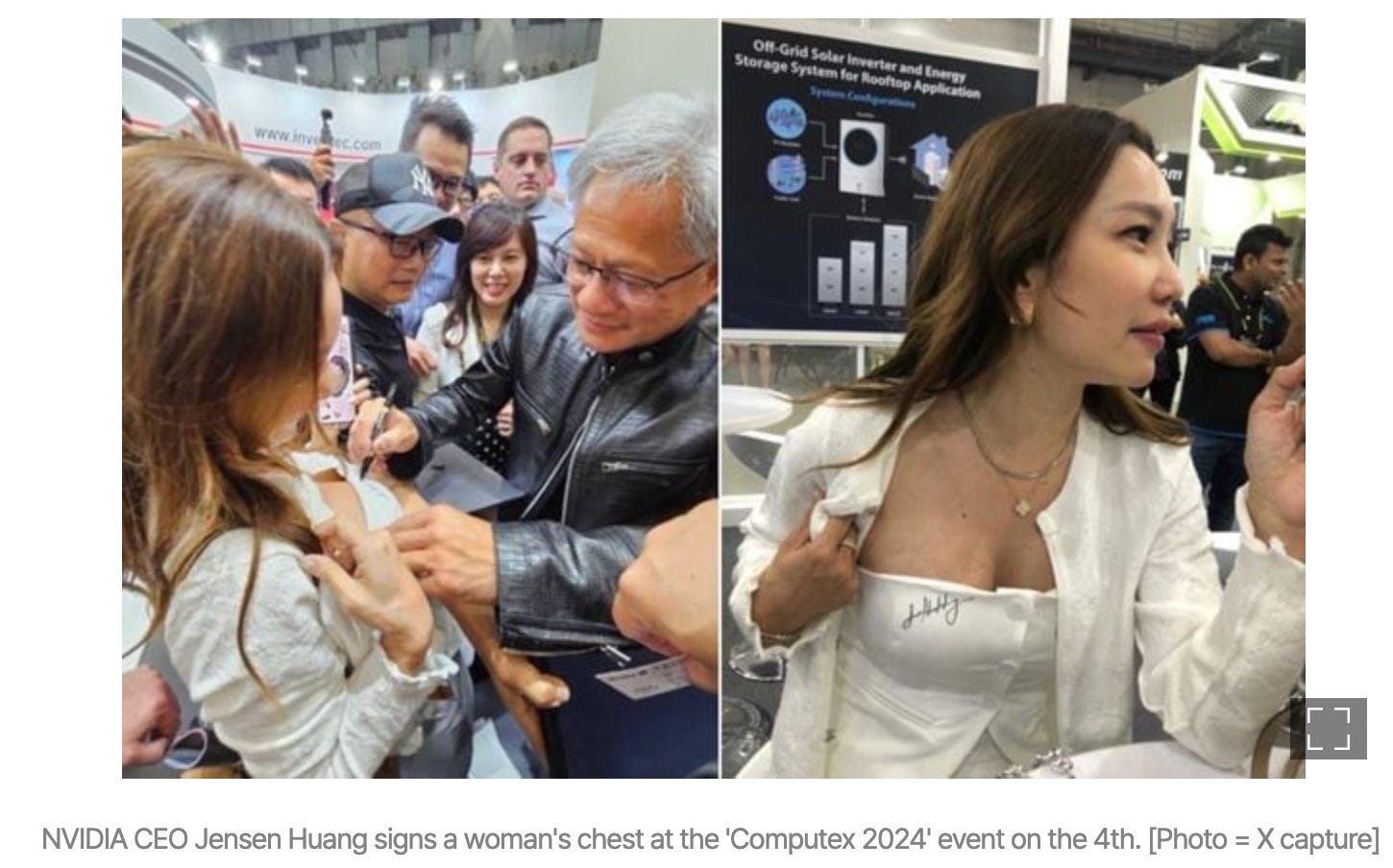
Though Mr. Huang’s has not stated his paramour’s name, he made the admission of infidelity after reports identified her as Alice Huang. Also known as Huang Le, she is a Chinese citizen who became a senior executive at Megaspeed International, a Singapore-based company that purchases Nvidia processors and supplies AI computing infrastructure.
Megaspeed has reportedly purchased more than $4.8 billion worth of Nvidia chips over two years. The company has drawn scrutiny over allegations that advanced American semiconductors may have been diverted to Chinese customers in violation of U.S. export restrictions. Megaspeed has denied allegations of illegal chip transfers
According to the Financial Times, American intelligence officials have concluded that Alice Huang was indeed recruited by China's Ministry of State Security, the country's main civilian intelligence agency, to collect information about Jensen Huang and potentially influence Nvidia's business dealings with China.
The New York Times reported that a classified memorandum, directed by Secretary of State Marco Rubio, circulated among senior Trump administration officials in the spring of 2026. The memo was reportedly based on electronic surveillance and described Huang's relationship with the suspected intelligence operative. These assessments have not been independently acknowledged to the public.
The circumstances in which Jensen Huang and Alice Huang met remain unclear. Photographs reportedly show them together at an industry conference in Taipei in June 2024. During the Computex technology exhibition in May 2025, they were captured on video together at a restaurant gathering hosted by Jensen Huang.
Footage reportedly shows Alice Huang kissing the Nvidia executive on the cheek, touching his lower back, and later departing in the same automobile. These encounters became highly significant after American intelligence reportedly identified her as a suspected Chinese operative.
Yesterday, November 8, Huang acknowledged his marital infidelity in an internal communication to Nvidia employees, declaring: “I was unfaithful to my wife.” He apologized to his family and colleagues. Nvidia simultaneously announced that independent directors, assisted by outside legal counsel, would investigate whether its chief executive had been targeted by foreign intelligence. The company declared it had no reason to believe its confidential information or American national security had been compromised, and no evidence of such as compromise has been reported. The Chinese government denies the espionage allegations, describing them as an attempt to discredit Beijing.
Huang has been an influential advocate of relaxing American restrictions on semiconductor exports to China, arguing that continued access to the Chinese market serves Nvidia’s commercial interests and helps preserve American technological leadership. His lobbying is said to have persuaded President Trump to permit certain advanced Nvidia processors to be sold to China.
Mr. Huang’s troubles reminded me of Neil Bush’s misadventures in China. In November 2003, it was revealed that Mr. Bush—the younger brother of President George W. Bush and son of former President George H. W. Bush— had possibly been honey-trapped while traveling on business in Hong Kong and Thailand in the late 1990s.
In Mr. Bush’s case, the possible honeytrap was decidedly unsophisticated. Attractive young women simply showed up at his hotel-room door, knocked, and said they were there to show him a good time.
He stated in a deposition during his 2003 divorce that these encounters happened on several occasions, that he did not know the women, and that he had not paid them.

The attorney taking the deposition expressed astonishment at the circumstances. Bush himself acknowledged that the encounters were highly unusual. Asked whether the women were prostitutes, he replied that he did not know.
The revelations drew special attention because of Bush’s lucrative business relationship with Grace Semiconductor Manufacturing Corporation, a Shanghai-based semiconductor manufacturer established in 2000. One of its founders was Jiang Mianheng, the son of Jiang Zemin, who served as general secretary of the Chinese Communist Party from 1989 to 2002 and president of China from 1993 to 2003.
Per a consulting agreement signed in August 2002, Bush was entitled to receive $2 million in company stock over five years, plus $10,000 for attending each board meeting. During his deposition, Bush acknowledged he had no training in semiconductor technology. Critical observers wondered if he received this generous compensation for his (non) expertise or for his exceptionally strong political connections.
The circumstances raised the possibility that Bush had been honey-trapped by Chinese intelligence for the purpose of obtaining compromising information or leverage over the US President’s brother, though these suspicions were never verified as fact—at least not publicly.
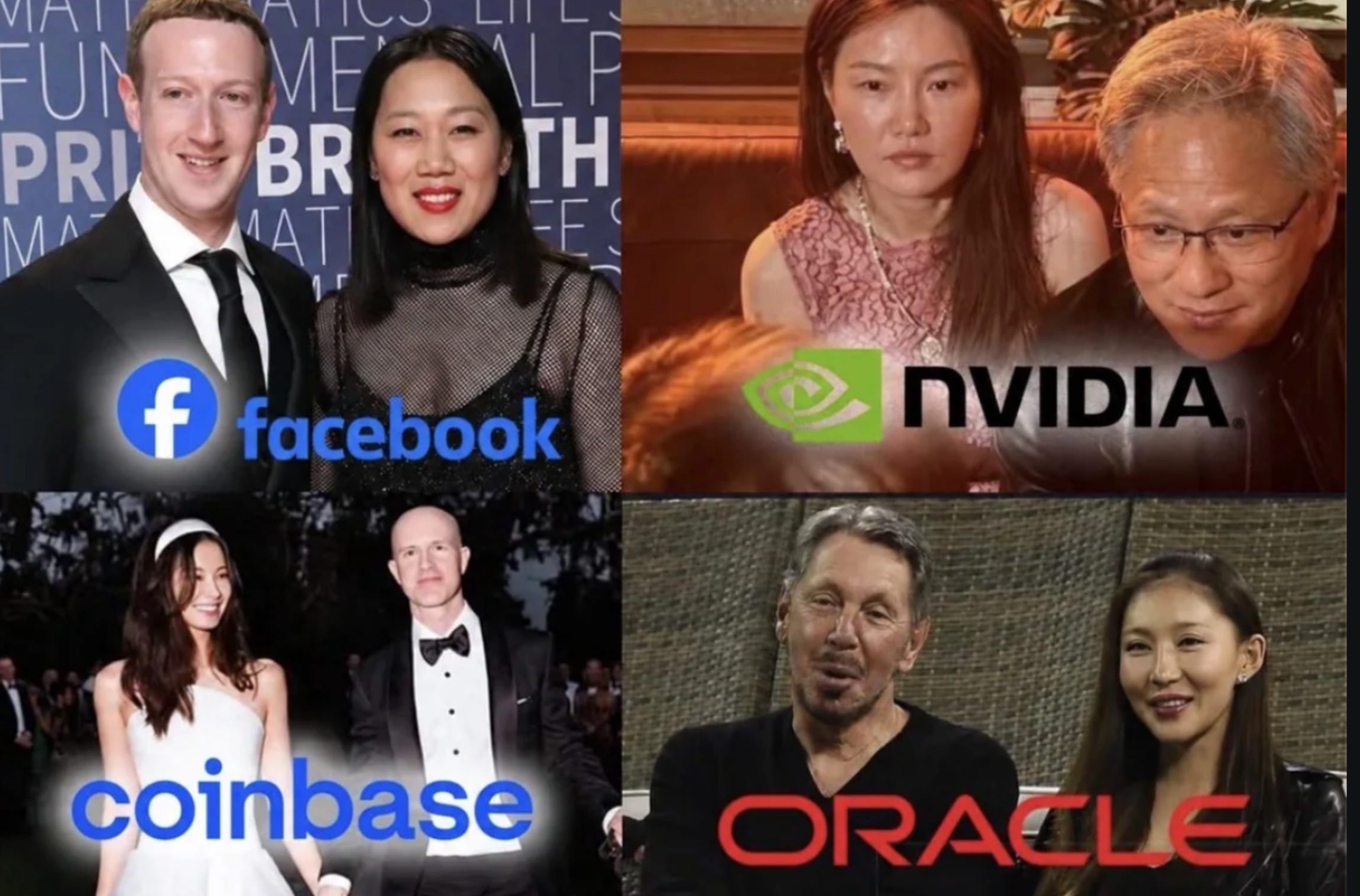
Like Neil Bush, Mark Zuckerberg, Brian Armstrong, and Larry Ellison, Huang has discovered the many attractive qualities of Chinese women.
The story has inspired me to write a potboiler novel (working title Chips & Honey) about the intersection of sexual desire, power, exploitation, and the quest for world AI dominance.
I’m finding creative inspiration in David Bowie’s dark 1983 hit, “Little China Girl”—the sort of super weird and disturbing song and video that only Mr. Bowie could invent and get away with.
Stevie Ray Vaughan’s guitar work—especially the opening guitar riff (a dyad melody played over an E minor harmony)—strikes me as wonderfully creative.
Long term question answered. How do novelists choose the subject of their next work? What are their plans for research? Of course, all the old jokes about writers apply. "True Crime writer visits China. Cannot attract spies. Joins Zen monastery. Now writing book about the Heart Sutra."
My experience was quite the opposite of Huang's, in context and content. I had an intense half hour conversation with a young Chinese lady in one of my dispute resolution classes. (Religion and dispute resolution.) We connected. She was powerfully intent in her desire to learn the faith. A spy tapping into the heavenly realm business. The entire class just went quiet and sat back as we had a beautiful exchange. Only later did I figure out who she was... hope the information had at least a modicum of positive influence on the Party.
Just wondering: Does Nvidia manufacture it's own chips? Of, does it just design them? I was under the impression TMSC manufactures them for Nvidia.