


In his masterpiece, The World as Will and Representation, Schopenhauer observed:
Das Leben schwingt also, wie ein Pendel, hin und her, zwischen dem Schmerz und der Langeweile.
Life swings like a pendulum back and forth between pain and boredom.
Schopenhauer didn’t believe this to be an accident, but an expression of human nature. When things are going well for us — when we are not having to contend with scarcity and adversity — we grow bored.
In our state of boredom, we intentionally pick a fight to create some excitement and drama. However, we usually get a bigger fight than we bargained for and are distressed by it.
In our state of distress, we seek peace and harmony, and return to a situation in which everything is going well, at which point we get bored and restart the cycle.
I sometimes wonder if Schopenhauer’s model could explain why the great nations of Europe—enjoying the greatest period of peace and prosperity in history (the “Belle Epoque” of 1871 to 1914)—made the strange decision to wage the First World War, thereby killing approximately 20 million young men.
Over 100,000 books have been written about the First World War, but no historian has ever explained why exactly the great powers decided to undertake such a destructive endeavor. I wonder if the decision makers in the various courts of Europe were simply bored with peace and prosperity.
In his biography of Hitler, the German journalist and historian, Joachim Fest, mentions a remark that Hitler made to one of his comrades—I think it was Ernst Roehm. If I recall correctly, he said:
This pleasant beer garden mood that I’m now seeing is intolerable, and it will certainly result in a general lack of resolve and purpose. We must overcome it.
Ernst Roehm was openly gay and I suspect that Hitler was a repressed homosexual. Both men were animated with enormous aggression, and were apparently always seeking targets on which to unload it. After Hitler decided to get rid of Roehm and his SA in the Night of the Long Knives, Roehm was put in jail, handed a pistol, and told to kill himself. He calmly replied, “If I am to be killed, let Adolf do it himself.”
Criminal psychologists have remarked that psychopaths cannot handle routine and monotony, and feel a strong compulsion to relieve it by thrill seeking.
While men may seek drama in brawling, gambling, and criminal activity, some women seek to relieve their boredom by creating interpersonal drama. Over the years I have known a few fun and exciting women who couldn’t handle more than a few weeks of peace. I learned to recognize that two months of uninterrupted harmony would invariably result in a perilous drama as psychologically dangerous as Perseus being called upon to slay the Medusa.
As Shelley described the Medusa.
Tis the tempestuous loveliness of terror;
For from the serpents gleams a brazen glare
Kindled by that inextricable error,
Which makes a thrilling vapour of the air
Become a … and ever-shifting mirror
Of all the beauty and the terror there—
A woman's countenance, with serpent-locks,
Gazing in death on Heaven from those wet rocks.
Medusa was dangerous as hell, but she wasn’t boring.
The English word boredom derives from “boring tool” (a drill), suggesting a dull, repetitive, and slow action. The German word “Langeweile” literally means “long while,” expressing the perception that time moves painfully slow when we are bored.
When prosperity removes external threats, a large portion of the population—especially young people—seek stimulation in political extremism, bouts of social-media outrage, interpersonal melodrama, and an array of other self-created crises. Conflict becomes a substitute for purpose.
When I was a thrill-seeking teenager, I occasionally asked my grandfather about his experiences fighting the Germans in Italy during the Second World War.
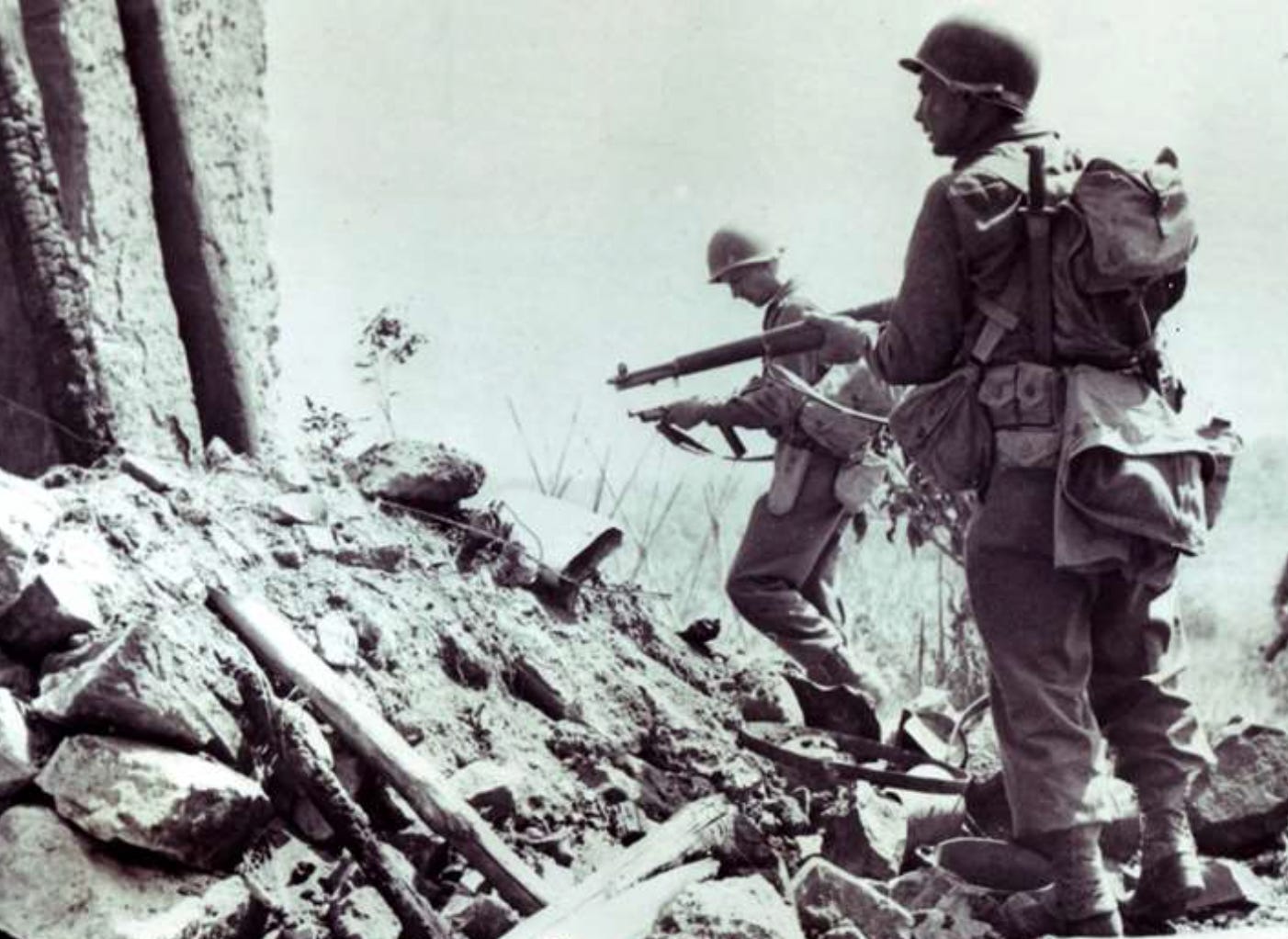
He was a brave soldier who won a Distinguished Service Cross, a Silver Star, a Bronze Star, and two Purple Hearts. Back then I marveled that he’d been such a man of action in his youth, because his life of quiet routine, working in a Dallas bank and playing golf or sailing his little boat on the weekends, struck me as incredibly boring.
It was only much later in life that I understood how grateful he was to make it back from the war alive, to sleep in a comfortable bed with his wife instead of on the ground in Italy, and to no longer be shot at.
You ask: 'Why did the great nations of Europe—enjoying the greatest period of peace and prosperity in history (the “Belle Epoque” of 1871 to 1914)—made the strange decision to wage the First World War, thereby killing approximately 20 million young men?"
The people of the great nations didn't chose WWI. It was a way for the sociopathic 0.1% to make even more money and gain even more power.
Bored? Most leaders wage war because they're evil. They have no sense of real meaning in their lives, and thrive on the feelings of power that come from controlling and hurting others. They feed off of the strife and pain they cause-- that's their energy source.