


Yesterday I drove from Edinburgh to Inverness, stopping at Urquhart Castle on Loch Ness along the way.

From the castle I enjoyed a panoramic view of the Loch, and when the sun peeked out of the clouds, I saw and was able to photograph the Loch Ness monster. He’s much bigger than I ever imagined.

As thrilled as I was to see the monster, the closer I got to Inverness, the more my thoughts turned to Macbeth.
I’ve long believed that Macbeth is a far more terrifying play than Richard III, Othello, or Hamlet. While Richard and Iago are plainly and self-consciously malevolent, and Hamlet is confused, the characters of Macbeth and his wife are a dreadful mystery.
Shakespeare apparently wrote the play in 1606 to flatter his new patron, King James I, following Elizabeth’s death in 1603.
King James traced his lineage back to Banquo. Shakespeare altered historical accounts to present Banquo as a noble, heroic ancestor of the Stuart line, while including a vision of future kings descending from Banquo. James I was fascinated by witchcraft and wrote a treatise on the subject, Daemonologie, in 1597. The Weird Sisters were influenced by James’s reflections on witches.
The play also seems to endorse the concept of the Divine Right—the belief that monarchs are chosen by God. Macbeth’s treason and murder of King Duncan ruptures the natural order, acting as a direct warning against overthrowing a divinely appointed king—an apt theme after the 1605 Gunpowder Plot against James.
Such is the straightforward political background. The psychology of the play is murky in the extreme. Macbeth’s journey from brave patriot to treasonous tyrant strikes me as the ultimate psychological horror story.
The play opens with Macbeth defeating the rebel Macdonwald — who has aligned himself with an invading Norwegian force — on a battlefield in Firth. Macdonwald is thus a traitor against King Duncan, and Macbeth destroys him in brutal combat—ripping him “from the nave to the chops” (from the navel to the jaw) and fixing his head upon the battlements.
Macbeth’s violence reinforces the established order, earning him praise as “brave Macbeth” and “Bellona’s bridegroom”—that is, the husband of the Roman goddess of war. His success affirms a clear moral structure in which loyalty is rewarded and betrayal punished with death. And yet, it’s a bit unsettling how he is exhilarated by the violence of war.
From Firth, Macbeth heads home to his castle in Inverness, stopping at King Duncan’s castle in Forres along the away.
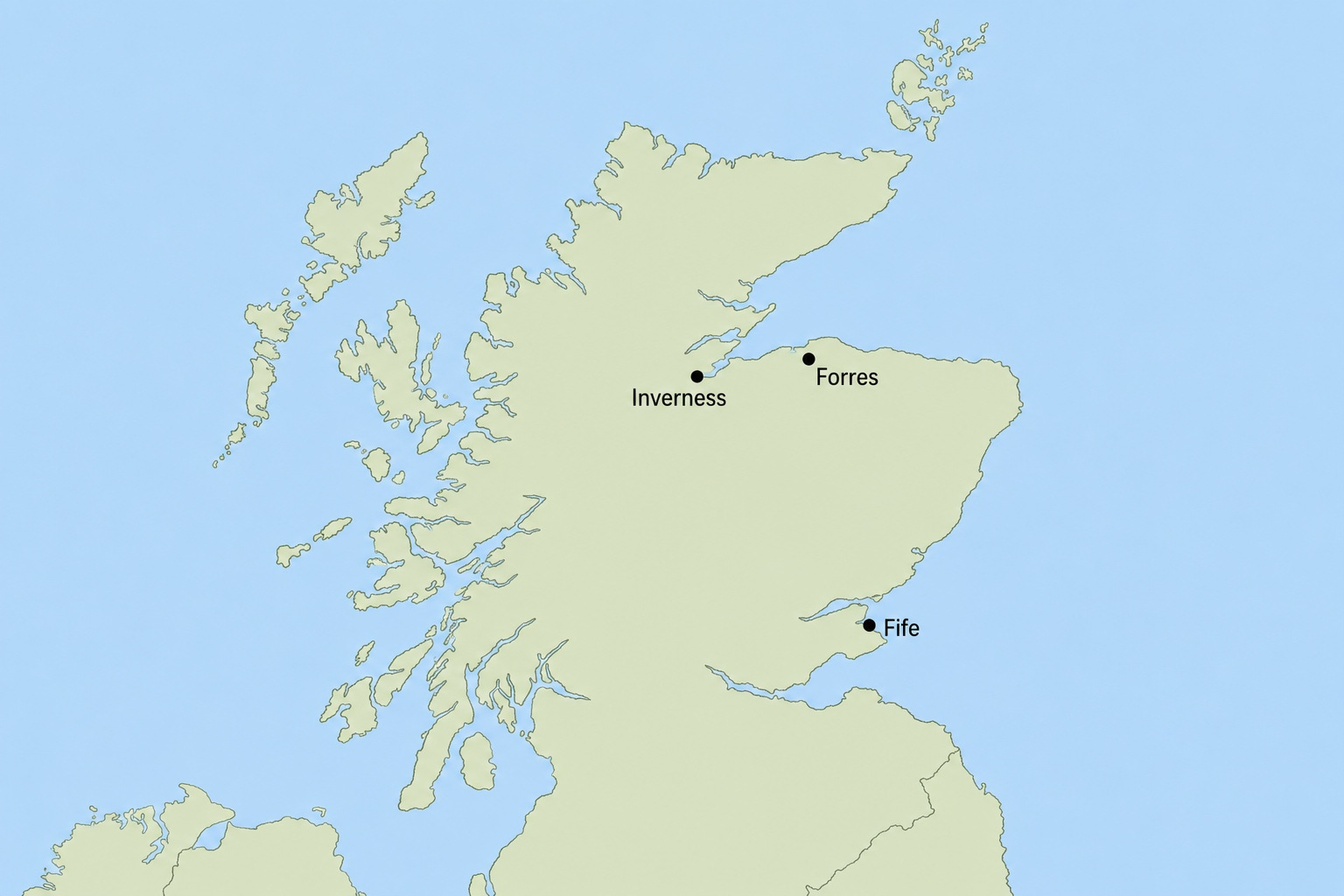
Outside of Forres, he encounters the “Weird Sisters” on the heath. Their prophecy—“All hail, Macbeth! Hail to thee, Thane of Glamis! ... Thane of Cawdor! ... that shalt be king hereafter!”—seems to catalyze a latent desire in Macbeth.
His immediate reaction is a combination of thrill and terror: “Why do I yield to that suggestion / Whose horrid image doth unfix my hair / And make my seated heart knock at my ribs?”
The witches don’t create his ambition; they give voice to a “buried nerve of desire” —especially as he has just proven his valor defending Duncan’s throne while Duncan stayed safe behind the lines.
When the title of Thane of Cawdor is conferred, the prophecy gains credibility, focusing Macbeth’s mind on the final prediction (“king hereafter”).
This, it seems to me, is a vivid expression of Shakespeare’s understanding of how a man’s apparent virtue can be highly deceiving. At the mere suggestion of some spooky old women, Macbeth’s thoughts turn from those of a loyal warrior to that of a treasonous murderer. The supernatural equivocation—“fair is foul, and foul is fair”—mirrors his lack of a reliable moral compass.
From here, Macbeth descends into regicide. When Duncan visits him at his castle in Inverness, he initially wavers, recognizing the “double trust” he owes Duncan as kinsman, subject, and host. In his soliloquy, he admits he has “no spur / To prick the sides of [his] intent, but only / Vaulting ambition.” This is where his wife enters the picture.
Lady Macbeth is the driving force of the play, spurring Macbeth from hesitation to action. Upon reading his letter about the witches, she swings into action, fearing his nature is “too full o’ th’ milk of human kindness” to snatch the crown.
She invokes spirits to “unsex” her and fill her with cruelty. She then plays her most devastating card against her husband—that is, she questions his manhood (“Art thou afeard / To be the same in thine own act and valor / As thou art in desire?”). In response to his getting wobbly about his initial oath to take out Duncan, she offers a horrifying image.
I have given suck, and know / How tender ‘tis to love the babe that milks me: / I would, while it was smiling in my face, / Have plucked my nipple from his boneless gums, / And dashed the brains out, had I so sworn as you / Have done to this.
When I first read Macbeth in high school, I imagined Lady Macbeth to look like a cruel and cold woman. Now it occurs to me that maybe she was pretty, sweet, and delicate looking, as these are the qualities that men find compelling and confusing.

Not only is her bold claim about infanticide horrifying; it also raises the question of what happened to her child, as it becomes clear that she and Macbeth have none.
In Act 3, Scene 1, Macbeth laments that he has no true successor. He refers to the witches' prophecy granting him a "barren sceptre" and a "fruitless crown," fearing he murdered King Duncan simply to pass the throne to his rival, Banquo.
Does Lady Macbeth’s childlessness explain her ferocious ambition?
It’s easy to understand why Macbeth has been subjected to so much modern psychosexual theory. Lady Macbeth is the archetypal wife who is unsatisfied with her husband, and tries to compensate for her lack of fulfillment by driving him to acquire wealth and power.
One wonders if Macbeth is—despite his prowess on the battlefield—a disappointment in the bedroom, perhaps even impotent. Maybe Lady Macbeth blames her childlessness on him.
At any rate, she succeeds in reframing the murder not as evil, but as a heroic expression of elemental manhood.
Macbeth’s own motives remain ill-defined. Unlike Richard III, he articulates little compelling desire for the throne. He speaks of “vaulting ambition” in an abstract way. It’s the witches and his wife who whip him into action.
This, it seems to me, is what is so disturbing about the play in which evil arises not from a clear desire, but from a feeling of emptiness. Even Lady Macbeth is ultimately overwhelmed with guilt and gets no satisfaction from seeing her ambition fulfilled.
Thus, in the final analysis, Macbeth is Shakespeare’s darkest and most despairing of plays—as dreary as a cold and cloudy day in Scotland in June.
I attended many Shakespeare play productions in Stratford CT as a child, but could hardly understand a word of what was being said, and could hardly glean anything of what was actually going on in those very great & talented productions in Stratford. It's fun to know more about Shakespeare and read an expert analysis.
So well said John and it seems to cover many people, especially now:
'This, it seems to me, is what is so disturbing about the play in which evil arises not from a clear desire, but from a feeling of emptiness.'
That picture of the Loch Ness Monster is amazing!