


Author’s Note: I initially wrote the following essay about 18 months ago. Recent reader comments inspired me to repost it with a few modifications.
When I was studying philosophy in graduate school, my favorite class was epistemology, or how we know what we think we know.
As philosophers from Aristotle to Wittgenstein have observed, “knowing” something to be true isn’t as easy to establish as we often assume it to be. A famous example of how hard it can be to nail down the reality of the physical world was the longstanding argument between Albert Einstein and Niehls Bohr whether quantum mechanics is a complete account of physical reality, or only an incomplete statistical tool. To this day, their argument has never been entirely resolved, though the weight of opinion has shifted to favoring Bohr’s intepretation.
The uncertainty of things is especially true in the realm of so-called “medical science.” Many make the unexamined assumption that “medical science” is akin to Newtonian mechanics, but this is a gross misconception. The causes of sickness and health—both in individuals and in large populations—are far more complex and multifactorial than than the behavior of solid bodies moving in space.
Consider that while reasonable people often debate about health and disease, none would debate about whether jumping off twenty-story building onto concrete would result in severe injury or death. A complex situation is inevitably riddled with ambiguity and uncertain outcomes and therefore becomes a subject of opposing interpretations and debate.
During the Covid pandemic, vaccine advocates often proclaimed that they “follow the science,” as though science was a settled entity in their possession. And yet, even a superficial study of the history of medicine teaches us that every generation has overestimated its understanding of the human body and disease. Only an arrogant fool would believe that scientific understanding has culminated with his generation.
Proper scientific inquiry has always given us glimpses into how much we don't know. As Oliver Wendell Holmes Sr. put it, “Science is the topography of ignorance. From a few elevated points we triangulate vast spaces, inclosing infinite unknown details.”
I often think about Holme’s statement when some of my readers tell me “Viruses don’t exist!”
Note that this is a categorical claim that a basic concept in the study of disease is a fiction—a figment of the human imagination.
The claim is NOT that the role of a contagious virus as a causative agent is often overstated, and that other factors (such as the host’s health and fitness) may play a greater role in disease development. Nor are these readers claiming that the attribution of a given disease to viral causes may be unfounded.
The latter argument was made by the molecular biologist Peter Duesberg, who proposed that the disease syndrome called AIDS is not caused by an agent called human immunodeficiency virus (HIV), detected by the presence of antibodies against HIV found in the blood of AIDS patients.
Note that Duesberg’s argument is not the same as the categorical claim that “viruses don’t exist.” Duesberg was a molecular biologist and virologist who is credited with identifiying the segmentation of the influenza virus genome in 1968 and co-discovering the first viral oncogene (the src gene) using retroviruses in 1970.
The claim that “Viruses don’t exist!” raises the following pressing question.
Why, around the turn of the 20th century, did guys all over Europe and the United States start believing in the existence of submicroscopic agents that cause diseases?
This is a huge and fascinating subject about which one could write thousands of pages. My intention with this essay is to offer a conceptual framework for readers to start thinking about this fascinating subject in a less categorical, either/or way.
Prior to the end of the 19th century, the word “virus” was used in the ancient Latin meaning of the word—that is, a “poison” in the form of a slimy fluid that seemed to have contagious, disease causing properties. This was the meaning of the word as Edward Jenner used it to describe the fluid that oozes out of smallpox blisters.
Likewise, Pasteur used “virus” in the old sense when he spoke about the rabies “virus” found in the saliva of rabid animals. If humans or animals were inoculated with this “poison,” they too frequently developed the same disease symptoms.
With the development of bacteriology and of ever more powerful microscopes during the last 20 years of the 19th century, infectious disease researchers began to wonder if there could be something in fluids associated with disease that could be much smaller than a bacterium—that is, so small that it cannot be seen with even the most powerful optical microscope.
During the first 30 years of the 20th century, lab researchers used porcelain filters to filter fluids associated with diseases. The object was to remove any particles that would be visible under the most powerful microscope they could lay their hands on.
They then injected this ultra-filtered fluid into healthy lab animals, and they frequently observed that such animals developed the same disease symptoms as the animal from which the fluid was taken. Such experiments seemed to confirm the perception that there was a disease-causing agent in the fluid that was much smaller than a bacterium.
In a seminal 1926 lecture and in a 1927 paper, the American infectious disease researcher, Thomas M. Rivers, proposed that such “filterable agents” were particles that appeared “to be obligate parasites in the sense that their reproduction is dependent on living cells.”
To understand why this is a compelling idea, consider the following salacious thought experiment.
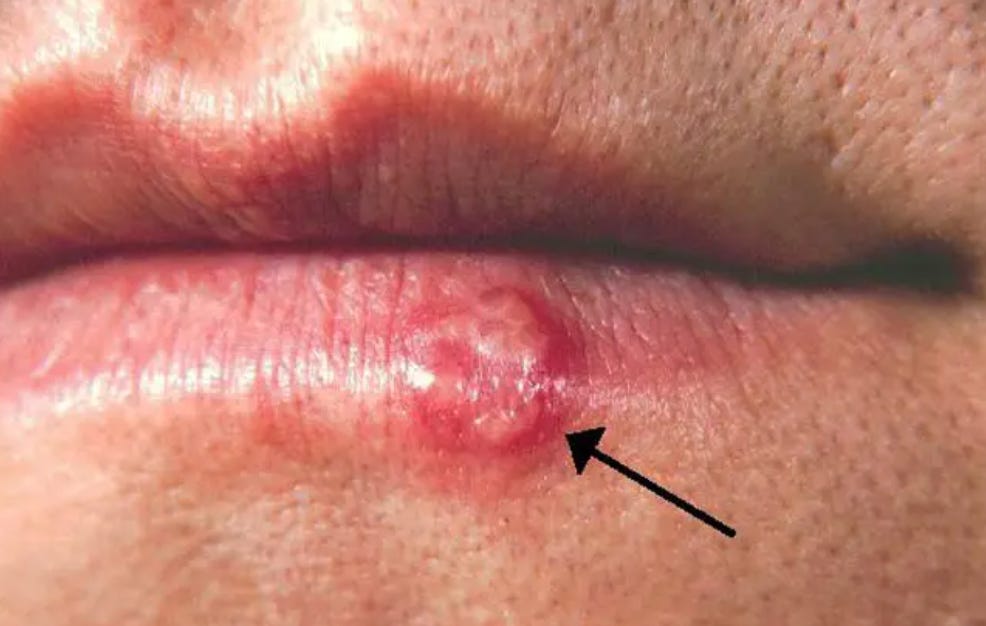
A married man goes to Las Vegas for a business conference. In the evening he gets drunk and has a sexual encounter with a strange woman. Though his vision and judgement are blurred, he vaguely notices a small red blister in her genital region. A few days later, he notices a similar red blister in his genital region, and he also notices that it’s very painful.
He goes to the doctor, who diagnoses the painful red blister as a symptom of a disease call genital herpes, which the doctor claims is caused by the herpes simplex virus, or HSV, a variant of which can cause blisters around the lips.
A bit of historical research indicates that this virus was first isolated and characterized in the modern sense of the word by a German virologist named Löwenstein, who published a paper in 1919 titled Aetiologische Untersuchungen über den fieberhaften Herpes—“Etiological studies on febrile herpes.”
Surveying the literature since Löwenstein, the man notices that hundreds of researchers have, over the span of a century, performed lab research on what they believed to be the infectious agent that Löwenstein believed he isolated and described in 1919.
The man supposes it’s possible that all of these people dedicated their formal education and professional lives to investigating a fiction—a mere figment of Löwenstein’s imagination—and that his rash of red blisters was caused by something other than this purported “herpes simplex virus.”
However, the man now has a practical problem—namely, what does he tell his wife? By a strange twist of fate, his wife is an extremely intelligent and curious woman who has recently drawn the conclusion that viruses don’t exist.
Over dinner one night, she ridicules “all the fools out there that cling to the fiction that ‘pathogenic viruses’ exist.
“What do you suppose was the cause of diseases observed like smallpox, rabies, yellow fever, measles, mumps, rubella, influenza, the common cold, and COVID-19?” he asks (stopping short of asking about genital herpes).
She sort of offers an alternative hypothesis that strikes him as vague and undefined, and he is puzzled by the strength of her conviction. On the other hand, he considers that—given his current circumstances—his wife’s conviction seems to offer him a practical advantage, so he contemplates not telling her about his condition.
He thinks perhaps he could just keep his infidelity to himself and hope that his prescription of “antiviral” medication will quickly and effectively suppress the red blisters from ever erupting again.
However, the man considers that, in addition to being dishonest, this approach has a practical disadvantage, because his doctor tells him that, even with the antiviral medication, there is still a risk that he will transmit the “HSV” to his wife.
After agonizing about it for a couple of days, the man decides to confess the entire disaster. After her initial anger at the betrayal subsides, she deliberates whether to divorce her husband or to try to forgive him and to remain in the marriage. After agonizing about it, she decides to try to forgive her husband and to remain married to him.
However, now she has to decide what to believe—and what practical steps to take—regarding his “HSV diagnosis.”
IF pathogenic viruses don’t exist—a proposition she believes with great conviction—then she doesn’t have to worry about it.
But then she is struck by the dreadful thought: “But what if this virus—this so-called herpes simplex virus—does exist? What if it is the agent of this disease that could be transmitted to me and cause me to suffer this very unpleasant disease?”
I mention this hypothetical scenario as an illustrative example that what we describe as “knowledge” may be characterized an explanatory model that has practical, real-life utility, even if we cannot be certain it precisely and entirely corresponds to the objective reality of the disease and its causes.
In the case of the painful, red blisters, the concept of ‘herpes simplex virus’ as the submicroscopic causative agent seems to have significant explanatory value. Ignoring this explanation does not seem like a rational option.
Here I would like to state that this essay is not meant to be a thorough explication of the entire field of virology. Many readers will note that the essay contains nothing about the related fields of serology, viral culturing, electron microscopy, and molecular biology/PCR analysis.
My intention with this brief essay is to give the reader a specific, real life example of why the concept of a virus as a causative agent of specific disease symptoms is a useful explanatory model.
POSTSCRIPT: Reviewing original reader comments, I saw that many interpreted my essay as an attempt to adumbrate all arguments for the existence of all viruses, which astonished me. When I composed the essay, I was under the impression that I was offering an account of why many researchers at the turn of the 20th century—and why a hypothetical unfaithful husband—would see practical, explanatory value in the concept of virus as a causative agent of disease.
I noted that none of the sharp critics of the essay address the specific example of the unfaithful husband’s experience with red blisters. Were they in his shoes, what causative agent would they hypothesize for their condition?
The discussion about viruses strikes me as further evidence that humans are very attracted to categorical (either-or) claims, and have an aversion to nuance, ambiguity, and uncertainty.
It reminds me of my longstanding perception that atheists are every bit as dogmatic and metaphysical in their worldview as the most faithful believer in God.
AUTHOR’S NOTE: If you found this essay interesting, please order a copy of our book, Vaccines: Mythology, Ideology, and Reality, which includes chapters on the history of bacteriology and virology.

We hate to admit we don't know stuff. One can no more prove viruses don't exist than that they do. It is closer to the truth to say that there are significant problems with the virus theory and with the no virus theory. It seems likely that once again, reality has escaped human's ability to pin it down. "There are more things in heaven and earth, Horatio,
Than are dreamt of in your philosophy" once observed a certain great writer and observer of human foibles.
John, thanks for taking on this subject. Let me add some rebuttal here to drive the conversation.
The biggest angle here for that statement “viruses don’t exist” is that NO VIRUS has even been isolated. It wasn’t discussed here in this article, but the “isolation practice” PRODUCES what people think at viruses. Remove the isolation practice, then there is no virus. Dr. Stephan Lanka has been the largest voice calling this out and I detail that here: https://unorthodoxy.substack.com/p/why-disease-causing-viruses-are-pseudoscience-93c
The other angle for “viruses do not exist” simply means that’s the concept of “viral particles” causing diseases is a fallacy. That’s the key here: “causing diseases.” What we’ve misnomered and call viruses are actually “messengers” — sharing information from one human to another.
However, due to modern science and looking to profitize off a scandemic, when the measles outbreak of the 50s occurred, this is when the “viral claim” became mainstream thanks to the work of Dr. John Enders: https://unorthodoxy.substack.com/p/why-disease-causing-viruses-are-pseudoscience
However, again, thanks to the flaw of the isolation practice, there is no such thing of a virus, and what we’re seeing in situations like chickenpox, measles, etc, is the passing of information from human to human — hence why we had chickenpox parties and these conditions were not considered deadly but healthy. Again, viruses do not causes diseases.
Regarding the HSV scenario, there’s actually an article that actually debunks that scenario too as to why it wasn’t a virus. Similarity to HIV, Jamie Andres has done phenomenal work on that condition and others on why these “viruses don’t exist.”
I placed a few links up there to explain my rationale, but hoping this clears up the space on why “viruses don’t exist.”