


By Peter A. McCullough, MD, MPH
One of the most common post-pandemic syndromes I encounter in the office is mast-cell activation syndrome (MCAS).
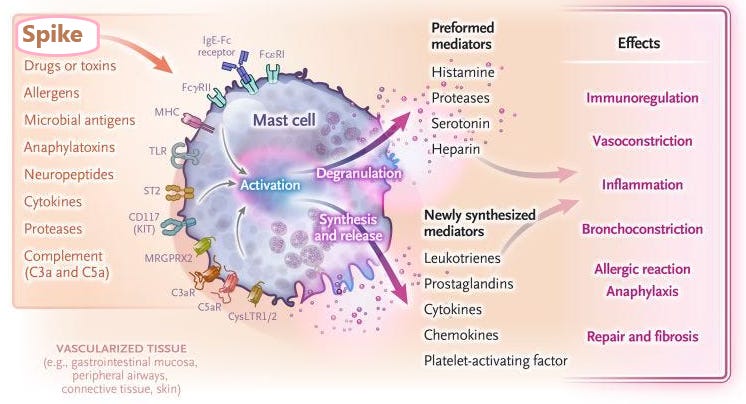
The ubiquitous nature of SARS-CoV-2 Spike protein and its ability to trigger mast cells is fundamental to understanding how long-COVID and COVID-19 vaccination can make a victim far more sensitive to many different environmental toxins (Lyme, mold, etc).
🧬 Spike Protein and Mast Cell Sensitization: The MCAS Connection We’re Finally Acknowledging

🔬 The Mechanism: How Spike Protein Hijacks Mast Cells and Basophils
Mast cells and basophils are the body’s frontline sentinels — granular leukocytes packed with histamine, tryptase, heparin, and a cocktail of inflammatory mediators. Under normal conditions, they degranulate in response to genuine threats. But the SARS-CoV-2 spike protein — whether from natural infection or the lipid-nanoparticle-delivered products — fundamentally alters this threshold.
The spike protein’s S1 subunit binds not only to ACE2 receptors but also to heparan sulfate proteoglycans abundantly expressed on mast cell surfaces. This primes the mast cell through several pathways:
Surface-bound spike protein acts as a persistent antigenic irritant, clustering IgE receptors (FcεRI) even without allergen cross-linking, lowering the activation threshold dramatically.
Intracellular spike protein — documented in circulating monocytes and tissue-resident immune cells months after exposure — interacts with mitochondrial membranes and the NLRP3 inflammasome, keeping mast cells in a state of chronic, low-grade activation.
The spike protein’s fusion peptide domain directly triggers MRGPRX2, the Mas-related G protein-coupled receptor that mediates pseudo-allergic degranulation independent of IgE. This explains why patients with no prior allergic history suddenly develop multi-system reactivity.
The result is a mast cell that’s hair-triggered — releasing histamine, prostaglandins, leukotrienes, and cytokines in response to stimuli that previously caused no reaction: temperature changes, foods, fragrances, exercise, emotional stress.
🩺 The Clinical Picture
Mast Cell Activation Syndrome presents with protean symptoms because mast cells reside in virtually every vascularized tissue. Skin flushing and urticaria. GI bloating, diarrhea, and unpredictable food intolerances. Tachycardia, blood pressure instability, presyncope. Brain fog, headache, anxiety that feels “chemical” rather than psychological. Throat tightness without bronchoconstriction. The spike protein’s dual residence — anchored externally AND internalized — means standard antihistamines often fail, blocking downstream receptors while upstream degranulation continues unchecked.

💊 The Solution: HistaCalm from The Wellness Company
The Wellness Company developed HistaCalm specifically for this pathophysiology. Rather than simply competing for histamine receptors, HistaCalm takes a multi-target approach to mast cell stabilization:
Component Mechanism Quercetin Inhibits FcεRI-mediated degranulation; stabilizes mast cell membranes; downregulates leukotriene synthesis Luteolin Suppresses MRGPRX2-mediated pseudo-allergic activation; crosses the blood-brain barrier to address neuroinflammation Pine Bark Extract Potent antioxidant (OPCs); reduces histamine release; stabilizes capillary integrity against spike-induced vascular permeability Butterbur Natural leukotriene inhibitor and mast cell stabilizer; well-studied for allergic rhinitis via petasin-mediated suppression of histamine and cysteinyl leukotrienes Apigenin Flavonoid that inhibits IgE-mediated degranulation; suppresses CD40 ligand expression on mast cells; anxiolytic properties through GABAergic modulation — directly relevant to the neuropsychiatric component of MCAS
The formulation addresses both the external spike protein anchored to mast cell surfaces (quercetin, luteolin, and apigenin prevent the clustering that triggers degranulation) and the internalized spike driving chronic inflammasome activation (pine bark extract’s OPCs and butterbur’s anti-leukotriene effects). For the millions navigating post-infection and post-vaccination MCAS, HistaCalm represents a rationally designed intervention targeting the actual mechanism rather than chasing symptoms.
Please subscribe to FOCAL POINTS as a paying ($5 monthly) or founder member so we can continue to bring you the truth. AlterAI may be used to assist in searches, synthesis, and review.
Peter A. McCullough, MD, MPH
Chief Scientific Officer, The Wellness Company
https://www.twc.health/pages/focal-points
📚 References
Theoharides TC, et al. Mast cells and inflammation. Biochim Biophys Acta. 2012;1822(1):21-33.
Afrin LB, et al. Characterization of Mast Cell Activation Syndrome. Am J Med Sci. 2017;353(3):207-215.
McNeil BD, et al. Identification of a mast-cell-specific receptor crucial for pseudo-allergic drug reactions. Nature. 2015;519(7542):237-241.
Weng Z, et al. Quercetin is more effective than cromolyn in blocking human mast cell cytokine release. PLoS One. 2012;7(3):e33805.
Kritas SK, et al. Luteolin inhibits mast cell-mediated stimulation of activated T cells. Int J Immunopathol Pharmacol. 2013;26(1):13-19.
Schapowal A. Butterbur for allergic rhinitis. Phytother Res. 2002;16(5):446-448.
Rohdewald P. Pine bark extract in cardiovascular health. Int J Clin Pharmacol Ther. 2002;40(4):158-168.
Kang OH, et al. Apigenin inhibits mast cell degranulation. Biol Pharm Bull. 2011;34(5):748-753.
HistaCalm — The Wellness Company. https://www.twc.health/products/histacalm
Zhang S, Xu C-L, Wang J, Xiong X, Wang J-H. Spike proteins of coronaviruses activate mast cells for degranulation via stimulating Src/PI3K/AKT/Ca2+ intracellular signaling cascade. J Virol. 2025 May 20;99(5):e0007825. doi: 10.1128/jvi.00078-25. Epub 2025 Apr 30. PMID: 40304504; PMCID: PMC12090780.
"But the SARS-CoV-2 spike protein — whether from natural infection or the lipid-nanoparticle-delivered products — fundamentally alters this threshold."
I pulled this quote from the article to add a reminder. While "natural infection" and by-injection are different ways our bodies become assaulted by spike protein, it's important to keep in mind there is nothing "natural" about the COVID-19 virus. It didn't occur in nature as most viruses do (or did, before gain-of-function ghouls got hold of them). It was cooked up in a lab.
Whenever we discuss the presumed difference between adverse reactions to the virus vs. the injections created to "treat" the virus, it's important to keep in mind that the virus itself is not from nature, and so neither is the infection it delivers.
May the gain-of-function ghouls rot in hell for eternity when their time comes.
I've said it before and I'll say again.. love what your company is doing however you really need to start using genetic testing on patients because so many have genetic SNPs that don't handle a lot of components in a blended supplement stack. Here again many people with MCAS have issues with slow COMT and can't handle any Quercetin.. and many struggle still with Luteolin as well.
(Vitamin C is an excellent stabilizer that's more broadly tolerated than Quercetin. )
The more we're using genetic testing and personalized targeted testing , the more we're finding stacks / blends are difficult to sell because of sensitivity to one or more ingredients.