


A UK Biobank study involving over 470,000 people found that individuals who reported using sunscreen more frequently had substantially higher risk of multiple skin cancers — even after researchers accounted for major confounding factors like age, sex, skin type, tanning ability, sunburn history, sunlamp use, and time spent outdoors.
The findings are worrisome:
• MELANOMA: +292% higher risk (RR = 3.92)
• BASAL CELL CARCINOMA: +140% higher risk (RR = 2.40)
• SQUAMOUS CELL CARCINOMA: +126% higher risk (RR = 2.26)
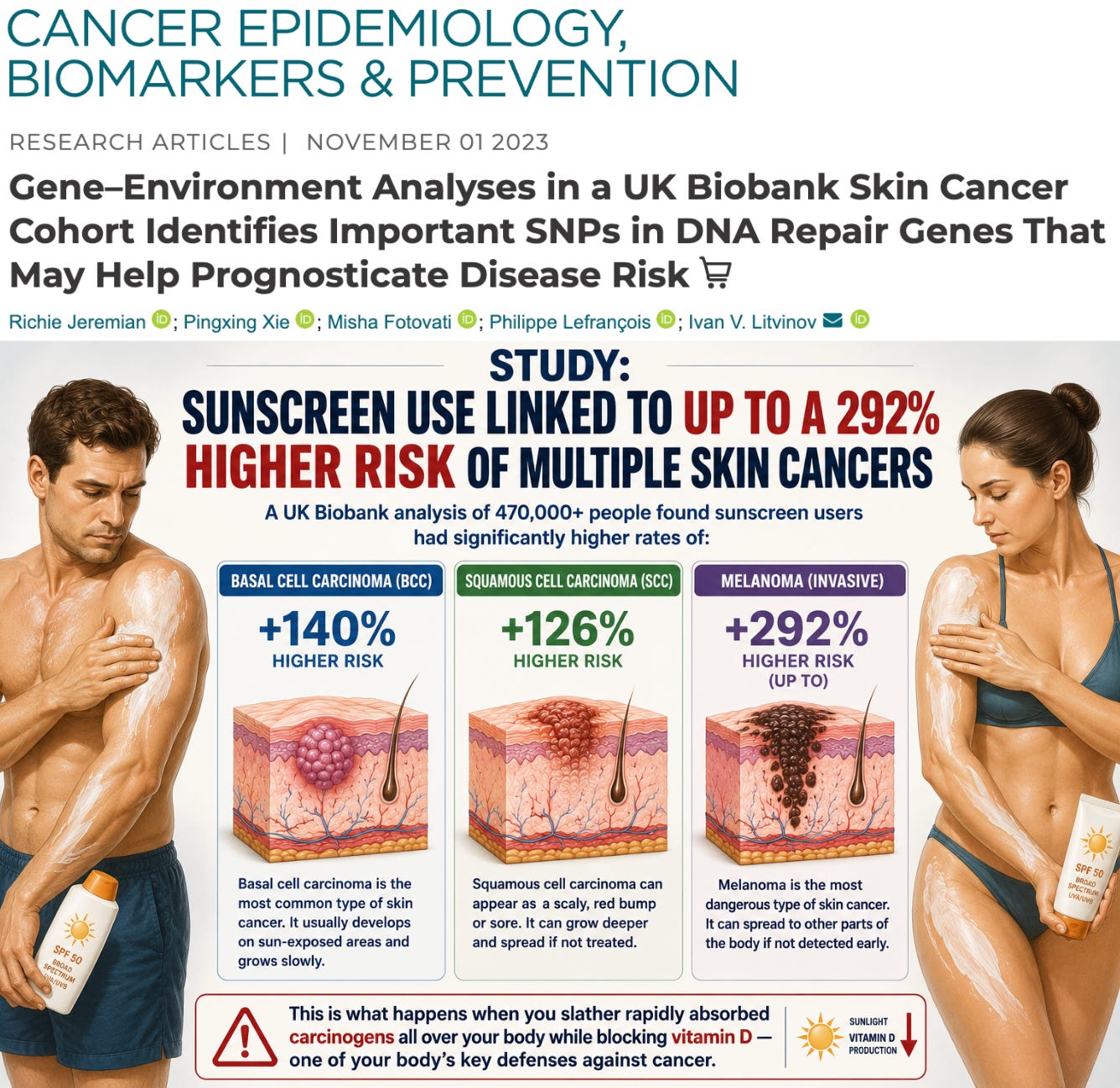
The researchers categorized sun protection habits from “never/rarely” to “always” and found the strongest associations among the most frequent sunscreen users.
In other words: the more sunscreen use reported, the higher the observed skin cancer risk.
This was an observational study, meaning it cannot prove sunscreen directly caused cancer. However, the study was also not a simplistic comparison of random sunscreen users versus non-users. Researchers statistically accounted for many of the biggest known skin cancer risk factors — including skin color, hair color, tanning ability, childhood sunburns, tanning bed exposure, outdoor time, age, and sex.
Even after all of that, the association remained.
Many chemical sunscreens contain hormone disruptors that are rapidly absorbed into the bloodstream, including compounds like oxybenzone, octocrylene, and homosalate.
Some formulations have also been found contaminated with benzene, a known human carcinogen.
And then there is the vitamin D issue. Sunlight is how the human body produces vitamin D, a hormone precursor involved in immune regulation, cellular repair, inflammation control, and cancer defense. People who never receive sunlight exposure without sunscreen are likely to become vitamin D deficient.
That does not mean people should recklessly burn in the sun. Sunburns are clearly harmful. Aim for sensible sunlight exposure — spending enough time in the sun reap the benefits without reaching the point of burning. If you’ll be out in the sun for hours on end during mid summer, consider opting for zinc-based (mineral) sunscreens rather than heavily absorbed chemical formulations.
The takeaway is not to fear sunlight, but to respect it.
Epidemiologist and Foundation Administrator, McCullough Foundation
Support our mission: mcculloughfnd.org
Please consider following both the McCullough Foundation and my personal account on X (formerly Twitter) for further content.
I have had over two dozen skin cancers (basal cell and squamus only) cut off by doctors and more frozen off for over 30 years. I used to wear sunscreen every day. I put it on when getting out of the shower. I wore a hat whenever I went outside. I joked with my dermatologist that my name should be on his exam room. I saw him every 4 months and always had something to cut off.
Then I got the idea the sun was good. I quit wearing any sun screen whatsoever, no hat or sun glasses. I took daily walks in the sun for about 45 minutes. I haven’t had anything to remove for almost 3 years. I know the scaly, near-scab of pre-cancerous tissue. It’s not happening any more. My experience is entirely in line with this finding.
I wrote about the risk of sunscreens back in 2007. Please see https://www.sciencedirect.com/science/article/abs/pii/S0891584907004911?via%3Dihub
Aluminium is a powerful pro-oxidant and a major ingredient and sometimes contaminant of most sunscreens.