


Iago very precisely identifies his purposes and his motives as being black and born of hate. But no; that’s not the way it is! To do evil a human being must first of all believe what he’s doing is good . . .
Macbeth’s self-justifications were feeble—and his conscience devoured him. Yes, even Iago was a little lamb too. The imagination and the spiritual strength of Shakespeare’s evildoers stopped short ad a dozen corpses. Because they had no ideology.
Ideology—that is what gives evildoing its long-sought justification and gives the evildoer the necessary steadfastness and determination. That is the social theory which helps to make his acts seem good instead of bad in his own and others’ eyes, so that he won’t hear reproaches and curses but will receive praise and honors. That was how the agents of the Inquisition fortified their wills: by invoking Christianity; the conquerors of foreign lands, by extolling the grandeur of their Motherland; the colonizers, by civilization; the Nazis, by race; and the Jacobins (early and late), by equality, brotherhood, and the happiness of future generations. Thanks to ideology, the twentieth century was fated to experience evildoing on a scale calculated in the millions.
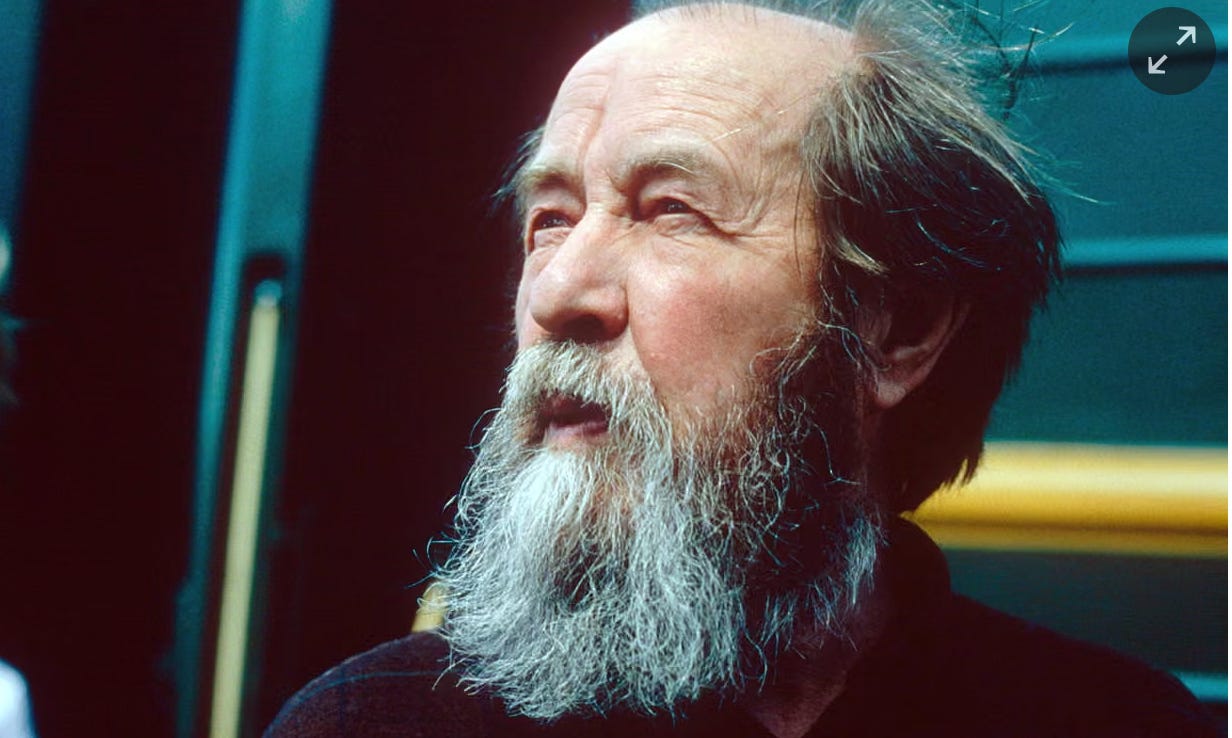
—Aleksandr Solzhenitsyn, The Gulag Archipelago
Stuck around St. Petersburg
When I saw it was a time for a change
Killed the Tsar and his ministers
Anastasia screamed in vain
I rode a tank, held a general's rank
When the Blitzkrieg raged and the bodies stank—Mic Jagger, “Sympathy for the Devil”
During the 19th and 20th centuries, much of the literature on the devil came out of Russia. Dostoevsky’s Demons, published in 1871-72, tells the story of young revolutionaries, possessed by ideas coming into Russia from Germany, who bring anarchy, chaos, and murder to a provincial Russian town.
Solzhenitsyn’s Gulag Archipelago and Mikhail Bulgakov’s The Master and Margarita, are expositions of the nature of evil and how it may possess anyone at any time.
Mic Jagger was inspired by the latter novel to write the lyrics of his 1967 hit, “Sympathy for the Devil.”
As has long been observed, the easiest people for the devil to possess are precisely those who are least aware of their capacity for doing evil—shallow people who walk around with the unexamined assumption that they are “the good guys.” Their moral blind spot combines with their ordinary vanity and ego, making them easy instruments for doing the devil’s work.
In 1978, Solzhenitsyn gave an address at Harvard in which he warned that the shallowness of American culture put the nation in danger of losing its way and its freedom. At the time I first read his speech (back in 1989) I didn’t understand what he was talking about. After all, I thought, he had fled from the Soviet Union, while we Americans had defeated it.
Now I understand Solzhenitsyn’s warning.
Simple test for the morality of any ideology: does it require coercion?
There is no difference between America and Rome 2,000 years ago. Corruption always leads to destruction.