


By Peter A. McCullough, MD, MPH
Virtually every medical commentator on mainstream media has blindly accepted a false narrative that Hantavirus Andes strain readily spreads from person-to-person (P2P) in the community and for that reason those who came off the ship are under forms of biosecurity lockdowns or quarantines.
In the fact pattern, a Dutch man, Leon Schilperood, likely died of Hantavirus on April 11 and was kept on board until April 24. A second German man died and was kept on the ship during the WHO imposed lockdown from May 2 to May 8, 2024. The only time the Hantavirus has been found in human secretions is from the oral cavity in ICU cases, many of whom died. Is it possible the dead bodies were the major source of contagion? Why are MSM commentators not mentioning rodents, a proven vector, and corpses a possible second source in their talking points?
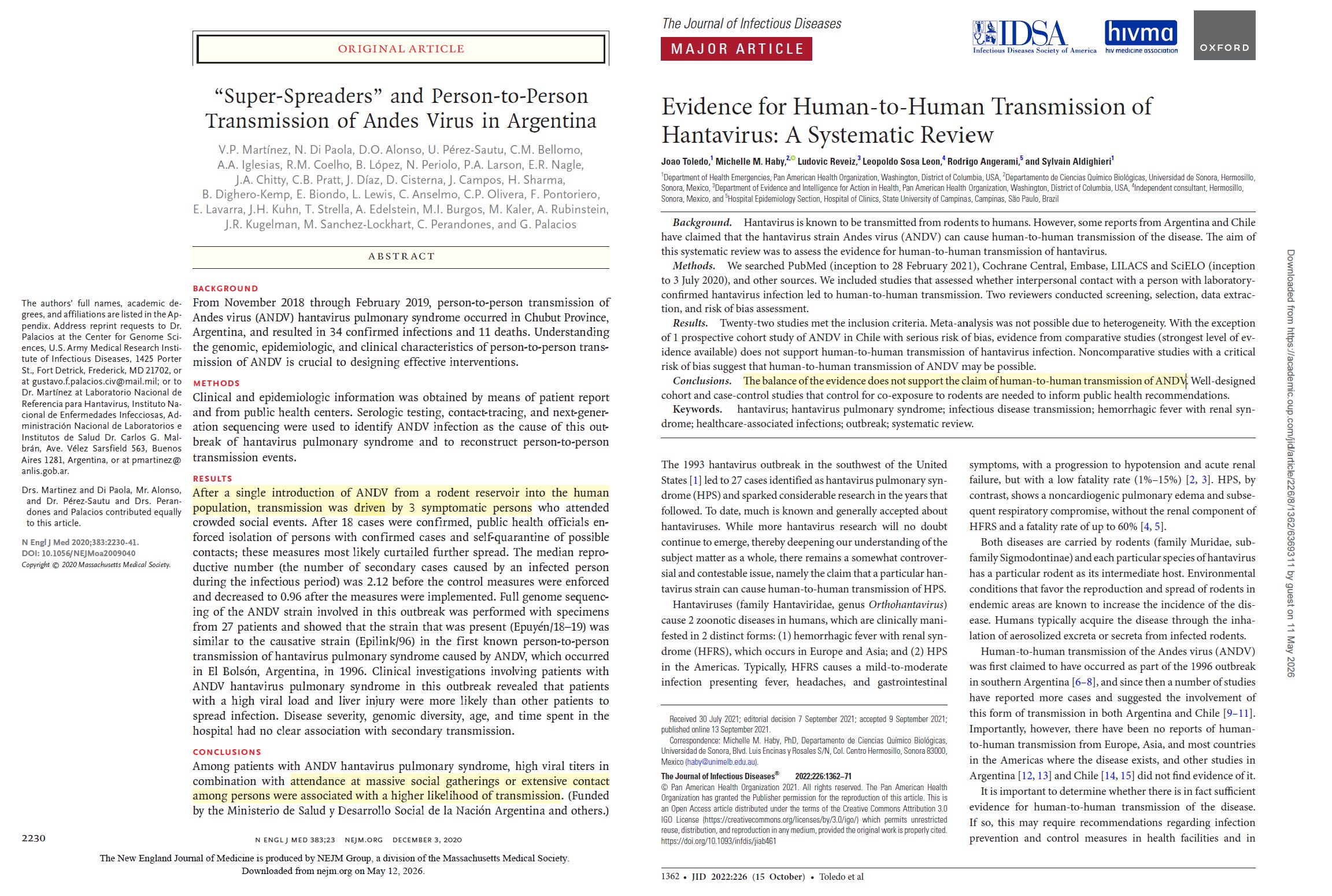
What is the P2P theory based upon anyway? The Martínez et al. (2020) NEJM publication—which chronicles the 2018–2019 Andes virus (ANDV) outbreak in Epuyén—represents the primary cornerstone of the modern “person-to-person” (P2P) transmission hypothesis. However, when scrutinized against rigorous systematic analysis, such as that provided by Toledo et al. (2022), the narrative foundational to the Martínez paper appears less like a settled scientific fact and more like an epidemiological inference driven by observational data gaps.
1. Absence of Direct Challenge and Oral/Nasal Validation
The P2P hypothesis, as posited by Martínez et al., relies heavily on epidemiological reconstruction—mapping social contacts and timing—rather than direct clinical demonstration. Rodent to human zoonotic spread was not ruled out in any of the Martinez cases. In fact, Martinez et al did not even sample the rooms, homes, or buildings were P2P spread allegedly occurred. Crucially, the supposed P2P transmission events have not been confirmed in controlled challenge studies, which would be ethically impermissible. While molecular and genomic evidence (identical viral sequences) is presented as a smoking gun, it remains circumstantial.
2. Epuyén vs. Broader Outbreak Contexts
The Martínez study focuses on a two-year window (2018–2019) in a specific, rural Andean village. Epuyén is situated in the Andean region of southern Argentina. It is a geographically isolated, rural community surrounded by wilderness. Contact tracing was done in 34 cases of which 11 died.

The authors did not rule out rodent exposure by proving the absence of viral-contaminated dust in every building. Instead, they used the following criteria to favor the person-to-person (P2P) hypothesis:
Geographic and Temporal Clustering: They argued that because cases occurred in established chains of transmission—where a person had no reported risk of rodent exposure but had clear, proximal contact with a confirmed index case—the P2P explanation was more parsimonious than a series of highly improbable, independent environmental infection events.
Molecular Identity: They relied on the fact that the full-genome sequences (blood samples) of the virus across generations of infection were identical (or nearly identical). They argued that if the cases were all coming from their own local rodent populations, you would expect more genetic diversity. Because the virus remained “cloned” through the human chain, they concluded it must have been passed directly between humans.
Exclusion by Interview: The environmental “exclusion” was largely based on the patients’ reported history. If a patient or their family reported no activities involving cleaning attics, cellars, or rural outdoor work—and if investigators found no evidence of a recent rodent infestation in the patient’s immediate living space—they marked the “environmental source” as unlikely. No sampling was done of dust or ventilation ducts.
“Super-Spreading” Logic: They reasoned that if a symptomatic individual (like the index patient at the birthday party) was present, and multiple people seated nearby fell ill within the expected incubation window, the presence of the symptomatic person was a better explanation for the cluster than the simultaneous presence of an invisible, aerosolized rodent excrement in circulating dust.
Attempting to extrapolate these findings—specifically the “super-spreader” model—to other outbreak contexts, such as the MV Hondius incident or other geographically disparate events, is scientifically unsound. The conditions in Epuyén—a tight-knit, socially interconnected village of ~2400 people with specific housing and storage practices—are unique. Applying the “Epuyén model” to maritime, urban, or hospital-based outbreaks ignores the critical role of local rodent reservoir dynamics that vary significantly across different latitudes and habitats. The Martínez narrative is highly localized, yet it is often inappropriately used as a universal template to justify extreme containment and quarantine measures in vastly different epidemiological environments.
3. The Toledo Systematic Review as a Counter-Narrative
The Toledo et al. (2022) systematic review explicitly evaluates the body of work supporting P2P transmission, including the papers authored by the Martínez group. Toledo et al. arrive at a conclusion that directly challenges the “super-spreader” and P2P narrative: the balance of evidence does not support the claim. Toledo highlights the severe “risk of bias” inherent in the noncomparative cluster investigations that define the Martínez thesis. By failing to account for environmental co-exposure, these studies suffer from critical methodological flaws. Toledo et al. conclude that the P2P spread of ANDV has likely never been definitively established, and that identical genetic sequences are more parsimoniously explained by exposure to a shared local rodent reservoir. Effectively, Toledo re-categorizes the “super-spreader” claims as alarmist interpretations of observational data that cannot withstand the scrutiny of robust, comparative epidemiological standards.
In short, the Martínez paper is a study of correlations, not causality. When subjected to systematic review, the “P2P narrative” dissolves into a series of unproven assumptions that prioritize the “super-spreader” label over the more mundane, but statistically likely, reality of shared environmental contact. In other words, a party in a room where rats are in the wall could appear to be a super-spreader event, but it’s not from a person rather an unseen rodent in the shadows. One observation is certain, the P2P spread is not taken seriously by everyone:
Those wise enough to get off the ship on 4/24/26 are out and about some on podcasts
The crew, heavily hantavirus exposed for 8 weeks now is back on the ship, unconcerned, chugging away for Rotterdam
The bus driver taking passengers in hazmat suits himself did not have a mask or PPE
See if you can find more examples where P2P is not taken seriously
Please subscribe to FOCAL POINTS as a paying ($5 monthly) or founder member so we can continue to bring you the truth. Alter AI may be used to assist in searches, synthesis, and review.
Peter A. McCullough, MD, MPH
President, McCullough Foundation
FOCAL POINTS has partnered with Patriot Mobile to defend your medical freedom. Join Patriot Mobile today!

References
Pettersson, L., Klingström, J., Hardestam, J., Lundkvist, Å., Ahlm, C., & Evander, M. (2008). "Hantavirus RNA in Saliva from Patients with Hemorrhagic Fever with Renal Syndrome." Emerging Infectious Diseases, 14(3), 406–411. doi: 10.3201/eid1403.071242.
Martínez, V. P., et al. (2020). “Super-Spreaders” and Person-to-Person Transmission of Andes Virus in Argentina. New England Journal of Medicine, 383(23), 2230–2241.
Toledo, J., et al. (2022). Evidence for Human-to-Human Transmission of Hantavirus: A Systematic Review. The Journal of Infectious Diseases, 226(8), 1362–1371.
All very good points you make. I have wondered similar. This reminds me so much of the covid scamdemic and how everyone jumped on board with a few thoughts and no one was allowed to question anything, yet the majority of the accepted assumptions made no logical sense. I'm not wasting any of my time or energy on this latest scam of trying to get the public hysterical again.
In the countryside, it's common to see mice in huts where there are very small farms, and probably within a 50 km radius of where I live, hundreds of small farmers, now elderly, with very small country properties, found themselves, like me, cleaning these old huts, where mice were common, especially if there were still farmyard animals and therefore food storage for these animals. These old huts were cleaned every so often, and, as I did, their droppings also had to be cleaned.
I've done it a couple of times; often, while cleaning, it was best to hold my breath due to the stench of their droppings.
I've never had any health problems that could be traced to these exposures, and I've never heard of anyone having problems cleaning old huts where there was even recent mouse droppings.
Before these latest incidents, in decades of living in the countryside, I'd never heard of anyone becoming infected simply by inhaling mouse droppings.