


Christopher Nolan’s recent film, The Odyssey, reminded me of Heinrich Schliemann (the man who is credited with discovering the ancient city of Troy in 1873. I’d always heard he was an enterprising man, but I had no idea—until I read his biography today—about the extraordinary life he led. Everything about it strikes me as so wildly improbable that no writer of fiction would dare make it up.
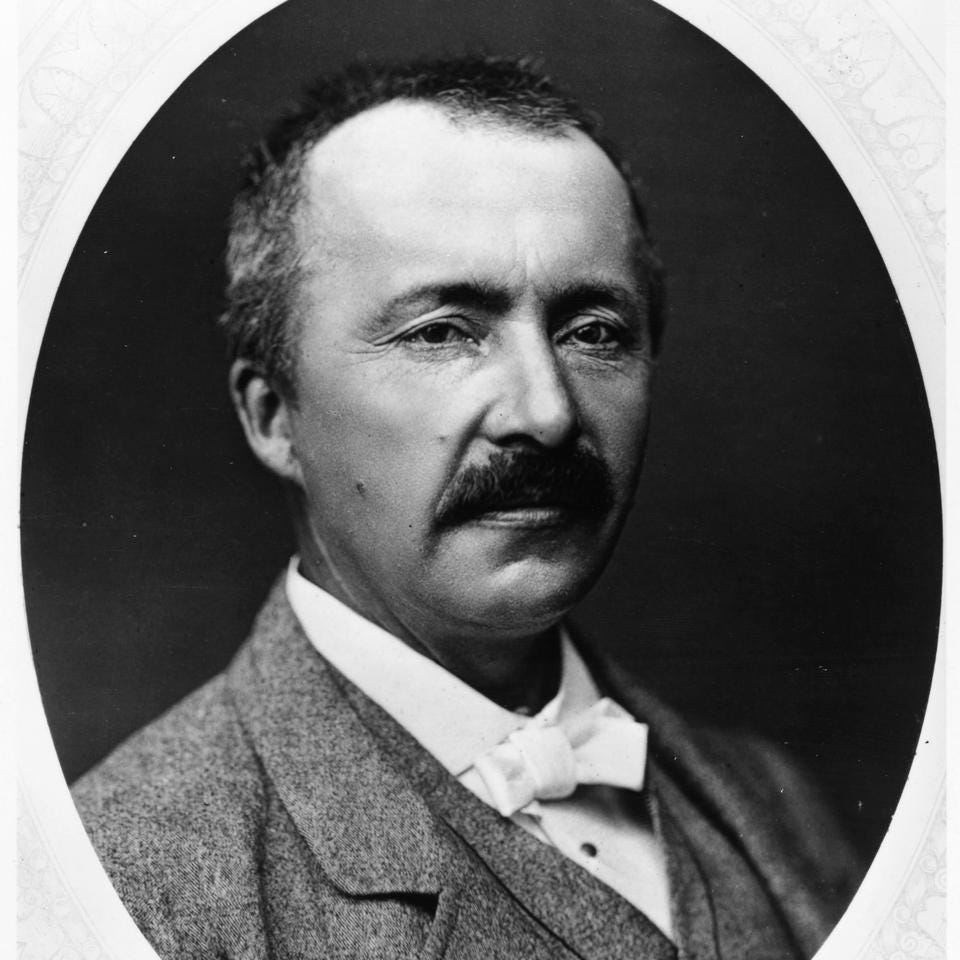
Schliemann was born in Neubukow, Mecklenburg in 1822, the son of an impoverished Lutheran pastor. According to his autobiographical accounts, when he was a boy of eight, he read Homer’s Iliad. When his father told him that the city of Troy might have actually existed in ancient times, he resolved to find it when he grew up.
When he was a teenager, his mother died and his father ran off with another woman, leaving him to fend for himself. For years he worked as a laborer and then as a grocer’s apprentice before seeking his fortune abroad.
In 1841, he boarded a ship bound for Venezuela, but the vessel was wrecked off the Dutch coast. He survived and made his way to Amsterdam, where he learned to speak Dutch with astonishing speed and got a job in a trading house. He spent all his spare time studying foreign languages, never going to the pub, socializing with friends, or pursuing girls. He eventually acquiring proficiency in Russian, French, English, Spanish, and several other languages, including ancient Greek.
In 1846, Schliemann traveled to St. Petersburg and set up shop trading commodities, including indigo. His fortunes expanded dramatically during the Crimean War (1853–1856), when shortages and wartime demand created lucrative opportunities for suppliers. By his thirties, Schliemann was extremely wealthy.
During the California Gold Rush, he traveled to Sacramento, where he operated a business handling gold dust and financial transactions. He subsequently travelled through Europe, the Middle East, India, China, and Japan. He was an exceptionally energetic traveler, combining commercial interests with voracious curiosity about foreign civilizations.
In 1866. at the age of forty-four, he moved to Paris and enrolled at the Sorbonne, where he attended courses in languages, literature, philology, philosophy, and archaeology. He then moved to Athens to study Greek with Bishop Theokletos Vimpos, whom he asked to help him find a young Greek bride who was acquainted with Homeric literature.
The Bishop thought his niece, Sophia Engastromenou, might be a good match, despite being only 17 (Schliemann was 48). She initially regarded him as way too old, but then warmed up to him and his boundless energy, enthusiasm, and adventurous spirit.
After mastering Greek, he decided to realize his childhood dream of finding the ancient city of Troy, and embarked to northwestern Anatolia, in the Ottoman Empire. Guided by the geographical thesis of the British expatriate Frank Calvert, Schliemann focused his excavations on the mound of Hisarlik, near the Dardanelles. In 1871, he employed a large team laborers to begin excavations.
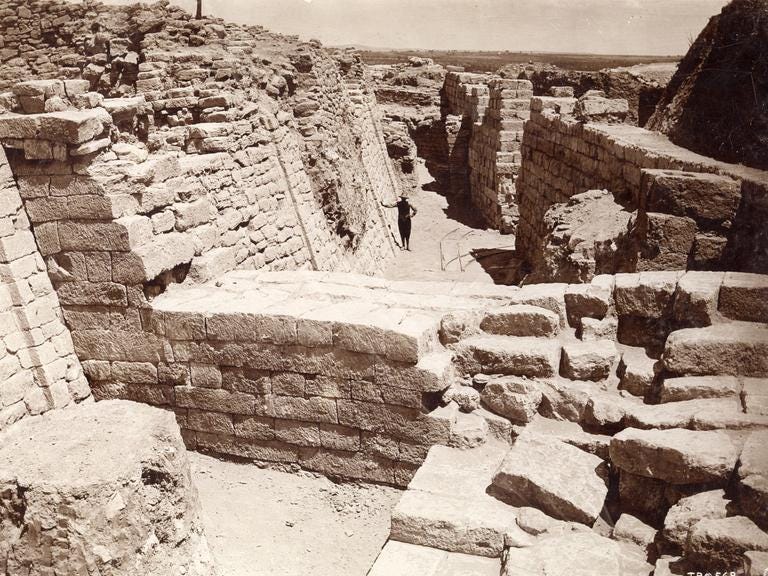
In May 1873, Schliemann announced a spectacular discovery: a collection of gold jewelry, silver vessels, and other precious objects that he called “Priam’s Treasure,” after the legendary king of Troy.
He then published a dramatic account of unearthing the treasure with the assistance of his young Greek wife, Sophia, whom he photographed wearing some of the jewelry he found.
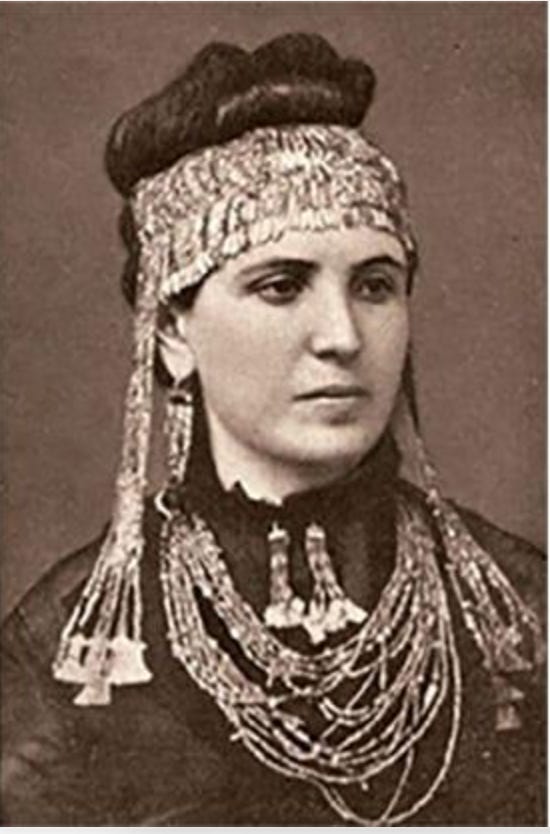
Modern archaeologist have relentlessly criticized Schliemann for his unscientific and romantic methods, and the consensus now is that what he called “Priam’s Treasure” dates to an earlier Bronze Age settlement, centuries older than the period associated with the Trojan War.
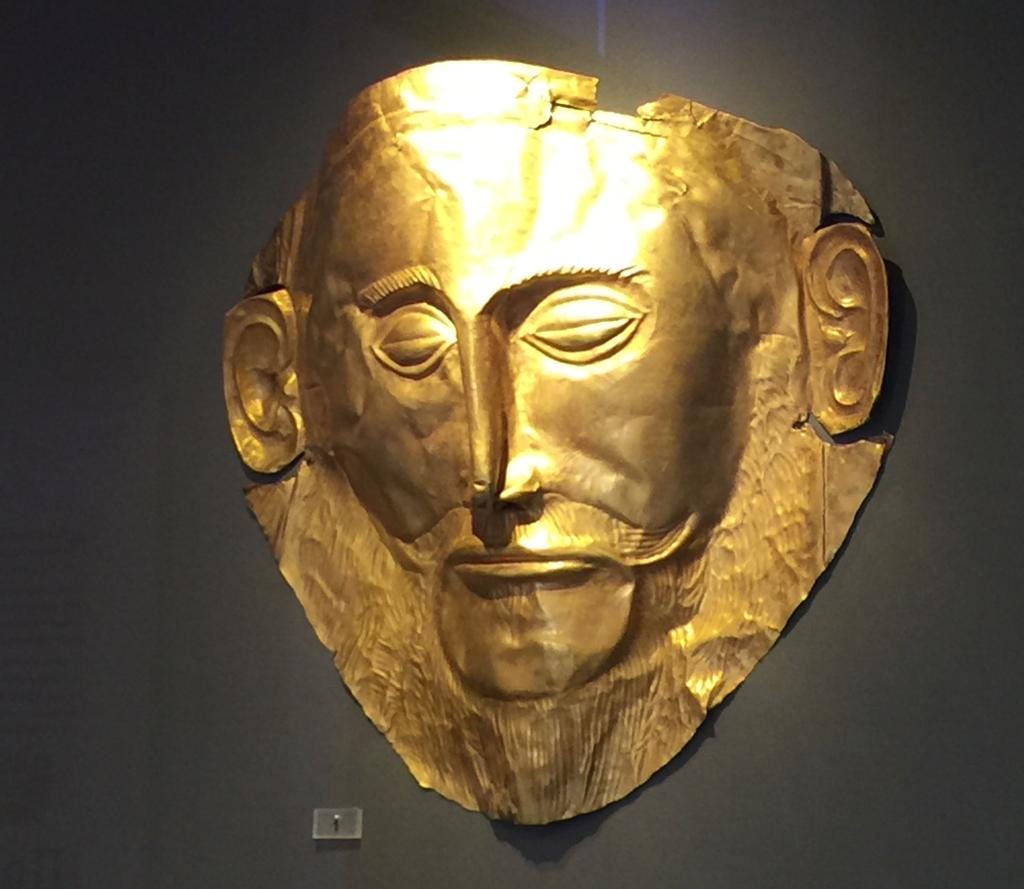
Schliemann continued his adventures on mainland Greece. In 1876, he excavated the ancient citadel of Mycenae, where he unearthed shaft graves containing gold jewelry, weapons, and elaborate funerary masks. His discovery of a magnificent gold death mask inspired him to declare that he had gazed upon the face of Agamemnon, the Greek commander who led the expedition against Troy. However, modern archaeologists believe the mask predates Agamemnon’s era by several centuries.
Schliemann died in Naples in December 1890, aged sixty-eight, following complications from an ear ailment and surgery. He was buried in Athens beneath a mausoleum decorated with scenes evoking the ancient Greek world.
I relate his story on this newsletter because I find it deeply inspiring. Consider that when the 19-year-old Schliemann was shipwrecked on the Dutch island of Texel and made his way to Amsterdam, he was dirt poor, parentless, and had no formal education. Through sheer force of will, guts, discipline, and enthusiasm for taking fantastic risks, he succeeded at every thing he did, including finding the ancient city of his boyhood dreams.
Sometimes, when I read stories like this man's, I wonder whether his early hardships helped shape his life. It seems to affect certain personalities determined to break free from their hardships.
How did Hollywood miss this story?