


There’s a disturbing scene in the 2000 film Gladiator in which the Emperor Commodus, played by Joaquin Phoenix, experiences a paroxysm of elation akin to sexual arousal at the sight of men grievously wounded and decapitated in the Arena.
I was reminded of this scene this morning when I saw newly released footage of Lyndsay Graham expressing elation at the news of bombing and mass destruction and killing.
Both spectacles remind me of a thought I’ve been turning over in my head since I was a teenager—namely, that some of the people among us, perhaps many of them, exult in the spectacle of other human beings being killed.
The joy of killing seems to be rooted in the archaic desire of some men to dominate and coerce other men and to destroy them if they don’t comply. This would explain why so much of human ingenuity as been dedicated to developing and refining ways to kill other humans.
When I was a kid, I had a friend who was obsessed with the drawings of Leonardo da Vinci, and one of his favorites was the carro armato con falci — scythed chariot, sometimes referred to as a man harvester.
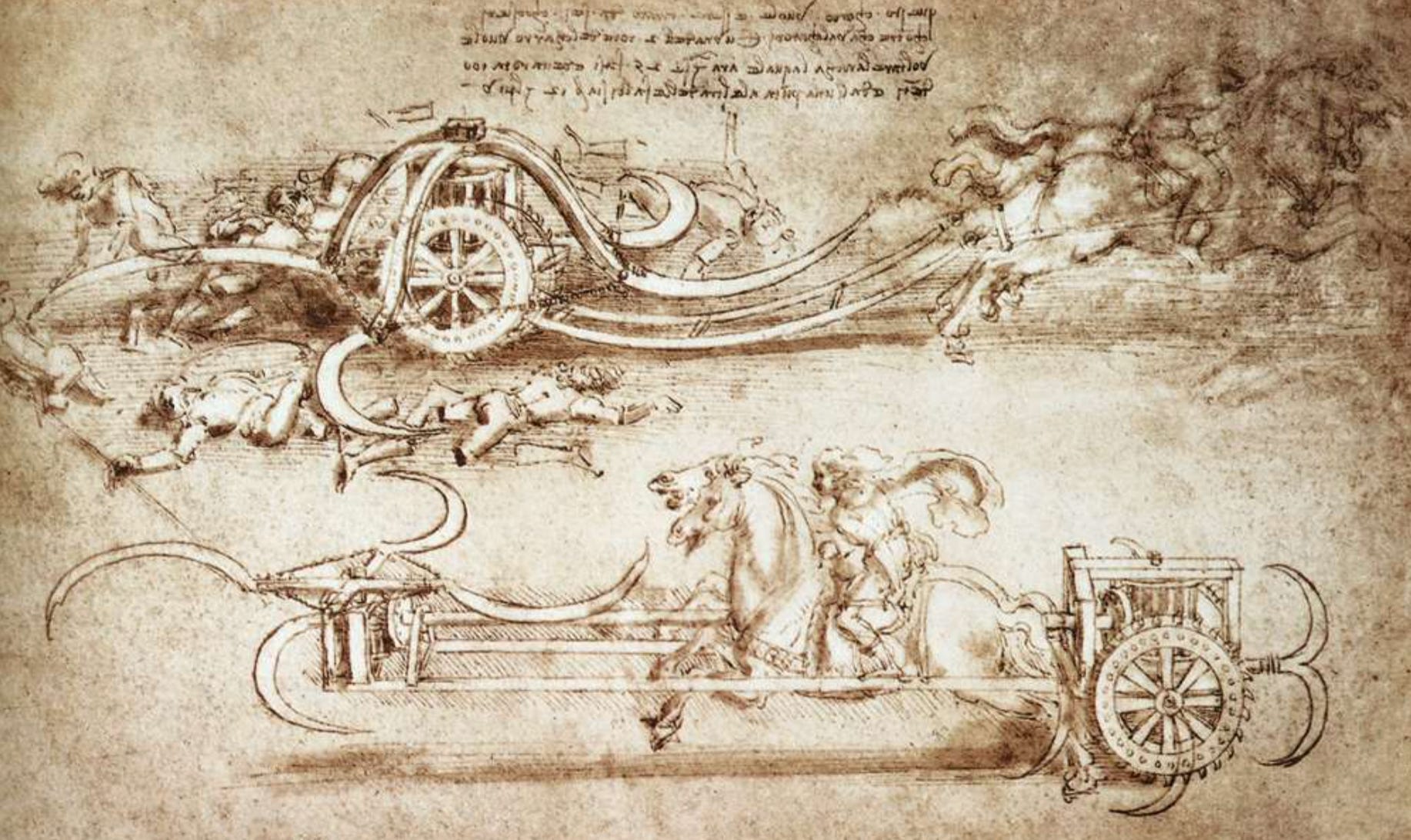
“Isn’t it cool?” my friend said. “You get a couple of guys mounted on really strong horses and then plough across the battlefield and just chop the other soldiers to pieces.”
“Yeah, that’s awesome!” I agreed, not stopping to think how weird we were being.
To be sure, most people can only enjoy the spectacle of killing when they are animated with the conviction that those who die deserve to die.. The psychological drama begins with imagining all the vices and depravity of the enemy, at least as he is portrayed to us by our governments.
This drama has enormous cathartic and therapeutical value for people who are—whether they admit it to themselves or not—troubled by their own vices or those that are pervasive in their community. Carl Jung called this projection. Closely related to projection is scapegoating, in which the sins of a community are transferred to a purported enemy.
After our minds are thus primed, we are treated to the spectacle of the enemy being destroyed. We find it thrilling and cathartic, and we triumph in the feeling that “we are killing the bad guys!”
A couple of years ago I listened to an interview with the British author Peter Hitchens in which he talked about World War I and its total catastrophe for the Christian civilization of Europe.
Most disturbing was the fact that the purportedly Christian clergy on both sides of the infernal war claimed that Jesus Christ was on their side. In Hitchens’s view, this was a total perversion of Christ’s teachings, and the despair the war ultimately created from millions of dead and disfigured was a massive blow to the Christian faith.
At one point in the interview, he made the startling statement that the Great Powers waged war not because conflict resolution was so hard, but because the men running the belligerent countries simply wanted war. Regarding his native Britain and its leaders, he said, “Churchill loved war. He didn’t look for ways to avoid it. He sought it.”
One positive thing that can be said about British and European war up until young Winston’s day is that the ruling class that started wars was expected to send their young sons to fight them. My favorite aristocratic warlord in history was James Thomas Brudenell, 7th Earl of Cardigan. He not only used his influence to push hard for the Crimean War, he served on the front line of it.
Notorious for his haughtiness and extravagance, he achieved legendary status for leading the Charge of the Light Brigade during the Battle of Balaclava, immortalized in Tennyson’s poem.
Watching Cardigan charge directly into a Russian battery, the French commander, Pierre Bosquet remarked: “C’est magnifique, mais ce n’est pas la guerre: c’est de la folie (”It is magnificent, but it is not war: it is madness.”)
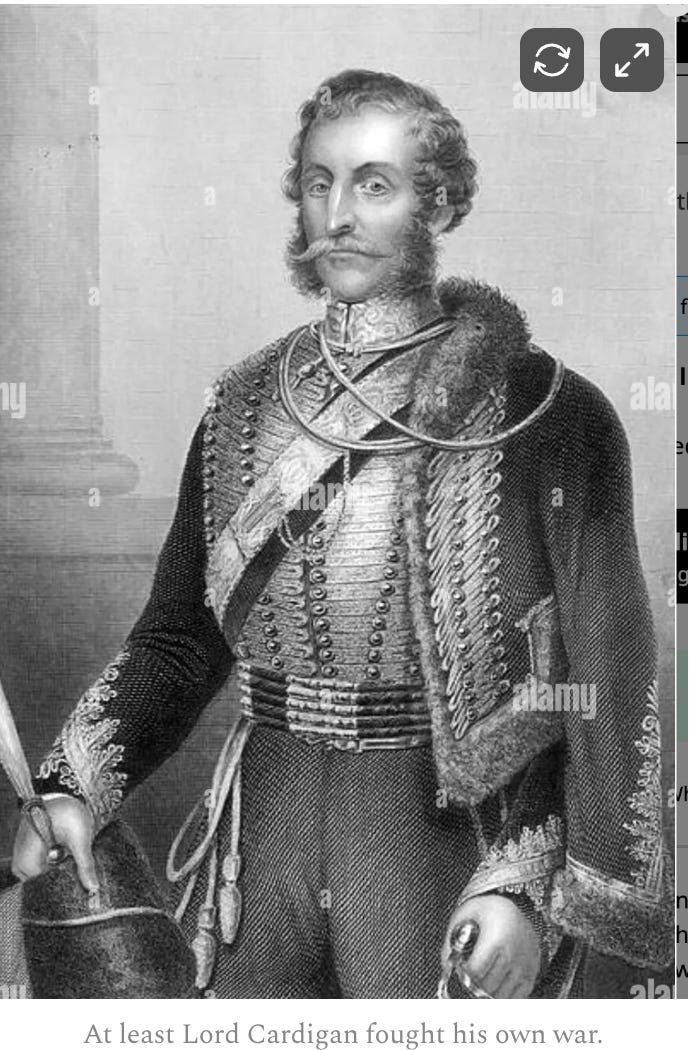
Prominent members of our warmonger class in Washington could do much to redeem themselves if they would, like Lord Cardigan, serve on the front line. Alas, that was never in the cards for Lyndsay Graham, who was able to obtain ecstatic satisfaction from viewing electronic recordings and reports of bombing and killing.
Author’s Note: For a more detailed history and analysis of how war and propaganda derange the mind, check out my new book, Mind Viruses: America’s Irrational Obsessions.
I don't see elation at the news of killing. (Defaming a dead man is twisted, by the way. You would do well as a podcast partner with Candace Owens.) I see a man elated at how well his country's military is doing at destroying a terrorist regime's ability to export killing to other regions of the world. As usual, Mr. Leake, you only see events through the prism of your own skewed worldview.
John Leake has no doubt tapped into a very important variable when it comes to mind viruses.
I believe he is correct in the observation that there are those who delight in mayhem and death, including Lindsey Graham. The virus of psychopathy that infects humanity was captured well in Snakes in Suits, a book about psychopaths in the boardroom.
Leake's comment on Hitchens (someone I did not particularly like) was helpful. Leake wrote, "At one point in the interview, he made the startling statement that the Great Powers waged war not because conflict resolution was so hard, but because the men running the belligerent countries simply wanted war." So true. And Hitchens' analysis of the damage done to Christianity, a faith that seemed cut loose from its moorings, was also good analysis. I sometimes worry that Christians, of which I am one, no longer understand their faith beyond third grade catechism or Sunday School.
The question that remains is what is the nature of the soil, the mind dirt, in which mind viruses thrive. At risk of being self serving and repetitive, I think Leake and others might enjoy a little speculative fiction on that topic that I put into a short story, The Rescue. https://firstimagefilms.com/the-rescue-story/