


By Peter A. McCullough, MD, MPH
Could Secretary of Defense Pete Hegseth be right? Is our military suffering from low testosterone?
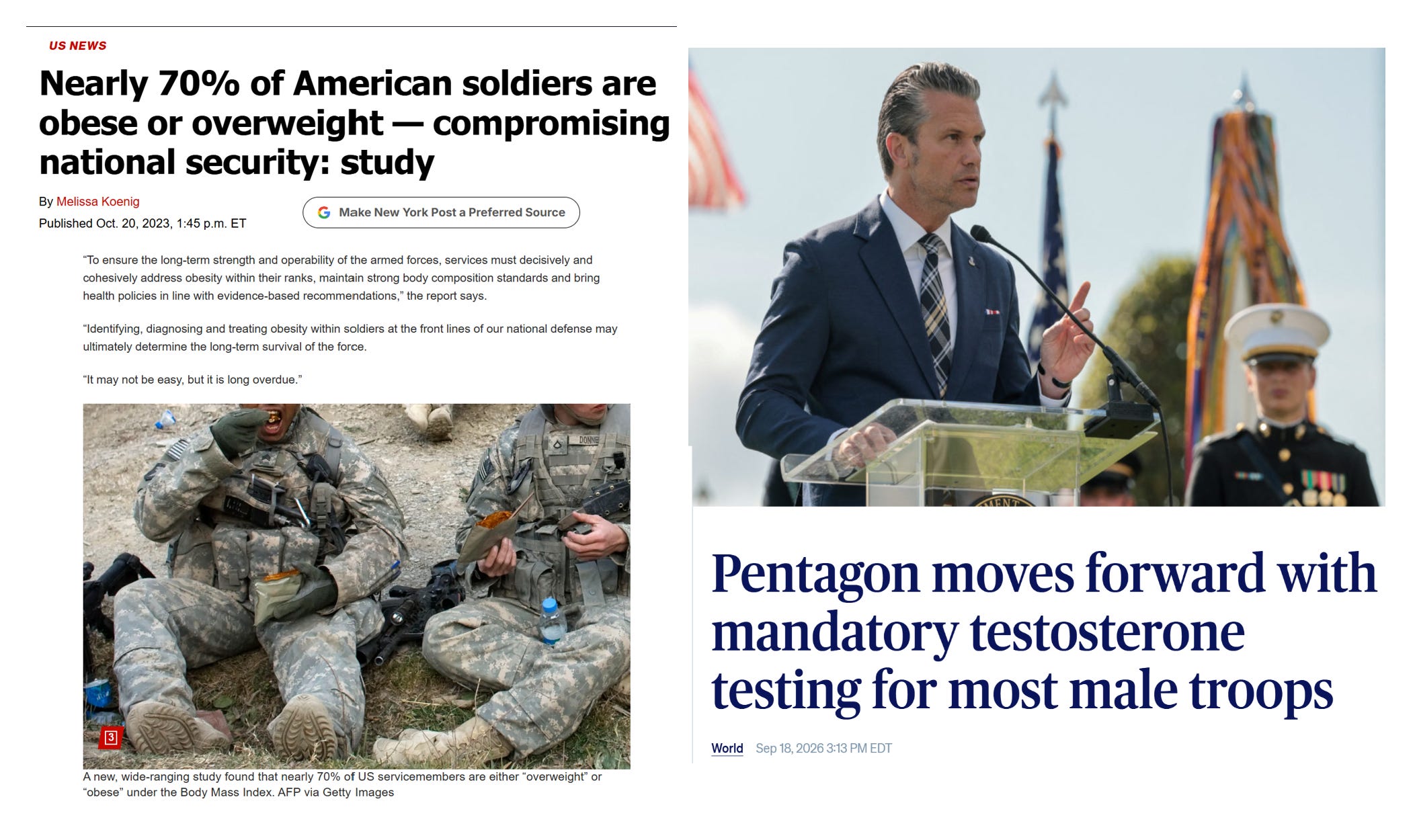
🪖 Testosterone Screening in the US Military: What the Evidence Shows
The Department of Defense now requires annual testosterone screening for all active-duty and reserve personnel aged 30 and older. That mandate prompted the research letter by Hennigar and colleagues, published in JAMA on October 15, 2026, and it is the reason the data exists at all. The study analyzed 479 active-duty Army men drawn from the Military Health and Nutrition Examination Study, with data collected at five Army installations between August 2024 and January 2026. Weighted to the active-duty Army population, the findings showed that 25.7% of men had a single morning total testosterone concentration below 300 ng/dL, the threshold the American Urological Association treats as a reasonable cutoff for low testosterone. Using the stricter harmonized CDC lower limit of normal of 264 ng/dL, 14.7% fell below the line. Among men aged 30 and older, the prevalence rose to 32.8% below 300 ng/dL and 18.6% below 264 ng/dL. Even among nonobese men aged 19 to 39, nearly one in ten screened below 264 ng/dL. Extrapolated Army-wide, that translates to roughly 100,691 personnel below 300 ng/dL and 57,788 below 264 ng/dL

.The study also identified the factors most strongly associated with low values. Each five-year increase in age was associated with an odds ratio of 1.29 for a testosterone concentration below 300 ng/dL, and each five-unit increase in body mass index carried an odds ratio of 1.90 for the same threshold. Body fat emerged as the single most powerful modifiable predictor in the dataset. The authors were careful to state that these estimates should not be interpreted as the prevalence of hypogonadism.
The editorial by Bhasin, Auchus, and Matsumoto, published in JAMA the same day, addresses the other half of the question: what the FDA’s recent label changes mean, and how thin the treatment evidence remains. The FDA issued two rounds of revisions to testosterone product labeling, the most substantial changes in more than seventy years. On February 28, 2025, the agency removed the classwide black box warning about cardiovascular risk after the TRAVERSE trial found testosterone replacement therapy noninferior to placebo for major adverse cardiac events, and it required product-specific blood pressure data or a blood pressure warning. On June 18, 2026, the FDA proposed removing the limitation of use for age-related hypogonadism, softening the warning about lower urinary tract symptoms in men with benign prostatic hyperplasia, and narrowing the prostate cancer contraindication to men with metastatic disease only.
The editorial’s caveats are as important as its summary of the changes. TRAVERSE found increased incidence of pulmonary embolism, roughly a fifty percent increase, tracking with testosterone-induced rises in neutrophil and monocyte counts, as well as an increased rate of clinical bone fractures. Testosterone therapy produced a small but statistically significant increase in systolic blood pressure. Twice as many testosterone-treated men in TRAVERSE underwent invasive prostate procedures compared with placebo. Testosterone also has well known side effects including increased agitation and irritability, sleep disturbance, and testicular atrophy which is mainly irreversible once testosterone is started.
The functional benefits were modest: six-minute walking distance improved by approximately 8.9 meters, effects on mood and energy were small, and effects on erectile function were inconsistent across trials.
Taken together, the two papers describe a problem and a constraint. Hennigar establishes the scale: a large fraction of the screened force has low screening values, and body composition is a major driver. Bhasin establishes the limits of the obvious solution: the evidence base for broad treatment is thinner than the volume of prescribing would suggest, the functional gains are modest, and the documented harms are real. The clinical pathway described in the research letter itself places counseling on modifiable factors before consideration of treatment, and the editorial’s assessment of the evidence provides the rationale for that ordering.
The reasonable synthesis is to treat a screening result as a question rather than a diagnosis, to confirm with repeat morning testing before initiating therapy, to address adiposity, sleep, diet quality, and physical training as first-line interventions such as Zeus from the Wellness Company.
The six active ingredients in the Zeus men’s vitality supplement are: [1]
Tribulus Fruit Extract (600 mg)
Tongkat Ali Root Extract (400 mg)
Horny Goat Weed Stem & Leaf Extract (250 mg)
Shilajit Powder (200 mg)
Zinc (as Zinc Oxide - 11 mg)
Boron (from Boron Glycinate - 3 mg) [1]

Pharmacologic therapy should be reserved for confirmed symptomatic organic deficiency. The DOD should fund the long-duration trials the editorial’s authors identify as missing. The authors note how few adequately powered, long-duration trials the National Institutes of Health has funded given how widely testosterone is utilized. They call for a sustained men’s health research initiative modeled on the Women’s Health Initiative.
The Department of Defense’s screening mandate has produced a genuinely useful dataset. The military now has a clearer picture of the biochemical profile of its force than it did before. What it does not yet have is a strategy for distinguishing the many men with a single low screening value from the smaller number with genuine clinical hypogonadism. That distinction is the entire policy problem, and both papers point toward the same answer: confirm before treating, address what is modifiable first, and build the evidence base that has been neglected for decades.
📝Please subscribe to FOCAL POINTS as a paying ($5 monthly) or founder member so we can continue to bring you the truth. AlterAI may be used to assist in searches, synthesis, and review.
Peter A. McCullough, MD, MPH
President, McCullough Foundation
FOCAL POINTS has partnered with AlterAI to support independent research and open inquiry. Subscribe to AlterAI today and get a discount on unbiased and accurate AI!

References
Hennigar SR, Heymsfield SB, Bukhari AS, Lieberman HR, Berryman CE. Testosterone Screening Thresholds in Active-Duty US Male Service Members. JAMA. Published online October 15, 2026. doi:10.1001/jama.2026.19794
Bhasin S, Auchus RJ, Matsumoto AM. FDA’s Testosterone Label Changes: Implications and Unresolved Issues. JAMA. Published online October 15, 2026. doi:10.1001/jama.2026.18140
It's an existential problem. Chemical castration essentially. Get the rope.