


The official story of the ceasefire is that, shortly before the doomsday clock ran down for “Iranian civilization,” President Trump agreed to a provisional peace plan brokered by Pakistani intermediaries and delivered to the White House yesterday afternoon. This is consistent with reports that Vice President J.D. Vance has been in talks with Pakistani General Asim Munir.
The role of Pakistan in this conflict is especially interesting. The country is now a significant regional power that has long maintained ties to Tehran, as well as strong military, security, and diplomatic relations with Washington and China.
Pakistan is often accused by the US of sponsoring terrorism, harboring terrorists, and is strongly suspected of having provided a haven for Osama bin Laden for five years in a secure compound in Abbottabad, a military garrison town close to Islamabad.
Following India’s acquisition and testing of a nuclear bomb in 1974, Pakistan began developing its own nuclear weapons against strong Israeli opposition. In 1981, the Mossad sent letter bombs to firms in West Germany and Switzerland that were assisting in the effort. Though Pakistan succeeded in acquiring and testing nuclear weapons in 1998, it has never threatened Israel with an atomic bomb attack. The government of Pakistan believes that possessing nuclear weapons is a deterrent against aggression from India and other nations in the region.
Pakistan’s status as a regional power may ultimately help it to facilitate a negotiated settlement to this conflict, though I am not wildly optimistic.
The ten point plan submitted by Iran via Pakistan to the White House is as follows.
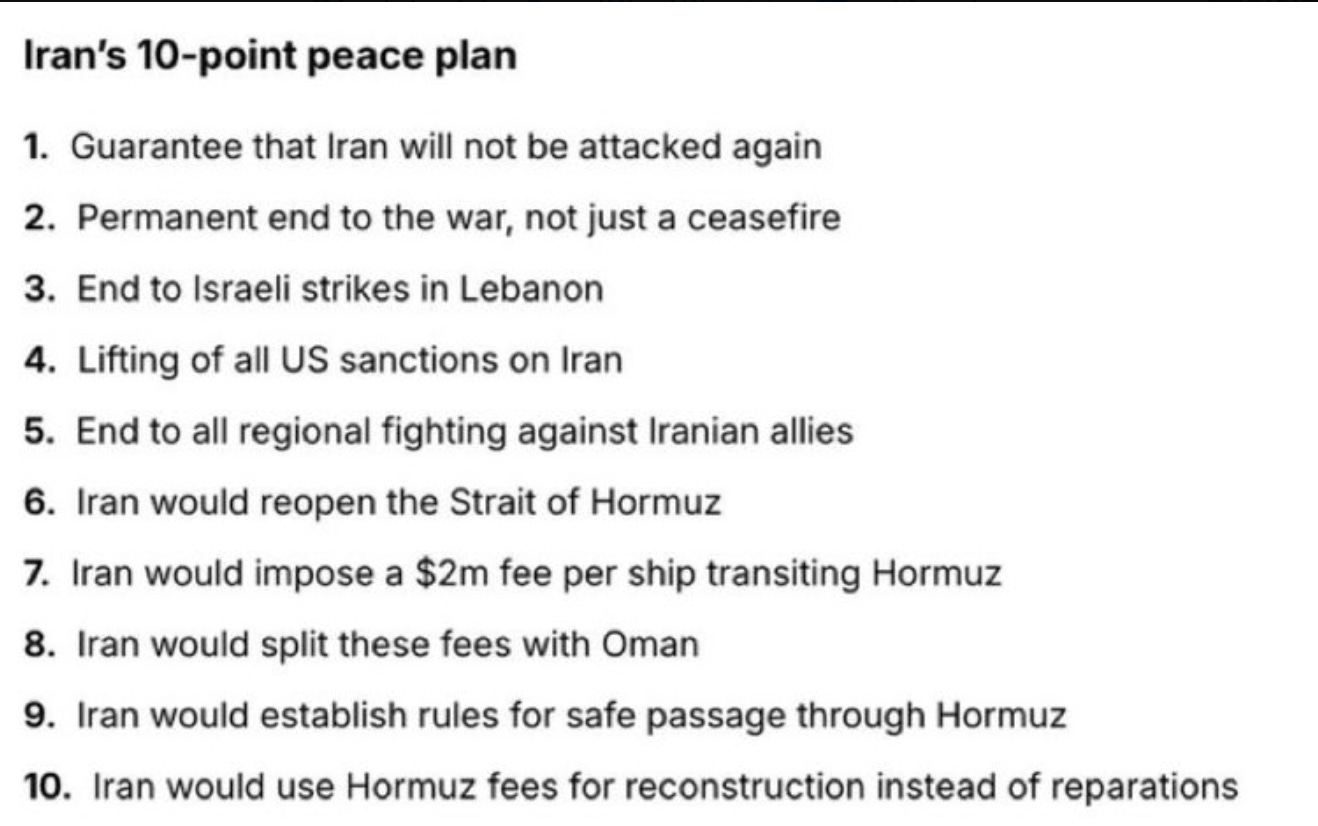
On Monday, President Trump said of the proposal, “It’s a significant proposal. It’s a significant step. It’s not good enough, but it’s a very significant step.”
Both belligerents are characterizing yesterday’s agreement as a victory.
The US and Iran have apparently agreed to meet for first direct talks in Islamabad Friday. However, the situation is volatile, with Iran threatening to respond to Israel’s Lebanon airstrikes. Moreover, Iran has apparently already halted shipping in the Strait of Hormuz until Israel ceases the strikes in Lebanon.
I wonder if one of Israel’s primary objectives for attacking Iran—and inciting the US to assume a leadership role in the conflict—was to use the Iran melodrama as an opportunity to establish a long-term "defensive buffer zone" in southern Lebanon between its current border and the Litani River. This large swath of land in Southern Lebanon is valuable for its agricultural productivity and its strategic location for regional water security. The river is a major source of irrigation for thousands of acres of farmland.
In addition to ongoing hostilities in Lebanon, Saudi Arabia’s East-West oil pipeline carrying crude from the Gulf to the Red Sea for export has been attacked at a pumping station.
Even if Trump ultimately claims to accept the above terms—or some iteration of these terms—in the form of a binding treaty, it will only hold if Israel honors it, and President Trump appears to be unwilling or unable to restrain Israel’s conduct.
This brings us to purported casus belli of this conflict—Iran’s 440 kilograms of 60% enriched uranium.
Last summer, President Trump assured us that Iran’s nuclear program—and apparently its enriched material—had been totally destroyed by Operation Midnight Hammer.
However, just a few months later, this story changed, and we were once again told that Iran posed an “imminent” nuclear threat to the US and Israel.
Note that, since 1992, we have been repeatedly told that Iran has been on the cusp of obtaining a nuclear bomb for the purpose of attacking Israel and the US, and that such an attack was just a couple of years, months, or even just weeks away.
The Israelis purportedly attacked Iran on February 28 to defuse this “imminent threat,” and the US immediately joined the attack. However, this morning, President Trump once again changed the story by posting the following on his Truth Social account.
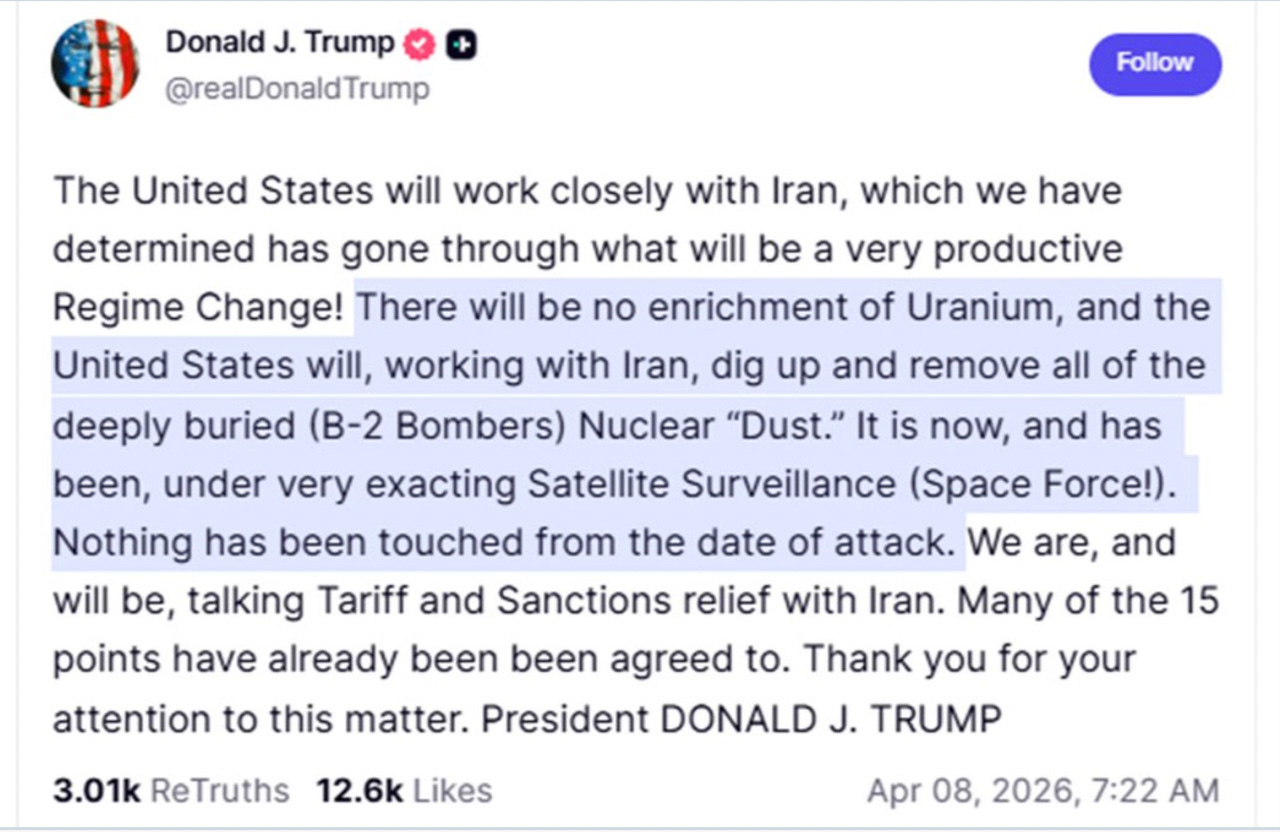
If the president’s assertions in this post are true, it means that the governments of Israel and the US lied when they told us that Iran was again on the cusp of obtaining a nuclear bomb and using it to attack the US and Israel.
One possibility that now comes to mind (in this ever changing story) is that Trump will agree to most of Iran’s demands in return for Iran handing over its enriched uranium and agreeing to terminate its nuclear program.
IF this is indeed the final agreement that emerges over the next two weeks, it will resemble the agreement that Iran apparently proposed at the meeting in Geneva on February 26, only with considerable additional advantages for Iran.
I was relieved yesterday that Trump did not carry out his threat to extinguish Iranian civilization, which I interpreted primarily to mean destroying the power generation plants supplying electricity to large cities such as Tehran.
I was also relieved to see that Trump’s loyal base perceives this to be a great victory for the president, because in order for this pointless and immensely destructive conflict to end, he will need to be able to frame it as a victory so that he can save face.
The markets are wildly celebrating the news of the cease fire, and I reckon that great fortunes have been made by market players who had reason (or actionable information) to believe that a ceasefire/provisional peace deal would be announced.
IF what is presented to the world as a binding agreement is indeed ironed out in the coming two weeks, how will it be enforced?
I suspect it can only be enforced if China, India, Pakistan, and Russia demand—and be willing to back it up with force if necessary—that all parties honor the agreement.
With my deepest respect as a long-time follower, I have recently started to feel that Focal Points has lost its way and is beginning to lose its value and credibility as a result. Please forgive my saying so, but I pray you will receive this honest feedback as “faithful wounds from a friend.”
At what point will you stop sharing crap that isn’t true?? This “10 point ceasefire plan” story was shared by CNN, but originated in Nigeria. Go grab the real one off Truth social and try again. Yesterday you said Trump was a genocidal maniac, today you share a fake peace agreement while you tear it apart. And then blame Israel again. This is truly bizarre—seeing otherwise intelligent ppl (I think) fall for this kind of nonsense. Seriously, what’s WRONG with you ppl?? Is your TDS really that bad? Are your reading and comprehension skills just not up to snuff? Or are you just suffering from severe confirmation bias? You would think that ppl who witnessed the media manipulation in regards to Covid and the vaccines might at least be a LITTLE SKEPTICAL of what the media is telling them now, but I guess the skepticism is like everything else appears to be these days: selective.