


When the MAHA movement launched, many of us hoped the first year would bring decisive action—accountability, safety recalibration, and an honest reckoning with the failures of pandemic-era public health. While important conversations have begun, particularly around food quality and chronic disease, the core biomedical and regulatory crises that resulted in millions of deaths, injuries, and disabilities remain largely untouched.
To be fair, there have been a few notable wins. These include HHS terminating 22 BARDA mRNA shot projects worth approximately $500 million, HHS moving to end COVID-19 vaccine recommendations for healthy children and pregnant women, and an 8–3 ACIP vote to eliminate the universal hepatitis B vaccine recommendation for infants. While meaningful, these actions remain limited in scope and impact relative to the scale of the underlying public-health failures. None of these actions have prevented approximately 5.5 million American children and 42 million adults from receiving the latest deadly mRNA gene-transfer injections. According to the CDC’s website:
Reported on Tuesday, December 30, 2025
The percent of the population reporting receipt of the 2025─26 COVID-19 vaccine is 7.4% (6.5-8.3) for children and 16.3% (15.6-17.1) for adults age 18+, including 33.7% (31.6-35.7) among adults age 65+.
The hard truth is that none of the reforms outlined below materialized during MAHA’s first year, despite overwhelming scientific, clinical, and legal justification. That does not mean they are unrealistic. It means they are politically uncomfortable.
The McCullough Foundation will be pushing aggressively for every item below—through research, public education, policy engagement, and legal accountability—because MAHA cannot succeed if it avoids the most consequential drivers of medical harm.
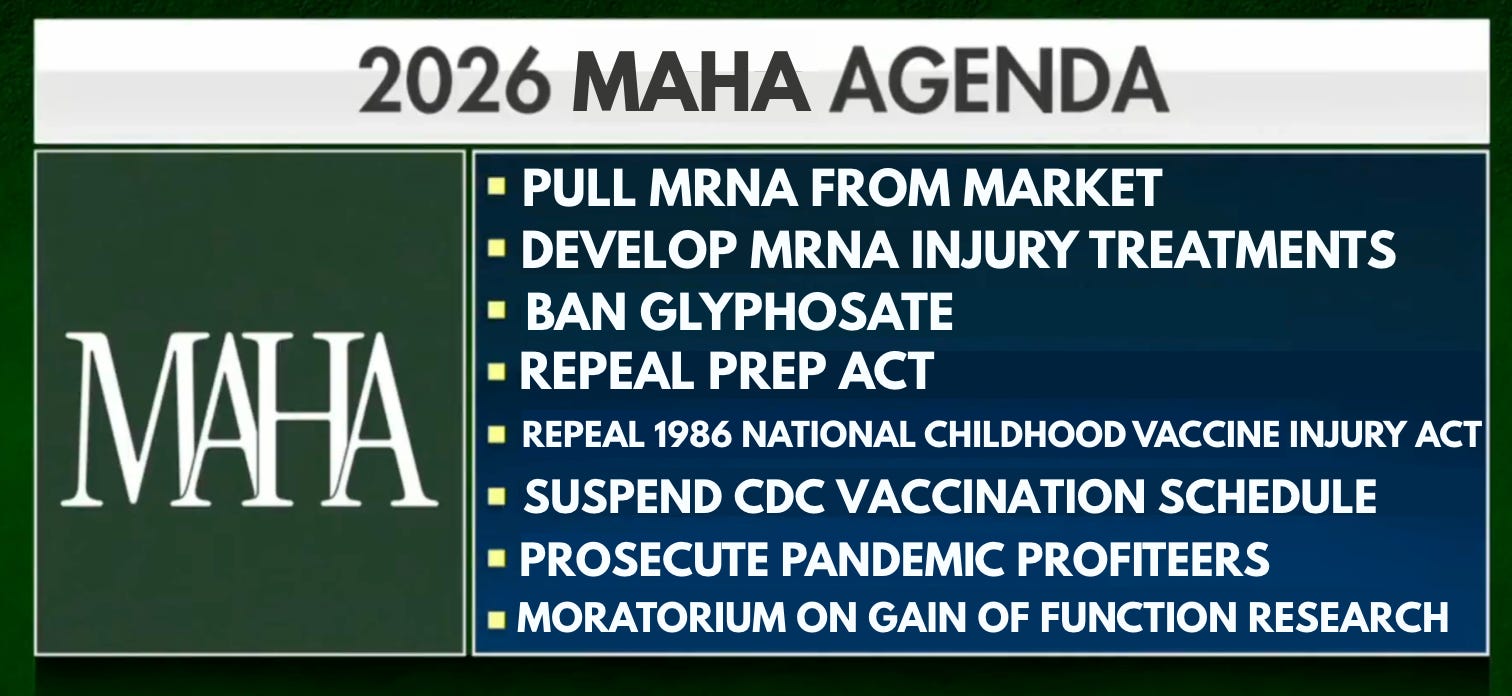
1. Pull mRNA from the market
Why it’s needed:
mRNA products were deployed at planetary scale under false assurances of transient expression, limited biodistribution, and favorable risk–benefit profiles—assurances now contradicted by accumulating clinical, mechanistic, and population-level evidence. The result has been mass casualties, including excess mortality, widespread chronic injury, and long-term disability affecting working-age adults and children. Emerging evidence of genomic disruption, severe reproductive damage, long-term biological activity, and transgenerational harms extends the risks beyond those directly exposed. Continued market authorization is incompatible with pharmacovigilance, informed consent, and the state’s fundamental duty to prevent large-scale iatrogenic harm.

How it can happen:
Under the Food, Drug, and Cosmetic Act, the FDA has clear post-market authority to restrict, suspend, or withdraw products that fail ongoing safety standards. When a product presents a reasonable probability of serious adverse health consequences or death, the FDA may initiate or request a Class I recall, the agency’s most serious recall classification. Products authorized under Emergency Use Authorization (EUA) can be revoked or withdrawn administratively, while fully licensed products may be subject to formal withdrawal proceedings, mandatory post-market safety actions, distribution restrictions, or recall pending an independent safety review.
In parallel, states are already moving to act where federal agencies have failed. Elected officials and county leaders in Michigan, Minnesota, Idaho, and Washington have begun advancing legislation and resolutions calling for state-level moratoria or restrictions on mRNA injections, citing mounting evidence of injury, regulatory deception, and loss of public trust. These efforts include proposed statewide bans on gene-therapy injections, reclassification of mRNA products under existing public-safety statutes, and county resolutions advising against their use. States retain broad police powers to protect public health and safety, and a successful moratorium in even one state would break the federal logjam—forcing overdue national reassessment of mRNA products. A coordinated, multi-state push is now underway, with 2026 poised to become the watershed year when state action compels federal accountability.
2. Develop mRNA injury treatments
Why it’s needed:
Millions of people report persistent, life-altering symptoms following mRNA exposure, yet no formal diagnostic or treatment framework exists. Denying treatment development on the grounds of narrative protection compounds harm and abandons patients who were assured these products were safe. Treating injury is a medical and ethical obligation.
How it can happen:
NIH and DoD can fund targeted research into spike persistence, genomic dysregulation, amyloid micro-clot accumulation, immune dysfunction, fibrosis, thrombosis, autonomic dysfunction, and oncogenic signaling. Repurposed therapeutics and novel interventions can be evaluated through existing clinical-trial infrastructure, compassionate-use programs, and expanded-access pathways, allowing rapid translation from mechanistic insight to patient care.
3. Suspend the CDC vaccination schedule
Why it’s needed:
The current CDC vaccination schedule was assembled incrementally and has never been evaluated as a cumulative exposure for long-term neurodevelopmental, immunologic, metabolic, or chronic disease outcomes. Critically, every vaccinated-versus-unvaccinated comparison study published to date has reported a substantially higher burden of chronic disease among the vaccinated, including neurodevelopmental disorders, autoimmune conditions, allergies, asthma, seizures, and other long-term health outcomes. No study has demonstrated superior overall health in the vaccinated when a genuinely unvaccinated comparison group is examined.
These findings directly challenge the assumption that the schedule is benign when considered in totality. Importantly, this failure of cumulative safety testing is now the subject of active federal litigation. In 2025, a lawsuit filed by Dr. Paul Thomas, Dr. Kenneth P. Stoller, and Stand for Health Freedom alleged that the CDC’s 72-dose childhood vaccine schedule is illegal, unconstitutional, and arbitrary, citing the agency’s admission that it has never tested the full schedule for cumulative safety, despite repeated warnings from the Institute of Medicine. The suit further alleges violations of the Administrative Procedure Act and constitutional protections, and documents retaliation against physicians who raised safety concerns.

A temporary suspension is not anti-vaccine—it is pro-science, allowing cumulative risk, timing, dose clustering, and susceptible subpopulations to be rigorously evaluated without coercion or mandate pressure. Continuing to enforce an untested schedule while credible scientific and legal challenges persist violates core principles of evidence-based medicine, informed consent, and public-health ethics.
How it can happen:
HHS has the authority to direct the Advisory Committee on Immunization Practices (ACIP) to pause or revise schedule recommendations pending rigorous cumulative-risk analysis and properly designed vaccinated-versus-unvaccinated studies that assess long-term outcomes. ACIP recommendations are advisory, not statutory, and can be suspended or modified without new legislation. In parallel, states retain independent authority to decouple school and employment mandates from CDC guidance, expand medical exemptions, and shift toward shared clinical decision-making while safety questions are resolved.
4. Repeal the PREP Act
Why it’s needed:
The PREP Act created sweeping and unprecedented legal immunity for pharmaceutical manufacturers, distributors, and government actors during declared emergencies—even in the face of mass injury, excess mortality, and widespread safety signals. By preempting state and federal tort law, the Act eliminated the primary mechanisms that enforce safety, transparency, deterrence, and accountability in medicine.
The result has been predictable: suppressed safety signals, distorted risk–benefit assessments, coerced uptake, and a compensation system that is opaque, underfunded, and inaccessible to most injured individuals.
How it can happen:
Congress already has a clear legislative pathway. Rep. Thomas Massie (R-KY) has introduced the PREP Repeal Act (H.R. 4388), which would fully repeal the Public Readiness and Emergency Preparedness Act.

The bill would:
Fully repeal Sections 319F-3 and 319F-4 of the Public Health Service Act, ending blanket liability protections for pandemic countermeasures
Restore the right to sue under federal and state law for injuries caused by drugs, biologics, and other PREP Act–covered products
Apply retroactively to pending lawsuits and appeals
Rescind unused federal funds from the PREP Act injury compensation program
Include a severability clause to ensure the law survives judicial challenge
The PREP Repeal Act is already drafted, introduced, and eligible for advancement. Supporting and advancing this bill would dismantle a central pillar of the Bio-Pharmaceutical Complex and restore the most basic safeguard in public health: legal accountability for harm.
5. Repeal the 1986 National Childhood Vaccine Injury Act
Why it’s needed:
Thanks to the 1986 National Childhood Vaccine Injury Act (NCVIA), Americans injured or disabled by vaccines have had virtually no legal recourse—while Big Pharma has faced little incentive to ensure the safety of its injections. Manufacturers were insulated from liability, eliminating the strongest incentive to rigorously test products for long-term safety, improve formulations, or promptly address harm signals. The result has been an ever-expanding childhood vaccination schedule accompanied by declining safety standards, minimal independent oversight, and profound barriers to justice for injured children and families. Notably, the autism epidemic began to proliferate shortly after the passage of the NCVIA, as an untested hyper-vaccination schedule began to take shape.

How it can happen:
Congress can restore full tort liability or substantially reform the Vaccine Injury Compensation Program to allow discovery, jury trials, and meaningful compensation. Because the National Childhood Vaccine Injury Act was a legislative creation, it can be amended or repealed legislatively.
A concrete pathway already exists. Rep. Paul Gosar (R-AZ) has introduced the End the Vaccine Carveout Act (H.R. 4668), which would dismantle the vaccine-specific liability shield by:
Eliminating manufacturer immunity for vaccine injuries and deaths, restoring access to civil courts on the same terms as other pharmaceutical products
Removing COVID-19 vaccines from PREP Act protection, allowing injury claims related to mRNA products to proceed
Ending arbitrary statutes of limitation that have barred legitimate claims, providing a fair window for families to seek justice
Preserving the Vaccine Injury Compensation Program as a voluntary option, rather than a mandatory, exclusive remedy
Closing loopholes created by the 1986 NCVIA and 2005 PREP Act that allowed unprecedented profit without accountability
BREAKING: Rep. Gosar Files Bill to Eradicate Big Pharma’s Vaccine Liability Shield

By Nicolas Hulscher, MPH
H.R. 4668 would realign incentives toward safety, transparency, and innovation—placing vaccines under the same legal standards that govern every other medical product. Advancing this legislation would represent a decisive step toward restoring accountability in public health.
6. Ban glyphosate
Why it’s needed:
Glyphosate exposure is linked in the scientific literature to cancer risk, endocrine disruption, microbiome injury, and metabolic dysfunction. A large, long-term animal carcinogenicity study found that glyphosate and glyphosate-based herbicides caused dose-related increases in multiple rare and fatal cancers across numerous organs, even at doses legally defined as “safe.” These findings align with human epidemiologic evidence showing increased risk of non-Hodgkin lymphoma among those with the highest exposures.

Further undermining claims of safety, a foundational 2000 glyphosate “safety” review relied upon by regulators for decades was formally retracted in 2025 after confirmation of undisclosed corporate ghostwriting, omitted carcinogenicity data, and financial conflicts of interest. Millions of pounds of glyphosate were approved and sprayed worldwide on the basis of evidence now deemed scientifically invalid. Multiple countries have already restricted or banned glyphosate over safety concerns, underscoring that continued U.S. use reflects regulatory choice—not scientific consensus.

The FDA 2020 Pesticide Residue Monitoring Report “tested for approximately 750 different pesticides and selected industrial compounds on 2,078 human food samples (316 domestic and 1,762 import samples) in its regulatory monitoring program.” Nearly 60% of all domestic foods contained herbicide and pesticide residue, with 3.2% violating federal standards. 11.6% of all imported foods violated federal standards for pesticide residues.
How it can happen:
The EPA can revoke or lower allowable residue tolerances for glyphosate on food crops under the Food Quality Protection Act, which would effectively prohibit its use in agriculture. Separately, under FIFRA, the EPA can cancel or suspend glyphosate product registrations if the pesticide no longer meets safety standards. In parallel, states retain authority to ban or restrict glyphosate independently, as several already have, creating bottom-up pressure for national action.
7. Prosecute pandemic profiteers
Why it’s needed:
Public trust cannot be restored without accountability. It is time to issue criminal charges for illegally mandating experimental mRNA gene therapies that have resulted in millions of deaths, injuries, and disabilities. Profiting from fear, coercion, and misrepresentation—while shielding oneself from liability—undermines medical ethics, democratic governance, and public health itself. Accountability is not vengeance; it is deterrence, and without it, the same abuses will recur under the next declared emergency.
Demands for accountability are no longer hypothetical. This year, formal criminal referral requests were filed in multiple states seeking investigations into senior public health and government officials over COVID-era policies alleged to have caused widespread and preventable loss of life. Individuals named in these referrals include Anthony Fauci, Francis Collins, Deborah Birx, Rochelle Walensky, Stephen Hahn, Janet Woodcock, Peter Daszak, and Ralph Baric, among others. The filings—supported by extensive victim testimony—allege that coercive mandates, suppression of effective treatments, and hospital protocols contributed directly to mass injury and death.

How it can happen:
The Department of Justice already has authority to pursue fraud, RICO, False Claims Act, antitrust, civil-rights, and securities violations tied to data suppression, misrepresentation, coercive mandates, and profiteering linked to government contracts—particularly where such conduct resulted in serious bodily injury or death. At the same time, state and local prosecutors retain independent authority to bring charges for negligent homicide, involuntary manslaughter, reckless endangerment, medical battery, and abuse of vulnerable persons when federal agencies fail to act. Congressional subpoenas, whistleblower protections, and formal criminal referrals can unlock internal communications, contracts, and regulatory correspondence necessary to establish knowledge, recklessness, coordination, and causation.
8. Complete moratorium on gain-of-function research
Why it’s needed:
Gain-of-function research poses asymmetric, catastrophic risk: a single laboratory accident or “accident” can trigger global consequences. Documented laboratory-acquired infections number in the hundreds since 2001 and the rapid expansion of high-containment laboratories—often in densely populated cities—has increased the probability of accidental release. Past activities have included the re-creation of eradicated viruses, engineering of chimeric coronaviruses, and serial passage experiments designed to increase transmissibility or virulence, frequently under opaque oversight:

In May 2025, the Trump Admin took an important step by signing an executive order halting federal funding for dangerous gain-of-function research overseas and temporarily suspending high-risk federally funded research in the United States pending new oversight standards. While this action acknowledges the severity of the threat, it is not sufficient. Executive orders are inherently temporary, reversible, and limited in scope. They do not permanently prohibit gain-of-function research, do not automatically cover privately funded or foundation-backed laboratories, and rely on future regulatory frameworks that may still permit the creation of “pathogens with enhanced pandemic potential” under permissive conditions.
BREAKING: Trump Bans Foreign Gain-of-Function Research — U.S. Experiments Paused

By Nicolas Hulscher, MPH
Absent a binding statutory ban with criminal penalties, comprehensive inspections, mandatory inventories, and enforceable sanctions, dangerous gain-of-function research can resume under revised terminology or alternate funding mechanisms.
How it can happen:
The President can impose and maintain an immediate executive moratorium on all federally funded gain-of-function and dual-use research of concern. Congress must then codify a permanent statutory ban, establish criminal and civil penalties for violations, mandate independent inspections and public transparency, and prohibit the creation, enhancement, or reconstitution of pathogens with pandemic potential. Internationally, the United States should lead efforts to strengthen enforcement of the Biological Weapons Convention, closing loopholes that currently allow bioweapon-adjacent research to proceed under the guise of preparedness.
Conclusion
None of these reforms require new science. They require regulatory courage, ethical clarity, and accountability—qualities that have too often been subordinated to institutional self-protection and corporate influence. Public health cannot be restored while the policies that enabled mass injury, excess death, and systemic coercion remain intact.
If MAHA avoids the most difficult reforms—those that confront pharmaceutical power, biosecurity threats, and pandemic-era misconduct—it becomes cosmetic rather than corrective. Food and environmental reform matter, but they are insufficient on their own. Real reform requires addressing the structural failures that allowed preventable harm on a historic scale.
In 2026, the McCullough Foundation will be actively working to advance these initiatives through independent scientific research, legal and policy engagement, public education, and accountability efforts aimed at durable, structural change. This work is essential, resource-intensive, and often opposed—but it is necessary.
America will be made healthy again when all eight of these reforms are completed. There are, of course, many additional issues that must be addressed beyond this list—but we have to start somewhere, especially given the snail’s pace of progress after an entire year.
If you believe these reforms must move forward, we ask for your support. Donations to the McCullough Foundation directly fund the research, advocacy, and legal groundwork required to turn these proposals into action: https://mcculloughfnd.org/products/donate-1

Epidemiologist and Foundation Administrator, McCullough Foundation
Support our mission: mcculloughfnd.org
Please consider following both the McCullough Foundation and my personal account on X (formerly Twitter) for further content.
Next up geoengineering and wireless infrastructure deployment.
Nicolas , thank you for all your hard work and efforts. You have been a shining light. 💥