


A new Pediatric Infectious Disease Journal study is being promoted by the pharma-captured mass media apparatus as a massive 2.56-million-child analysis disproving an MMR–autism association, but major methodological problems undermine the entire paper.
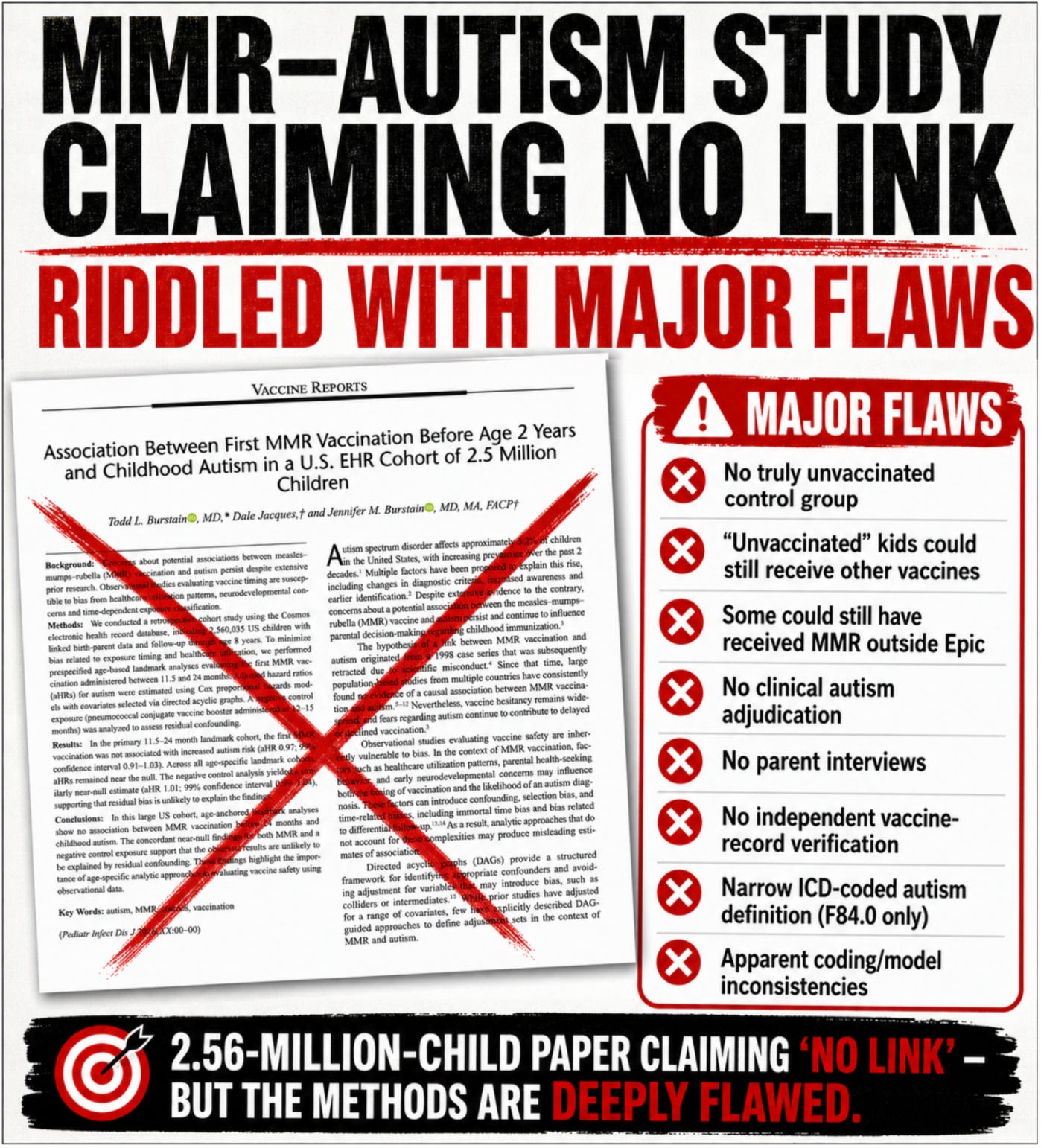
They did not use a truly unvaccinated control group, did not clinically adjudicate autism, did not interview parents, did not independently verify vaccine histories, and used a narrow ICD-coded autism definition.
No True Unvaccinated Control Group
Most importantly, there was no true unvaccinated control group. The comparison children were only those without a recorded MMR vaccination during the relevant analysis. They were not required to be vaccine-naive and could have received other routine childhood vaccines. The study itself reports that 62.1% of the overall cohort received a PCV booster.
Even their MMR status was not independently verified. Vaccination exposure came from Epic records, including historically documented doses, with no reported state immunization-registry confirmation, parent interview, or outside-record review. That means some children classified as “unvaccinated” in the dataset could theoretically have received MMR outside the participating Epic/Cosmos system without that dose being captured.
Autism Was Based on ICD Codes, Not Clinical Adjudication
The study relied entirely on electronic health records. Autism was defined by an ICD-10 F84.0 encounter code, not by independent clinical adjudication, ADOS testing, chart review, or parent interview. Nearly 9% of autism cases had only a single encounter carrying the diagnosis. Vaccine status was likewise taken from Epic records, with no reported state-registry verification, parent confirmation, or external record review.
The Study Did Not Measure the Full Autism Spectrum
The investigators counted only ICD-10 F84.0 “childhood autism,” a relatively narrow diagnostic code, rather than the broader range of autism-spectrum diagnoses captured under F84.. Yet the 3.2% national benchmark they cite reflects that broader autism-spectrum definition. This means their 2.55% autism prevalence is not directly comparable to the national 3.2% figure and may miss children coded under other autism-spectrum categories. The authors themselves acknowledge this limitation and state that future studies should examine the full F84. spectrum.
Serious Methodological Inconsistencies
The supplemental appendix also appears to define maternal diabetes using O23.*, while O23.* is simultaneously used for genitourinary infections in pregnancy. This needs clarification as either a typographical error or a potential coding error in the actual analysis. Sex is also shown as a confounder in the study’s DAG but is absent from the stated primary adjustment model.
Our Comprehensive Autism Paper Exposes the Bigger Problem
This narrow MMR-only analysis must also be viewed against the much broader evidence base. In our recently published paper, Determinants of Autism Spectrum Disorder, we evaluated 136 studies examining childhood vaccines or vaccine components. Of those, 29 reported neutral findings while 107 reported findings interpreted as suggesting a possible association with ASD or other neurodevelopmental disorders across epidemiologic, clinical, mechanistic, neuropathologic, and case-report evidence.
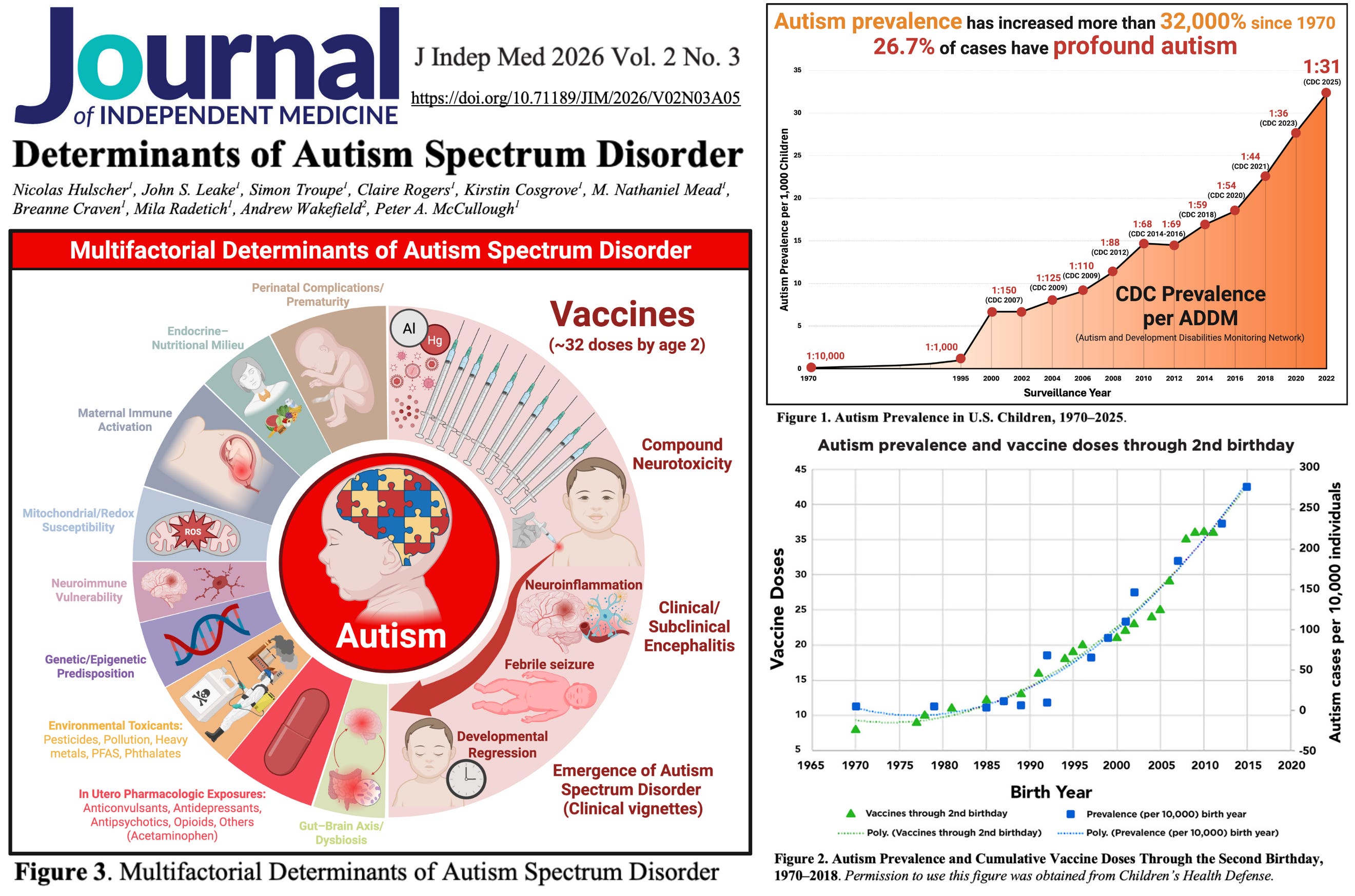
Most importantly, we identified 12 studies that actually compared vaccinated children with completely unvaccinated children. These studies consistently found better overall health outcomes in the unvaccinated cohorts, including lower risks of chronic and neuropsychiatric conditions such as autism.
That is the fundamental problem with studies like this new MMR paper: they repeatedly test one vaccine against children who received other vaccines, then portray the result as evidence against a broader vaccine–autism relationship. No study has yet evaluated the cumulative safety of the entire pediatric vaccine schedule for neurodevelopmental outcomes through later childhood. Based on the evidence so far, childhood vaccines remain a major risk factor for autism spectrum disorder.
Epidemiologist and Foundation Administrator, McCullough Foundation
Support our mission: mcculloughfnd.org
Please consider following both the McCullough Foundation and my personal account on X (formerly Twitter) for further content.
They will try so many ways to hide autism — and one of the biggest ways they’ve hidden is to change the diagnosis. The biggest diagnosis signaling autism is vaccine induced encephalopathy: https://unorthodoxy.substack.com/p/stop-calling-it-autism-start-calling
But what’s make it worse is that it’s hidden; it’s hidden behind propaganda and it’s hidden to sound normal. They are hiding it everywhere while making it normal: https://unorthodoxy.substack.com/p/how-the-dsm-iii-and-tv-shows-rebranded
But thanks to all the works out there, this news is getting out and this ideology is breaking!
Also, I think there is a huge hole of not understanding that when these studies say “vaccinated” they mean …14 days after injection. That conveniently removes any discussion about what might be happening in those first 13 days. It never gets recorded.