


This royal throne of kings, this scepter’d isle,
This earth of majesty, this seat of Mars,
This other Eden, demi-paradise...
This blessed plot, this earth, this realm, this England.-Shakespeare, Richard II
On a recent visit to London I spent days wandering around my favorite spots in South Kensington, Chelsea, and Mayfair, and many happy hours strolling in Kensington Gardens and Hyde Park. I had lunch in the Orangery of Kensington Palace, high tea at the Goring Hotel in Belgravia, and met a friend for lunch at the Savile Club.
One day, an old English friend who happened to be in town for a few days — before returning to his more affordable home base in Kuala Lumpur—joined me for a long walk through Bloomsbury, Soho, and Mayfair. We popped into the Lamborghini showroom on Berkeley Square to gawk at cars. A very young and handsome Dutchman was already there, flirting with the beautiful young woman who worked in the showroom.
“Are you thinking about buying a Lambo?” I asked him.
“Uh, yeah,” he said indecisively, glancing at the girl.
“Are you a scion of an old Dutch East India Company fortune?” I asked.
'Uh, I think so,” he replied.
From Lamborghini, we walked over to James Purdey & Sons to look at handmade shotguns.
“Who are your biggest customers these days?” I asked the man who worked in the main salon.
“Mostly Americans,” he said.
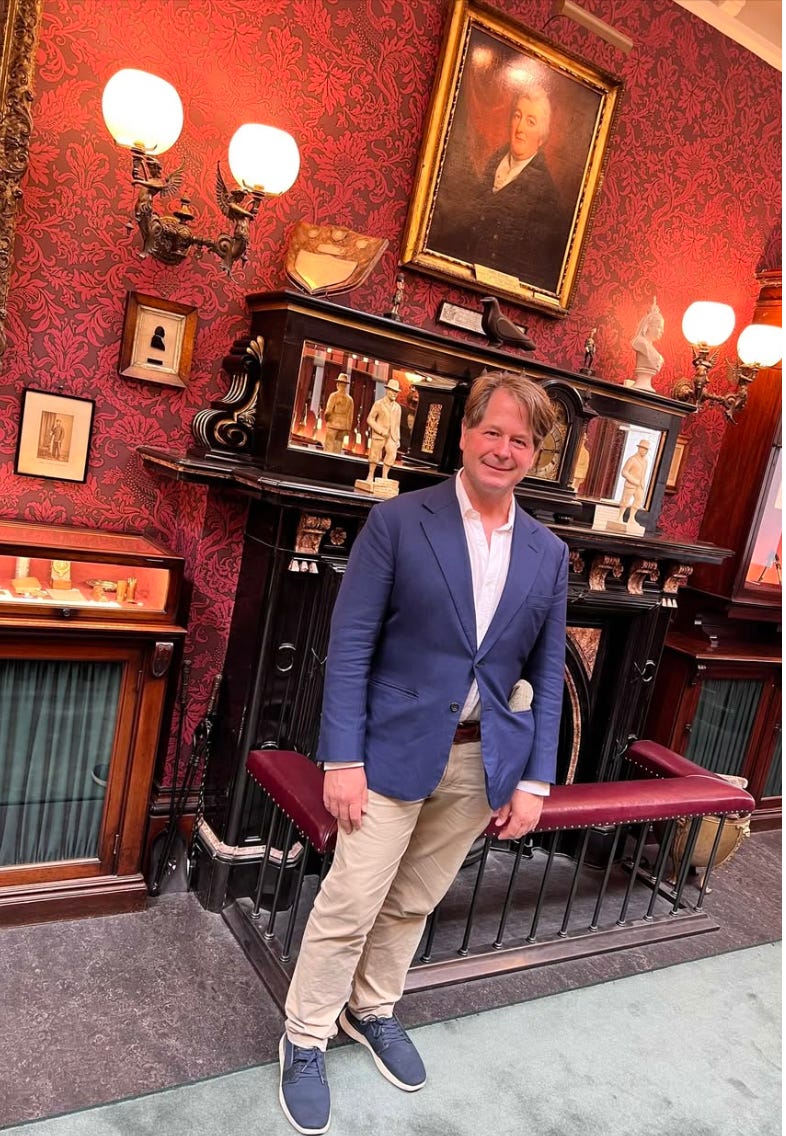
We left Purdey’s and walked to my friend’s club for a beer.
“Say what you want about London, it’s still an incredibly wealthy city,” I observed.
“Yes, but little of the wealth you observe belongs to English people,” he replied. “Few Englishmen can afford these fancy places and products on display in London. In fact, only about thirty-six percent of the population of London is ethnic English.”
One night, at a swanky rooftop birthday party for a City banker, I fell into conversation with a man who took a different view of the matter.
As he told me, “Your rightwing American pundits—guys like Tucker Carlson—are totally exaggerating our problems in this country. All the chatter about excessive immigration and crime and political dysfunction is wildly overblown.”
“I am mainly concerned about the infringement of free speech in this country,” I said.
“There is no infringement of free speech in this country,” he replied.
I mentioned a report in the Times last spring that over 12,000 people had been arrested in Britain in 2023 for online speech violations.
“That’s not true,” he replied.
So, what is the truth about Britain? Survey data of the primary concerns expressed by people in England, Wales, and Scotland are the following:
1. Cost of Living and the Economy
Prices: High inflation and expensive energy bills remain major worries, leaving households dealing with high debt.
Growth: The government is trying to increase the country’s weak productivity and find the money to repair crumbling public services.
2. The National Health Service (NHS)
Wait times: Long delays for routine hospital treatments and emergency care are major concerns.
Funding: The health service faces high demand from an aging population while managing limited budgets.
3. Immigration and Borders
Asylum system: Debates over how to process asylum seekers and control illegal border crossings remain dominant political issues.
4. Housing
Shortages: A lack of affordable housing and high rent prices make finding suitable homes a widespread problem.
5. Climate Change and Energy
Green transition: Moving to clean energy while keeping household utility costs down is a difficult policy balancing act.
These problems apparently proved too much for Sir Keir’s government, prompting to announce his resignation today. He will likely be replaced by Andy Burnham, who previously served as the Mayor of Greater Manchester from 2017 to 2026 and MP for Leigh from 2001 to 2017. Before becoming mayor, he held several cabinet positions, lastly as Secretary of State for Health from 2009 to 2010 under Gordon Brown. He identifies himself as a socialist and part of the soft left faction of the Labour Party.
If I were advising Burnham, I would tell him to start by abolishing the suicidal policies of Green Energy and Russian Bear-Baiting. As I point out in my forthcoming book, Mind Viruses, the irrational obsessions with “climate change” and the Russian bogeyman are extremely profitable for certain financial, industrial, and military interests, but are massively deleterious for the great majority of citizens.
I suspect that Burnham is another globalist stooge who—like Mark Carney in Canada an Friedrich Merz in Germany—will continue the same destructive policies of his predecessor until he, like Starmer, resigns after only a couple of years in office.
I often think of my old professor, Roger Scruton, who died on January 12, 2020, just before the Covid pandemic, and I wonder what he would think about Britain today.
The last time I spoke to him was in November 2018, when I congratulated him for being appointed chair of the UK government’s Building Better, Building Beautiful Commission.
“I doubt I’ll be allowed to keep the position for long,” he replied. “There are many people who don’t want me in it.”
A few months later, on April 10, 2019, I wasn’t surprised by the news that he was fired. His sacking occurred after a journalist named George Eaton, formerly the deputy editor of the New Statesman, published an interview with him. Eaton used partial and edited quotes—wildly out of context—to frame Scuton as a racist and homophobe.
Following the firing, Eaton posted an Instagram picture of himself drinking a bottle of champagne with the caption: “The feeling when you get right-wing racist and homophobe Roger Scruton sacked as a Tory government adviser.”
Scruton spent much of his professional life trying to define and defend England in accordance with his distinctly conservative worldview. Lord Salisbury (Prime Minister 1885 – 1892 and 1895 – 1902) was his ideal British statesman.
Sir Roger knew that his life’s work was an uphill battle. Once, over dinner at his farm, he explained to me that the idealistic project of trying to conserve a culture is doomed by the fact that we only become fully conscious of a culture worth conserving when it is already passing away. To illustrate his point, he cited Hegel’s famous remark in his preface to the Philosophy of Right.
. . . only in the maturity of reality does the ideal appear as counterpart to the real, apprehends the real world in its substance, and shapes it into an intellectual kingdom. When philosophy paints its grey in grey, one form of life has become old, and by means of grey it cannot be rejuvenated, but only known. The owl of Minerva takes its flight only with the gathering of the dusk.
In plain English, “You don’t know what you’ve got until it’s gone.”
Disjointed reply here as low on time…
There is definitely a divide among who will describe the UK as having systemic problems, and especially any to do with immigration or misguided net-zero policies. The educated will discuss things more the way a cookie-cutter educated leftie would in the United States, even if that person espouses some degree of fiscal ‘conservatism’. The cost of living has risen whilst wages and purchasing power have stagnated. GDP is up partly because it includes rents and property values - indicative of bubble money, not productivity or production.
Natural gas is being phased out to be sent to France to be converted to electricity which will then be sent via conduit back to the UK, leaving the UK vulnerable. Coal is gone. Last power station gone. Rights to North Sea oil have been sold. Green credits are going to owners of unused land with trees, for example in Scotland.
Since the Iran war, airlines have been given government permission to reduce overseas flights and cancel flights without usual notice or usual reimbursement to customers. The number of flights offered has halved, while the prices have roughly doubled. Planes are flying with heavier loads than before, as there are fewer of them.
The people are being told to prepare for shortages of fuel in the winter months and a difficult environment (prices and supplies) for heating homes. Likewise, the fuel issues in the Middle East are forecast to affect phosphorus and fertilizer supplies, which may cause later shortages. The UK already only produces 40% of the food it uses.
As in many places, everything costs more now - but there is so little wiggle room for most British people to absorb the excess costs. Even the wealthy are not very rich, and usually not very British. For a time, the welfare state and free higher education did dramatically change the lives and social classes of many people, but the ease of having the good life has waned over the past twenty years, much as in the US.
A leaked white paper from April on Project Cornerstone (I think I mentioned this before) outlines contingency plans on rationing of fuel and goods should things become more difficult, and its framework implementation relies on all persons having a unique identifier within the digital ID system which many think is optional or not up and running, and both of these are incorrect assumptions.
More and more towns and villages are becoming like the cities, very pluralistic and diverse, with new people and populations which many do not feel they have seen before or in such great numbers. Under-used churches are becoming mosques. In-home care work and social care work is heavily saturated with workers from southerly continents. Word has it that these people are recruited, and then encouraged and funded by local councils to start their own companies, and to recruit from their countries. Many of these people work very hard, and do jobs which many natives seem disinterested in or unaware of - but this is the same trope used in the US - so of course not entirely true.
The tabloids, which offer different content to UK IP addresses than to US IP addresses will run stories about grotesque violence against women in parks and on beaches and walking to their cars to go home, usually some time after the event, and always with online reader comments disabled so as not to incite any uprisings. Companies like Serco, hotels, and property management companies offering what are called HMOs to house many people in converted houses are making a lot of money via contracts housing the growing number of migrants that arrive daily, after they are escorted by the coast guard safely across the channel. The costs to house migrants are three quarters of the budgetary black hole deficit Labour is trying to fill through other cuts and increased taxation.
Even access to legal aid or solicitors or lawyers is limited because so many have redirected their services to fulfilling the administrative need for help with asylum claims which amount to a multi-year backlog. Courts are backlogged. While migrants wait, they can have their families join them. As these people plant roots in the UK, they cultivate different legitimate reasons to be granted leave to remain or asylum in the UK because they satisfy Articles 3 & 8 of the ECHR - even if the original threat necessitating asylum is no longer a paramount or a proved concern. Persons and their families who entered the UK under asylum seeking also have completely different access to funded higher education and training programmes. Some would say this is good, but many natives just feel taxed and exploited.
The UK will probably never leave the ECHR. MPs are under no legal obligation to do as their constituents ask, and there really remains the question if all party policies are steered toward a roughly common outcome from some force of decision making at the top of the political food chain.
Businesses on high streets are closing left right and centre because they cannot afford the high tax rates imposed by Labour policies just to maintain facilities. The lower and middle classes continue to bicker online about the alms for the poor and disabled being too generous because they often exceed wages. A majority of disability claimants receive money for mental health disorders, but many things distort the true picture of how well the national health service is not bettering the health of the nation.
Figures will show that native British tend to be high recipients of social welfare benefits, but this is also because many work but are underemployed or earning too little with full employment, and so get top-ups or low income assistance through what is called “Universal Credit”. The elephant in the room is that wages and salaries are stuck in 1986 for a developed nation. Labour recently repealed the two-child benefit limit, but to people with racial sensitivities, they point out that native British are not typically the families which have more than two children. One wonders if the natives would care about the costs helping others if they felt that they were doing well and that their culture and heritage were under no threat of change from heterogeneity of occupation.
Nobody would be surprised if the IMF has to be approached in another year or two.
Socialism is still strong in Wales and anywhere north of the Midlands. Likewise the economic picture of the UK is incredibly bleak when London and or the Home Counties are removed from statistics.
The NHS continues to deliver services through torpid and inept methods to those desperate enough to seek help. Complaints are handled or ignored through services called PILS or PALS which will often do nothing more than help someone attain services they should have been provided in the first place, or perhaps a written apology for ill treatment. Medical negligence legal claims options are narrow under the law and what is permissible would probably offend most who are used to more responsible medical care.
Accident & Emergency department waits are now routinely in excess of 12 hours. Waits to see a GP are 2-4 weeks on average.
The UK suffers through heatwaves with most businesses and individuals having inadequate money to install air conditioning in buildings, or even to pay for recreation in the few buildings which do have it - never mind that there have been significant heatwaves at least for a few days here and there for years, if not decades. The media spin is heavy on catastrophism of climate change.
We expect more taxes, stagnant growth, and no way to get a General Election in time to turn the ship around. Maybe it’s Agenda 2030 in action? NPR got it right today when they said that Burnham represents a change in personality, not a change in policy… And parliament isn’t back until September anyway.
In a country where it rains nine months of the year and yet more essential services are mismanaged, all we can expect is a hose pipe ban due to potable water shortages. No joke.
A woman was sent to prison for 2 1/2 years for saying something mean on social media, yet the fool you spoke to thinks there is no infringement on free speech?