


I knew that Venezuela’s vaunted oil reserves were heavy and sulfurous, but until this morning, I didn’t realize that most Venezuelan oil has the consistency of asphalt and requires enormous volumes of diluents just to get it flowing.
This hard, material fact was the primary reason why Venezuela’s economy began to falter in the 1980s and 1990s. I still remember vividly in 1998 when the price of West Texas Intermediate Crude dropped to $11 per barrel. I grew up in Texas and my grandfather was an oil industry banker, so I was paying very close attention.
At that price, there was no way anyone could make any money extracting and refining Venezuelan heavy crude.
Faced with this hard economic reality in a nation that had become hopelessly dependent on oil — a textbook case of the “oil curse” that causes oil rich countries to fail to diversify and develop their human resources — the increasingly poor people of Venezuela elected Chavez on his old Latin American platform that rich Yankees and other foreigners were getting too rich off of Venezuelan oil and depriving the Venezuelan people of their rightful share.
In 2007, Chavez imposed new rules requiring a minimum 60% state (PDVSA) stake in oil projects, particularly in the Orinoco Belt, which transformed previous joint ventures into minority partnerships for foreign firms like ExxonMobil, ConocoPhillips, and Chevron. This augmented the original 1976 nationalization under President Carlos Andrés Pérez, which created PDVSA but later allowed private investment.
Chevron accepted the new terms and continued to make a modest profit on its 40% when oil prices were high enough to do so. ExxonMobile and ConocoPhillips were butthurt and complained to their buddies in Washington. In 2014, Obama (ever the Wall Street lackey) imposed sanctions, and President Trump significantly increased them in 2017.
In addition to the high cost of extracting and refining Venezuela crude and the usual Banana Republic corruption and mismanagement, U.S sanctions had a crippling effect on the Venezuelan economy—the final push that sent over 90% of Venezuelan households under the poverty level.
This brings me to the big question of this post: What would U.S. Marine Corps Major General Smedley Butler say about the situation in Venezuela?
At the time of his death in 1940, he was the most decorated Marine in U.S. history. During his 34-year career, he fought in the Philippine–American War, the Boxer Rebellion, the Mexican Revolution, and World War I.
However, at some point after World War I, he began to have grave doubts about his profession. Over time, with study and reflection, he concluded that he had NOT spent his life fighting and killing for the American people, but for special interests in New York City and Washington.
As he memorably stated it in his 1935 book, War is a Racket:
I helped make Mexico, especially Tampico, safe for American oil interests in 1914. I helped make Haiti and Cuba a decent place for the National City Bank boys to collect revenues in. I helped in the raping of half a dozen Central American republics for the benefits of Wall Street. The record of racketeering is long. I helped purify Nicaragua for the international banking house of Brown Brothers in 1909-1912. I brought light to the Dominican Republic for American sugar interests in 1916. In China I helped to see to it that Standard Oil went its way unmolested.
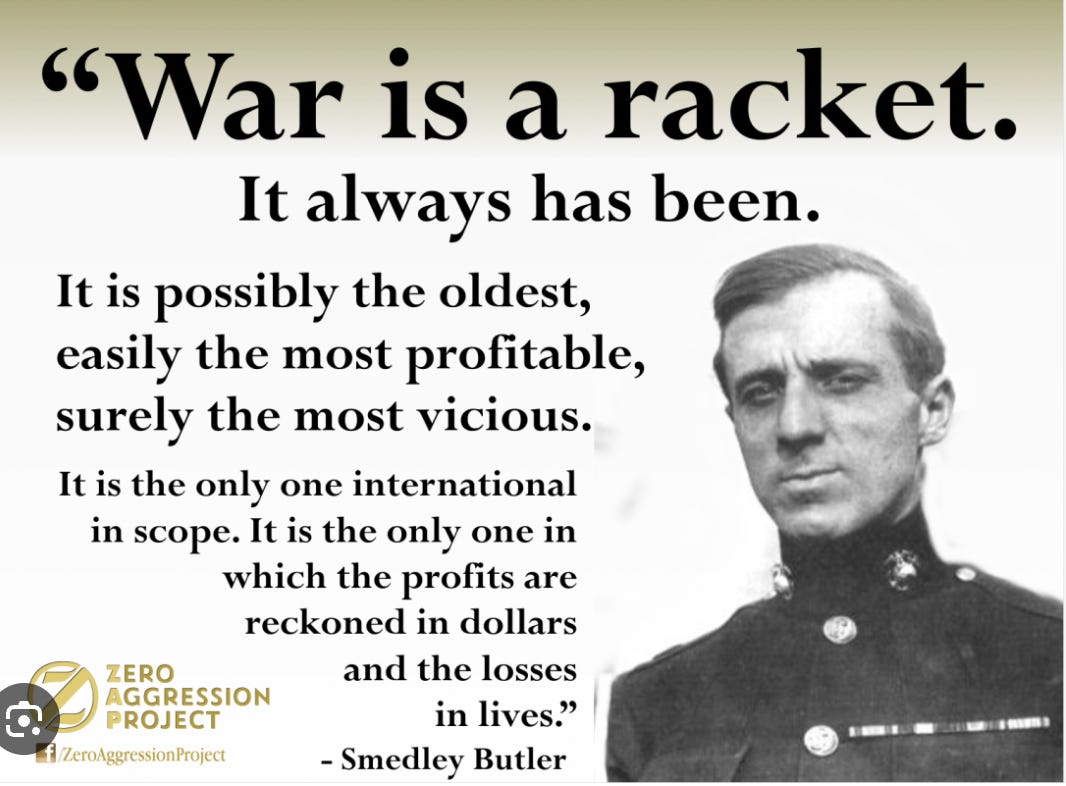
The situation in Venezuela is a classic Smedley Butler scenario. Oil is discovered in a poor Latin American country with grossly undeveloped institutions—a country that has long struggled to develop and diversify its economy. Major U.S. oil companies go in to develop the oil industry so that they can (understandably) take a handsome share of the profits.
However, lack of diversification, corruption, and the usual shortcomings of such underdeveloped nations bring the oil companies into conflict with the nation’s inept political establishment.
The oil companies complain to their friends in Washington, and Smedley Butler is sent in to rectify the situation for the benefit of the oil companies.
However, in the case of Venezuela, the situation will almost certainly prove to be far more complicated and costly for the American taxpayer, because it will takes many years and billions of investment to make the Venezuelan oil industry profitable. The U.S. government will doubtless offer rich incentives and military protection to U.S. oil companies to great cracking.
The Venezuelan people will probably enjoy a quick benefit from U.S. sanctions being lifted, and this amelioration of their poverty will doubtless—in a very loud and boastful way—be attributed to U.S. brilliance, conveniently overlooking that it was the U.S. that imposed the crippling sanctions in the first place.
However, it will still take take years to elevate living standards of ordinary Venezuelans in a meaningful way. In the meantime, the U.S. will likely be obliged to respond to whatever civil unrest and instability occurs in the years ahead in order to protect its renewed investment in the Venezuelan oil industry.
The CIA’s practice of paying off assorted troublemakers with billions of dollars of U.S. taxpayer money is now widely understood and has created a perverse incentive for assorted troublemakers to make trouble so that they will get paid.
The notion that Maduro’s abduction was not an act of war is silly. The CIA handsomely paid off his security apparatus to stand down so that a Delta Force team could waltz into his palace and grab him without suffering a single casualty.
Going forward, if the U.S. wants to consistently exert its will over the country and its new puppets, it will have to demonstrate that it is willing to use military force to back it up.
Maybe this latest U.S. intervention in the affairs of a highly dysfunctional state will prove to be easy and beneficial for all parties involved. I certainly hope so, but I doubt it will be nearly as easy as Trump’s childish sycophant supporters seem to think.
And for the record: I like President Trump and have consistently supported and defended him since 2016, often at the cost of social ostracism. As a free citizen and educated man, I will always insist on my right to criticize my president, no matter how much I like him personally. I’ve never kissed anyone’s ass in my entire life, and at the age of 55, I’m not about to start doing it now.
Even as Canadians, it’s difficult not to feel a warm, vicarious pride in all the winning our American neighbours managed to rack up—watching, from a safe distance, as President Trump, acting conspicuously in alignment with Israeli strategic interests, allegedly green-lit the CIA to remind the world that national sovereignty is less a rule than a flexible suggestion.
In one decisive flourish, a foreign president and his wife were removed for safekeeping, a regime change pencilled neatly into the schedule, and an oil-rich nation’s resources politely earmarked for redistribution under a more agreeable leadership—one reliably aligned with U.S. and Israeli regional priorities.
The $1 billion cost of the operation, of course, will be graciously covered by American taxpayers. A trivial inconvenience, really—especially in a country that somehow never seems to have that same $1 billion available for healthcare, education, or addressing domestic crises. But priorities must be respected.
More impressive still is the efficiency of it all: a government that can bypass Congress to apprehend a foreign head of state halfway across the globe, yet remains curiously powerless to pursue well-documented figures on the Epstein list at home. Sovereignty abroad, paralysis at home—a truly remarkable balance.
And how comforting it is to know the estimated $17 trillion in newly liberated oil wealth will be shared so equitably with the public—by which we naturally mean the billionaires, who will now enjoy the rare honour of graduating into the exalted ranks of multi-billionaires.
Yes. The winning. So much winning. One almost forgets to ask who’s paying for it—and who’s cashing in.
#sarcasm
I'll take the racket of war for oil over the suicide of solar panels any day.