


By Peter A. McCullough, MD, MPH
The person closest to me in life has suffered miserably for about 9 months with a shoulder injury after doing a workout with weights. I am observing in real time the development of a frozen shoulder.
📈 Prevalence of Frozen Shoulder in the General Adult Population
The commonly cited figures:
General adult prevalence: roughly 2–5% of the population at any given time
Lifetime incidence: about 2–5%, with some studies pushing toward 5–10% depending on how strictly the diagnosis is defined
Annual incidence: approximately 3–5 per 1,000 people per year in primary care settings — some Western population studies land in the 2–4% range over a lifetime
In a country of 360 million, that is several million people walking around with a shoulder that will not move.
👥 Who Gets Hit Hardest
The distribution is not random:
Age: Peak onset is 40–60 years — the “shoulder decade” where cumulative wear meets declining tissue elasticity
Sex: Women are affected more than men, roughly 60–70% of cases in most series
Side: Non-dominant shoulder is often involved first, though the dominant side is not spared
Bilateral / sequential: The opposite shoulder is at meaningful risk — commonly quoted at 10–30% — and a small fraction develop it in both shoulders
🩺 The Risk Multipliers
Certain conditions turn a 3% baseline risk into something far higher:
Diabetes mellitus: the single biggest risk factor. Prevalence of frozen shoulder in diabetics is often cited at 10–20%, and it can run higher in long-standing or poorly controlled disease. It also tends to be more severe, more bilateral, and more resistant to treatment
Thyroid disease (both hypo- and hyperthyroidism)
Dupuytren’s contracture and other fibrotic conditions
Cardiac disease and stroke — partly via immobilization
Prolonged immobilization after any injury or surgery — the exact mechanism discussed above
🔢 The Alarming Attack Rate
Here is the framing that matters clinically:
Roughly 1 in 20 to 1 in 50 adults will develop adhesive capsulitis at some point — and a large share of those cases begin with a shoulder injury that was immobilized too long.
That is the preventable fraction. The injury is not the disaster. The weeks of guarding and stillness afterward are. Early range of motion is what stands between a 3% population risk and an individual patient’s personal one-to-three-year problem.
🦴 Frozen Shoulder: How Joint Injuries Quietly Become a Debilitating Trap
Adhesive capsulitis — frozen shoulder — is one of the most frustrating conditions in musculoskeletal medicine. It is common, it is painful, it is slow, and it is stubborn. And in the overwhelming majority of cases, it does not appear out of nowhere. It is the endpoint of a process that usually starts with something much more mundane: an injury, a period of guarding, and then a shoulder that simply stops moving.
🔬 What Actually Happens Inside the Joint
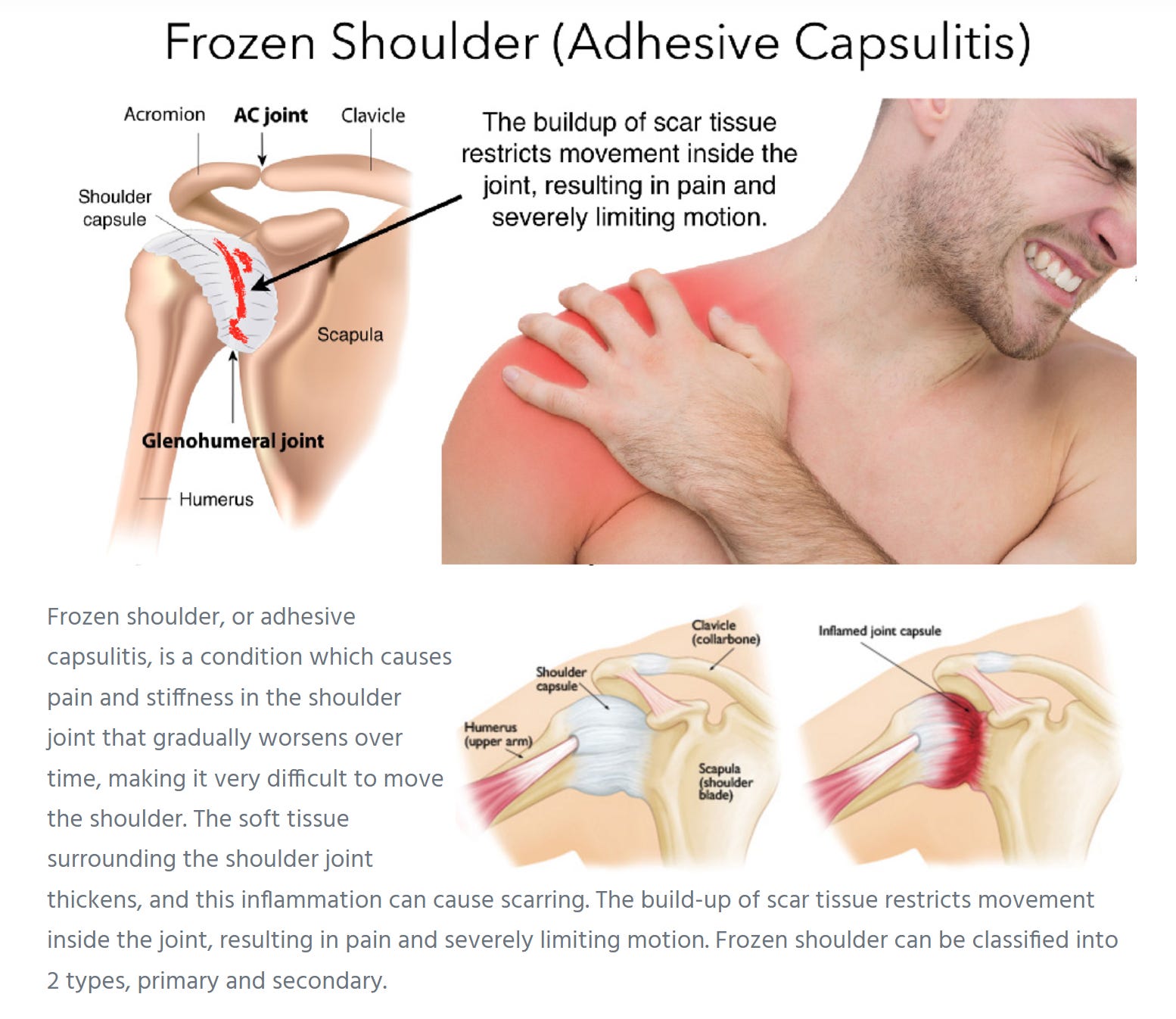
The shoulder is a ball-and-socket joint, but it is a shallow, unstable one held together largely by soft tissue. The key structure is the glenohumeral joint capsule — a fibrous envelope lined with synovium that surrounds the joint and, in health, is loose and elastic enough to allow roughly 180∘180^\circ180∘ of elevation and full rotation.
In adhesive capsulitis, that capsule undergoes a characteristic pathologic transformation:
Synovial inflammation — the lining becomes hypervascular and inflamed, producing pain
Fibrotic contracture — the capsule thickens and shrinks, especially in the anterior-inferior coracohumeral ligament and the rotator interval
Loss of capsular volume — the normally capacious joint space (roughly 20–30 mL20\text{–}30\ \text{mL}20–30 mL) can shrink dramatically, which is why arthrography historically showed a reduced, tight joint
The result is the classic triad: pain, stiffness, and loss of both active and passive range of motion — the last point is critical, because passive restriction distinguishes a true capsular problem from a purely muscular or tendon-based one.
🔄 The Three Phases
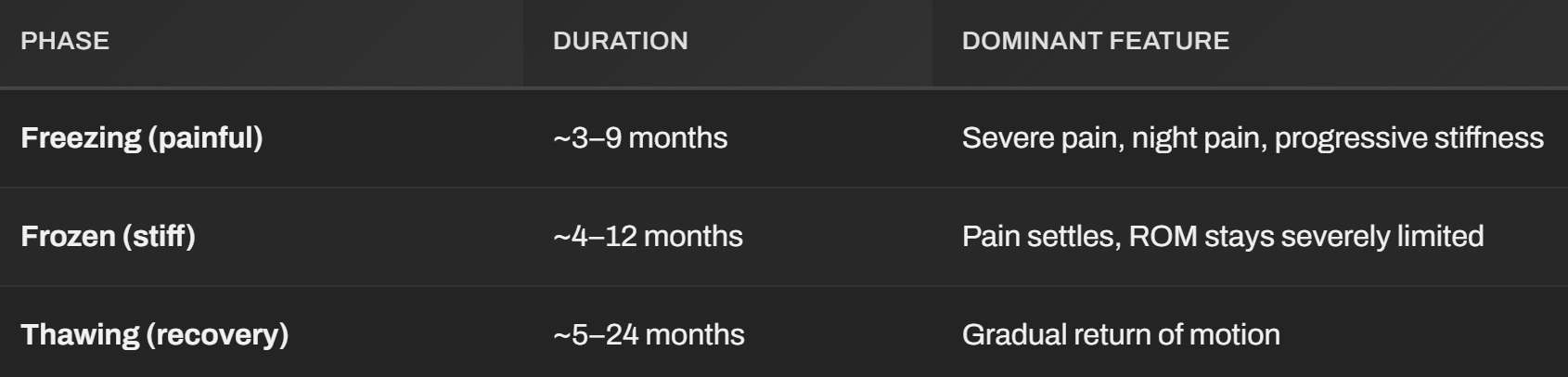
Total course can run 1–3 years, and a meaningful minority of patients — often cited in the range of 20–40% — are left with persistent restriction. Diabetics fare worse, sometimes dramatically so.
🧩 Inside the Joint: Rotator Cuff Injury as the Trigger
The rotator cuff — supraspinatus, infraspinatus, teres minor, subscapularis — is the dynamic stabilizer of the glenohumeral joint. It is also the most commonly injured structure in the shoulder.
When the cuff is torn, tendinopathic, or acutely inflamed:
Pain inhibits movement. The nervous system does what it is designed to do — it splints the injured area.
Guarding becomes habitual. What begins as protective immobilization becomes an entrenched movement pattern.
The capsule loses its stimulus to stretch. Capsules are like any connective tissue: without mechanical loading they shorten and stiffen. Hyaluronan turnover drops, collagen cross-linking increases, and the tissue literally remodels toward contracture.
This is the pivot point. A cuff injury that would otherwise heal becomes a frozen shoulder because the patient never restores motion. The tissue that needed to glide now scars into place.
🧩 Outside the Joint: Bicipital Tendinitis and the Same Trap
Not every culprit is intra-articular. Bicipital tendinitis — inflammation of the long head of the biceps tendon as it runs through the bicipital groove and into the joint — produces pain in the anterior shoulder that radiates down the arm.
The mechanism is identical in outcome:
Anterior shoulder pain causes the patient to avoid flexion, abduction, and external rotation
The capsule, especially the anterior capsule and rotator interval, is precisely the region that goes unstretched
The anterior capsule is also where adhesive capsulitis concentrates its fibrosis
So a problem that is technically extra-articular — tendon sheath inflammation — drives an intra-articular catastrophe. Subacromial bursitis, AC joint pathology, and even cervical referred pain can do the same thing. The shoulder does not much care where the pain originates; it responds the same way, by shutting down.
⚠️ Why Frozen Shoulder Is So Hard to Treat
Frozen shoulder resists treatment for several structural reasons:
The pathology is mechanical and fibrotic, not simply inflammatory. Anti-inflammatories help the pain but do not reverse contracture.
You cannot stretch a capsule that is too painful to move. Pain and stiffness fight each other — movement is the cure, but movement hurts.
The natural history is long, so both patient and clinician lose patience.
Recurrence in the same shoulder is uncommon, but the contralateral shoulder is at real risk — often quoted around 10–30% — which tells you the underlying diathesis (diabetes, thyroid disease, Dupuytren’s, prolonged immobilization) matters as much as the local injury.
Interventions are limited: corticosteroid injection, hydrodilatation, manipulation under anesthesia, arthroscopic capsular release. All have a role, all have downsides, none substitutes for restoring motion.
✅ The Essential Point: Motion Is the Medicine
Here is the practical takeaway that matters more than any of the above.
Any shoulder injury — inside or outside the joint — should be managed with early, protected range of motion. Not aggressive stretching into pain, but consistent, low-grade movement that preserves capsular elasticity and prevents the fibrotic cascade from taking hold.
Pendulum exercises in the acute phase
Passive and active-assisted ROM as pain allows
Gradual progression to active ROM and strengthening once the acute phase resolves
Treating the underlying driver — cuff rehab, biceps tendon management, diabetes control

The window matters. A cuff tear or a bout of bicipital tendinitis is a treatable problem. Let the shoulder sit still for six to twelve weeks, and you have converted a recoverable injury into a one-to-three-year ordeal that may never fully resolve.
Range of motion exercise is not an optional adjunct. It is the primary prevention strategy against adhesive capsulitis — and the single most important thing a patient can do after any shoulder injury to avoid the frozen shoulder trap.
📝Please subscribe to FOCAL POINTS as a paying ($5 monthly) or founder member so we can continue to bring you the truth. AlterAI may be used to assist in searches, synthesis, and review.
Peter A. McCullough, MD, MPH
President, McCullough Foundation
FOCAL POINTS has partnered with AlterAI to support independent research and open inquiry. Subscribe to AlterAI today and get a discount on unbiased and accurate AI!

DMSO!