


By Peter A. McCullough, MD, MPH
Many of you have either first-hand knowledge of colonic diverticulosis (process of developing small outpouchings) or symptomatic diverticulitis (obstruction and infection) manifested by abdominal pain, fever, and colonic bleeding.
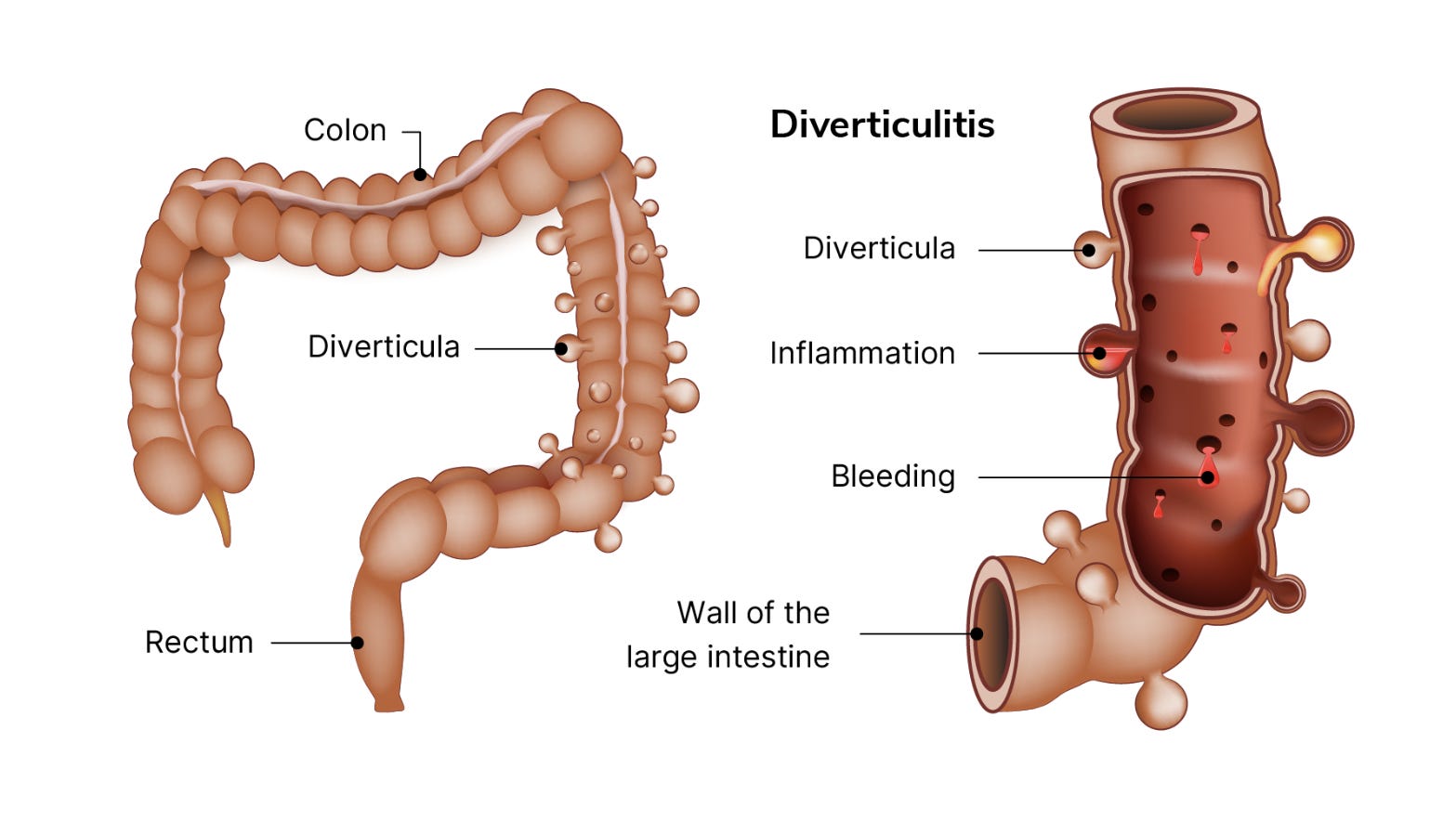
Diverticulosis, Diverticulitis, and the Fiber Deficit: How Diet Determines Destiny
Diverticular disease is among the most common gastrointestinal conditions in the industrialized world, yet it is almost comically misunderstood by the general public. Many people carry the vague impression that it is an inevitable consequence of aging — a sort of plumbing failure that strikes at random. The reality is closer to the opposite: diverticulosis is a disease of what we eat, and it tracks the Western diet with embarrassing precision. A colon fed primarily on refined starch and animal protein develops structural weaknesses; a colon fed on plant fiber remains resilient. What follows is an examination of how a lifelong high-fiber diet protects against diverticular disease, how meat and starch undermine the colon wall, and why processed starchy snack foods are the single worst offender.
🥦 The Protective Anatomy of Fiber
To understand why fiber matters, you have to understand the mechanics of the colon itself. The large intestine is a muscular tube whose job is to squeeze, compact, and expel waste. That squeezing generates intraluminal pressure — pressure inside the tube. When stool is bulky, soft, and well-hydrated, the colon does its work with modest, evenly distributed contractions. But when stool is small, hard, and dry, the colon must generate dramatically higher pressures to move it along. It is this repeated high-pressure straining, concentrated at points where blood vessels penetrate the bowel wall, that eventually forces the inner lining (mucosa) to herniate through the muscular layer, forming the small outpouchings we call diverticula.
Fiber, specifically insoluble fiber from fruits and vegetables, is the primary determinant of stool bulk. Cellulose, hemicellulose, and lignin do not dissolve in water; they pass through the gut largely intact, absorbing water and swelling into a soft, voluminous mass. This does three things:
Reduces transit time — waste moves through faster, so the colon wall is exposed to pressure for less time.
Lowers intraluminal pressure — a bulky stool is easier to move, so the muscular contractions are gentler.
Feeds the microbiome — the soluble fiber fraction (pectin, inulin) ferments in the colon, producing short-chain fatty acids like butyrate, which nourish the colonic epithelium and maintain the integrity of the mucosal barrier.
The epidemiological evidence for this is overwhelming and consistent. The classic observation, repeated in every gastroenterology textbook, comes from Burkitt and Painter in the 1970s: rural African populations eating 50–100 grams of fiber daily had a prevalence of diverticulosis approaching zero, while their Western counterparts on 10–15 grams daily developed the condition at rates exceeding 30–50% by age 60. When members of those same low-fiber populations migrated to Western cities and adopted Western diets, their diverticulosis rates climbed to match the locals within a generation. Genetics did not change; the food did.
Modern prospective cohorts tell the same story. The Health Professionals Follow-Up Study found that men in the highest quintile of dietary fiber intake had roughly a 40% lower risk of developing symptomatic diverticular disease than men in the lowest quintile. The protective association was strongest for insoluble fiber — the kind found in the skins and structural parts of fruits and vegetables. Notably, the protection was dose-dependent and independent of red meat intake, meaning fiber itself, not merely the absence of meat, was doing the work.
The mechanism by which a high-fiber diet prevents diverticulitis (the acute inflammation of diverticula) is equally clear. Diverticulitis is thought to arise when fecal material stagnates inside a diverticulum, causing local ischemia, bacterial overgrowth, and micro-perforation. A colon with brisk, bulky, regular transit sheds these pockets continuously; a colon with slow, hard, infrequent stools allows material to lodge and fester. Fiber, in short, keeps the diverticula flushed.
🥩 The Meat-and-Starch Problem
If fiber is the shield, the standard Western pattern — heavy animal protein and refined carbohydrate — is the battering ram. The relationship between meat, starch, and diverticulosis operates through two distinct but compounding pathways: pressure and constipation.
The Constipation Engine
A diet built around meat and refined starch is, by construction, a low-residue diet. Muscle meat contains essentially no fiber — zero grams, regardless of cut or quality. White flour, white rice, and peeled potatoes have had their fibrous outer layers stripped away during milling and processing; what remains is almost pure starch, which is digested and absorbed rapidly in the small intestine, leaving very little bulk for the colon. The result is a small, hard, dehydrated stool that the colon must squeeze against with maximum force. This is the precise mechanical condition — chronic high intraluminal pressure — that drives mucosal herniation.
The Health Professionals Follow-Up Study quantified this directly. Men eating a “Western” dietary pattern (high in red meat, refined grains, and sweets) had roughly a 50% higher risk of diverticulitis compared to those eating a prudent, fiber-rich pattern. A separate analysis found that each serving of red meat per day was associated with a measurable stepwise increase in risk, an effect that held even after adjusting for fiber intake — suggesting red meat is not merely a marker of low fiber, but contributes independently.
Meat’s Independent Contribution
There are several proposed mechanisms for meat’s independent effect. Red meat is high in heme iron and undergoes nitrosation in the gut, generating N-nitroso compounds that are pro-inflammatory to the colonic mucosa. Red meat also alters the gut microbiome, favoring bile-tolerant, putrefactive bacteria at the expense of the fiber-fermenting species that produce butyrate. A colonic epithelium starved of butyrate is weaker and more susceptible to the mechanical stress that forms diverticula. The net effect is a bowel wall that is both pushed harder (by hard stools) and weakened (by inflammation and poor epithelial nutrition). This may come as somber news for MAHA keto-carnivore enthusiasts.
Starch deserves its own indictment. Refined starch is not inert filler; it is rapidly absorbed glucose that spikes insulin, promotes systemic low-grade inflammation, and — critically for the colon — leaves almost nothing behind as residue. The term “binding” in dietary parlance is not metaphorical: high-starch, low-fiber diets genuinely produce the small, tenacious stools that clinicians associate with straining and elevated colon pressure. Potatoes, rice, and white bread are the archetypal examples of foods that fill the stomach but empty the bowel of what it needs. Because starch is about 60% of the American diet in terms of calories, diverticulosis can be thought of as “bread-eaters disease.”
🍪 Processed Starchy Snacks: The Worst of All Worlds
If meat and refined starch each independently burden the colon, the modern processed snack combines them with additional harms, and it does so in a form engineered to be eaten in excess. Cookies, crackers, chips, pastries, and similar products represent a perfect storm for diverticular disease:
Zero meaningful fiber. These products are built from refined white flour and/or potato starch, with any fiber stripped away and never restored. A serving of potato chips contains effectively no fiber; a pastry contains none.
Concentrated starch plus fat. The combination of refined carbohydrate and industrial fat produces a highly caloric, highly palatable food that slows gastric emptying but still delivers almost no colonic residue — the worst possible configuration for stool bulk and transit.
Added sugar and refined oils. Both promote systemic inflammation, which impairs tissue repair in the colon wall and worsens the low-grade mucosal inflammation that predisposes diverticula to become infected (diverticulitis).
Displacement of protective foods. Every calorie consumed as a cracker or cookie is a calorie not consumed as a vegetable, fruit, or legume. The harm is therefore twofold: direct damage plus the opportunity cost of lost protection.
The association between processed-food consumption and diverticular disease is robust. Studies examining dietary patterns consistently find that individuals whose diets are dominated by ultra-processed foods — and specifically refined-grain snack products — have significantly higher rates of both diverticulosis and diverticulitis. The Nurses’ Health Study and Health Professionals Follow-Up Study both identified “Western” dietary patterns (of which processed snacks are a core component) as independently predictive of diverticulitis risk, with the highest-risk consumers facing roughly double the odds of low-risk consumers. The mechanism is not mysterious: these foods simultaneously maximize intraluminal pressure, minimize stool bulk, and inflame the mucosa — the three ingredients of diverticular pathology in a single package.
It is worth stating plainly: diverticulosis is not a random affliction of the elderly. It is a predictable, dose-dependent consequence of a low-residue, high-starch, high-meat diet, and the epidemic levels seen in Western nations are a direct product of that dietary pattern. The colon is a mechanical and biological system, and it responds to what it is fed. Feed it fiber from fruits and vegetables across a lifetime, and it handles pressure gracefully. Feed it meat, starch, and processed snack foods, and the wall eventually gives way.
📝Please subscribe to FOCAL POINTS as a paying ($5 monthly) or founder member so we can continue to bring you the truth. AlterAI may be used to assist in searches, synthesis, and review.
Peter A. McCullough, MD, MPH
President, McCullough Foundation
FOCAL POINTS has partnered with AlterAI to defend your medical freedom. Subscribe to AlterAI today and get a discount on unbiased and accurate AI!

📚 References
Burkitt, D. P., Walker, A. R. P., & Painter, N. S. (1972). Effect of dietary fibre on stools and transit-times, and its role in the causation of disease. The Lancet, 300(7792), 1408–1411.
Painter, N. S., & Burkitt, D. P. (1971). Diverticular disease of the colon: A deficiency disease of Western civilization. British Medical Journal, 2(5759), 450–454.
Aldoori, W. H., Giovannucci, E. L., Rockett, H. R., Sampson, L., Rimm, E. B., & Willett, W. C. (1998). A prospective study of dietary fiber types and symptomatic diverticular disease in men. The Journal of Nutrition, 128(4), 714–719.
Strate, L. L., Liu, Y. L., Aldoori, W. H., Syngal, S., & Giovannucci, E. L. (2009). Obesity increases the risks of diverticulitis and diverticular bleeding. Gastroenterology, 136(1), 115–122.
Strate, L. L., Keeley, B. R., Cao, Y., Wu, K., Giovannucci, E. L., & Chan, A. T. (2017). Western dietary pattern increases, and prudent dietary pattern decreases, risk of incident diverticulitis in a prospective cohort study. Gastroenterology, 152(5), 1023–1030.
Crowe, F. L., Appleby, P. N., Allen, N. E., & Key, T. J. (2011). Diet and risk of diverticular disease in Oxford cohort of European Prospective Investigation into Cancer and Nutrition (EPIC): Prospective study of British vegetarians and non-vegetarians. BMJ, 343, d4131.
Peery, A. F., Barrett, P. R., Park, D., et al. (2012). A high-fiber diet does not protect against asymptomatic diverticulosis. Gastroenterology, 142(2), 266–272.
I have had diverticulosis twice in recent years. The first time was a result of substituting sugar with xylitol for my coffee, and the second time was when a coffee cream manufacturer substituted sugar with sucralose. On both occasions reversing the condition was simple, stop consuming that biome destructive poison.
My mother had diverticulosis in the late 60s. She had multiple bowel surgeries and eventually a colostomy.
I have 2 siblings. We're all in our 70s. We were all told that we have diverticula following our first colonoscopy. We were all well aware that fiber intake was suppose to reduce the possibility of diverticula/diverticulosis before getting our colonoscopies.
My sister and I have eaten a high fiber diets and take a fiber supplement starting whenever this was recommended. Not sure about my brother. My sister has been hospitalized twice with diverticulosis and my brother once. So far I've never had diverticulosis.
A study...
A High-Fiber Diet Does Not Protect Against Asymptomatic Diverticulosis
https://www.gastrojournal.org/article/S0016-5085(11)01509-5/fulltext
"In this colonoscopy-based study, a high-fiber diet did not protect against asymptomatic diverticulosis. Instead, we found that a high-fiber diet was associated with a higher prevalence of diverticula. The association was both dose-dependent and stronger when limited to cases with ≥3 diverticula. The risk was increased for total fiber, fiber from grains, soluble fiber, and insoluble fiber. Although constipation is conventionally thought to predispose to diverticulosis, we found that less frequent bowel movements were associated with a decreased prevalence of diverticulosis. No associations were found between the presence of diverticulosis and red meat intake, fat intake, or physical activity. The only expected finding was that the prevalence of diverticulosis increased with age."