


A friend just sent us the following New York Times report from March 2, 1991.
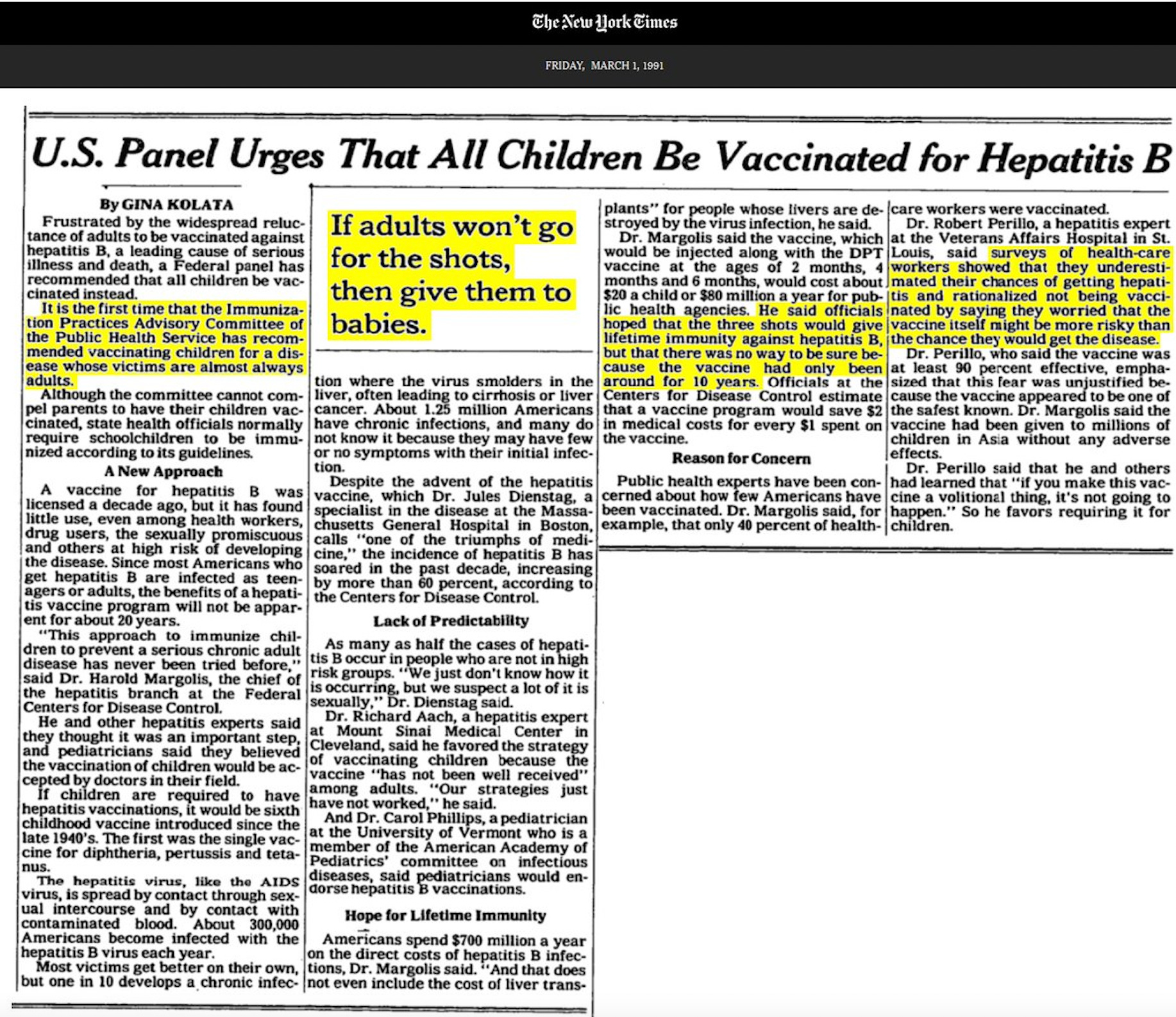
Back then, it was estimated that approximately 300,000 Americans (out of population of 252 million) were infected with Hepatitis B each year, mostly through sexual intercourse and contact with infected blood.
In 1991, the CDC ACIP panel added the Hep B vaccine part of the childhood schedule. The rationale was that, because so many sexually promiscuous adults refused to get the shot, the only way to deal with the problem was to administer the vaccine to ALL infants, with the first shot administered within 24 hours of birth.
Note that there are reliable tests for Hepatitis B infection that can be administered to pregnant mothers or women contemplating having a child. In the event of a positive test, it would be appropriate to administer a Hep B vaccine to the newborn, as the shot can be effective as a post-exposure prophylaxis.
But what about mothers in a committed, monogamous relationship and/or those who have received a negative Hep B test?
The CDC claims that adding the shot to the childhood schedule has markedly reduced the incidence (new infections diagnosed each year) of Hepatitis B in the American population, from 8.5 per 100,000 in 1990 to less than 1 per 100,000 today.
However, this claim is not entirely consistent with Hepatitis B prevalence today compared to its prevalence in 1990. Back then, 1.25 million Americans (in a population of 252 million) were estimated to be living with Hepatitis B infection. Today, the estimate widely varies between 850,000 to over 2 million (in a population of 345 million). With the CDC’s much touted reduction of incidence, it seems like the prevalence number would have come down more.
Making the Hepatitis B vaccination part of the childhood schedule is typical of the U.S. government’s practice of acting like an all knowing “father figure” who regards ALL citizens as irresponsible children who cannot be allowed to make important decisions on their own.
The concept of a married (monogamous) couple that makes prudent reproductive decisions does not seem to be part of the CDC ACIP calculus.
Vaccinating newborns is either profoundly evil or stupid. Newborns are protected for several weeks after birth by their mother's immune system through colostrum in the first breast feeding. This is important as newborns do not have a functioning adaptive immune system until two to three weeks after birth. Immunizing a newborn only inflicts a dose of toxins euphemistically called antigens, adjuvants, preservatives, and manufacturing residuals.
Great rationale John! The less the government thinks for us (usually actually trying to damage or murder us) the better!