


Lord Salisbury used to complain to his officials during Jingoistic outbreaks that it was like having "a huge lunatic asylum at one's back.”
—Andrew Roberts, Salisbury, Victorian Titan
The prodigious number of Iran war advocates who commented on my last post, “One Man”: Tucker Carlson’s Mission to Save the Republic,” reminded me of a post that I wrote a while back about Traumatic Brain Injuries.
When I was living in Menlo Park, California in the years 2011-2015, I knew an affluent, patriotic man who was a benefactor the VA hospitals in Palo Alto and Menlo Park. He introduced me to a psychiatrist with whom I got to be pals, and on a few occasions I was given permission to accompany him when he visited his patients.
By far the most common injury I saw was what neurologists call a Traumatic Brain Injury (TBI). According to the National Institutes of Health (Occupation and Risk of Traumatic Brain Injury in the Millennium Cohort Study) from 2000 to 2021, an estimated 449,026 active-duty U.S. service members experienced a TBI. These injuries were often caused by combat-related incidents, such as explosive blasts, and are considered a “signature injury” of post-9/11 conflicts.
The vast majority of these injuries are considered mild, but a “mild” diagnosis is cold comfort for those suffering from the syndrome and their family members, as mild symptoms include:
Headache
Dizziness
Nausea and vomiting
Fatigue
Sensitivity to light or noise
Blurred or double vision
Balance problems
Cognitive: Confusion or difficulty concentrating, memory loss or problems with recall, Difficulty with attention or problem-solving, and slowed thinking or processing speed.
Emotional: Irritability or mood swings, anxiety or depression, difficulty sleeping, and changes in appetite.
Other: Ringing in the ears, loss of consciousness (briefly), and seizures (rare).
The following 2023 news segment presents a pretty good overview of the epidemic. Note that, as of this posting, it has only received 235 views.
Though I haven’t analyzed it, I suspect that the TBI epidemic is related to the epidemic of suicide among U.S. service personnel. According to the 2021 Brown University Cost of War Project, since 2001, 30,000 active-duty personnel and veterans of post-9/11 conflicts have died by suicide as of June 2021.
A remarkable feature of many severe cases of TBI is that they were not caused by a penetrating object such as shrapnel or a gunshot, but by the shockwave generated by a roadside bomb.
Most of the patients I visited had been diagnosed with moderate to severe TBI, and were profoundly debilitated. Their young lives—and the lives of their young wives and children—were totally destroyed forever.
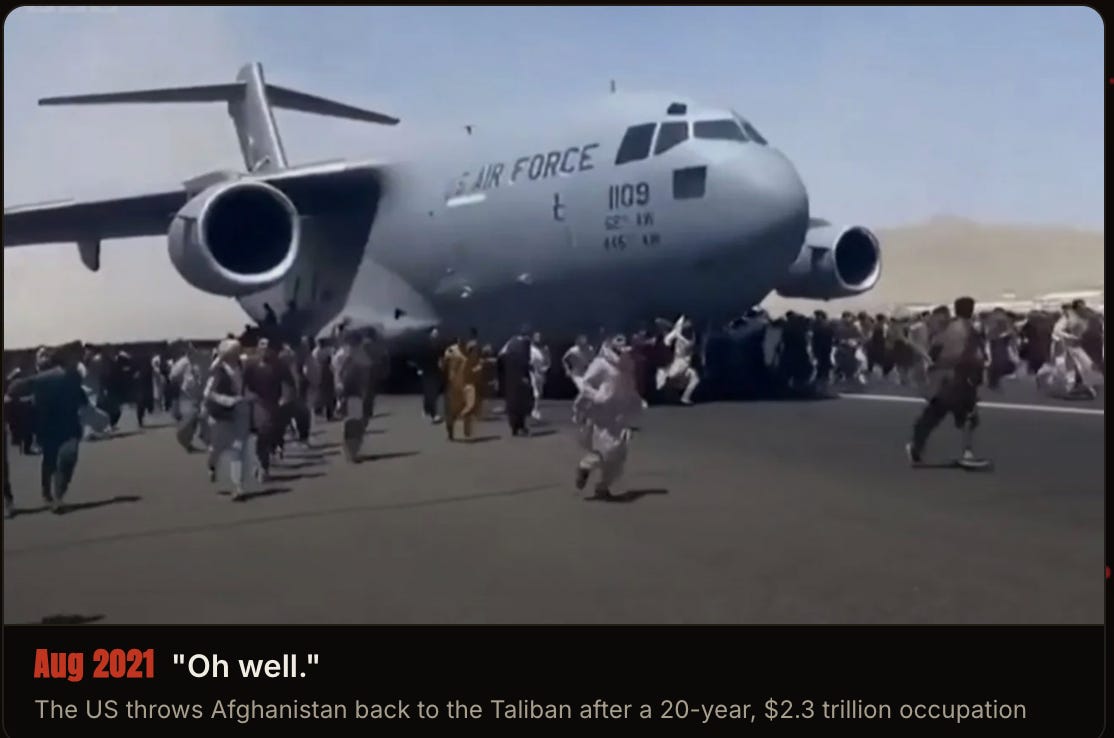
I was reminded of the shattered young men I visited when, in August 2021, the US precipitously pulled out of Afghanistan, leaving it to the Taliban, after a twenty year occupation in which many of the poor fellows had been destroyed. What was the point of their sacrifices?
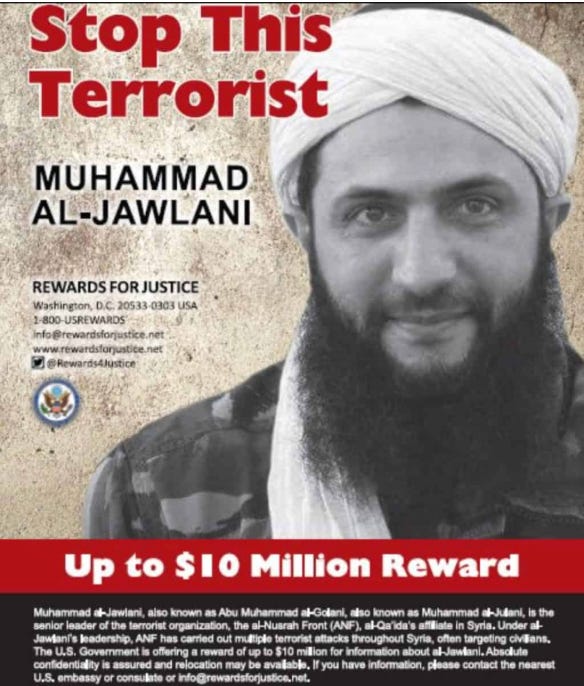
Roadside bombs—and their hundreds of thousands of forgotten victims—remind me of the new Syrian President—Ahmed Al-Sharaa (AKA Muhammad Al-Jawlani). Not so long ago, he was regarded as a top al-Qaeda, “specially designated global terrorist” with a U.S. government ten million bounty on his head.
On November 10, 2025—the official 250th birthday of the U.S. Marine Corps and the National Forget-Me-Not Day (commemorating the sacrifices returning soldiers have made of body, blood, and limb)—President Trump hosted him for an official state visit at the White House.
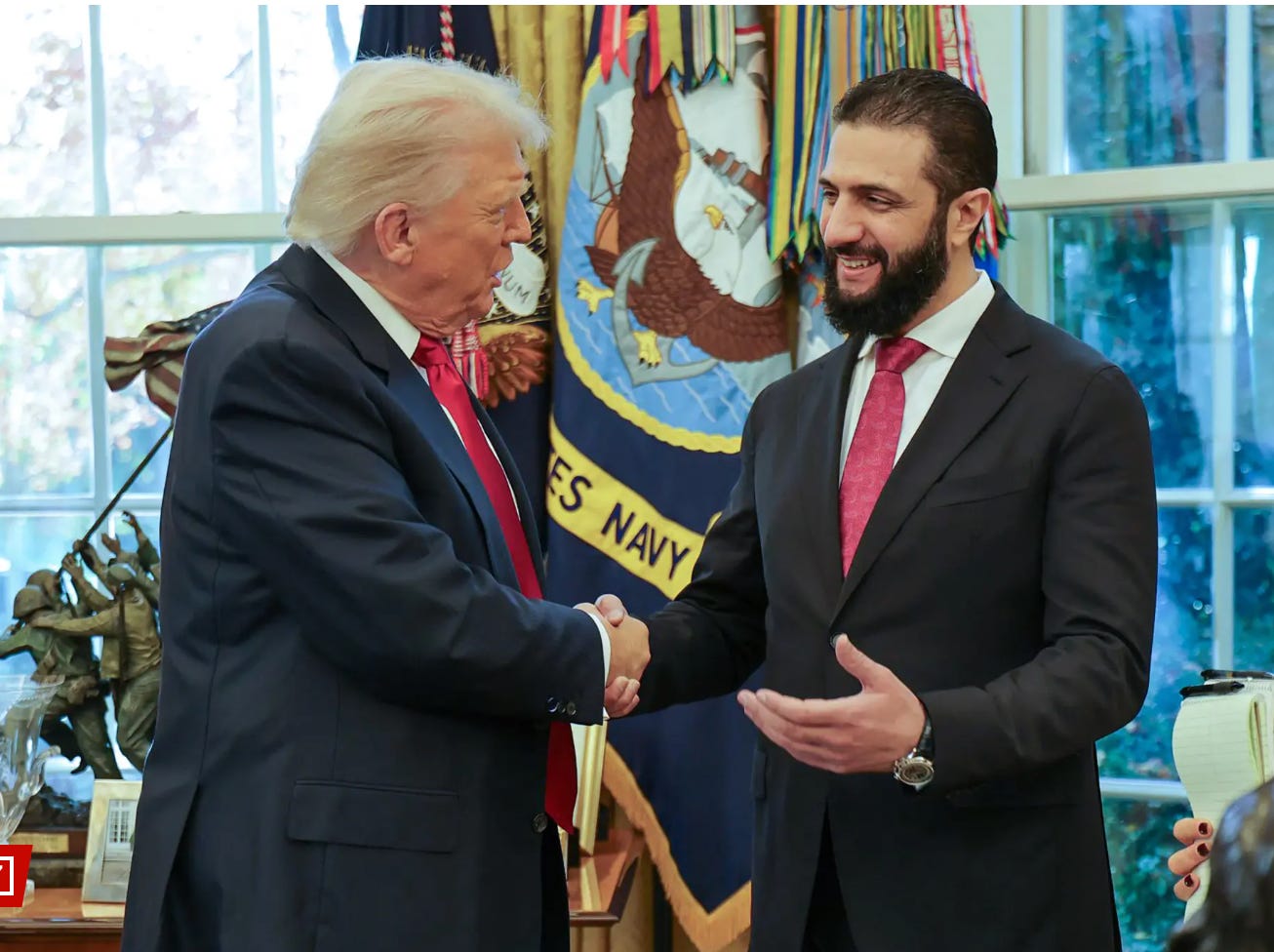
Al-Sharaa was detained by American troops in 2006 for planting explosives along a road near Mosul in northern Iraq and imprisoned for five years. A former killer and maimer of American soldiers and Marines in Iraq was made into today’s new darling in Syria and got an official White House reception on the 250th anniversary of the US Marine Corps.
Are “We the People” really such terrible suckers?
Ahmed Al-Sharaa began his career with the the Islamic State of Iraq (ISIL), joining the group in Iraq after the 2003 invasion. For those that don’t remember ISIL: the group was formed in 2004 by Abu Musab al-Zarqawi, who pledged allegiance to Osama bin Laden, and was known as Al-Qaeda in Iraq (AQI).
U.S. Marine Corps veterans remember Abu Musab al-Zarqawi as a key leader in the insurgency that fought the Marines during the first two battles of Fallujah in 2004—which included some of the hottest house to house fighting in U.S. Marine Corps history.
Indeed, the fighting got so hot during the first battle in March 2004 that President Bush decided to pause it—prompting the Marines to pull back from the city and give up their initial gains—because it was creating political blowback in the U.S., and “Dubya” was afraid it could hurt his reelection prospects. Two days after he was reelected in November, he sent the Marines back into the Fallujah meat grinder.
Following Ahmed Al-Sharaa’s adventures and prison sentence in Iraq, he shifted his attention to Syria. In 2012, he founded the Syrian group, Jabhat al-Nusra, and worked closely with ISIS and al-Qaeda in Syria until purportedly splitting from the former in 2013 and the latter in 2016.
Ahmed Al-Sharaa remained on the U.S. Wanted List with a ten million bounty on his head until November 7, 2025—three days before his White House visit. By all appearances, the U.S. government perceives that he has experienced a “damascene moment,” referring to Saul of Tarsus on the road to Damascus.
Al-Sharaa’s “damascene moment” apparently occurred when he assisted in overthrowing former Syrian president Bashar al-Assad.
The U.S. military knows how to wage Blitzkrieg against an underdeveloped foreign nation, but when it comes to occupying the country to produce a favorable political settlement, our skills quickly reach their limits.
In the run-up to the Iraq War, key Bush administration policymakers such as Condoleezza Rice, Donald Rumsfeld, and Paul Wolfowitz claimed that occupying Iraq would be like the successful post-World War II occupations of Germany and Japan, revealing that they knew nothing about Iraq, Germany, or Japan.
I’ll conclude this post by inviting my readers who feel compelled to leave rude comments—with no instructive content—to read other newsletters.
If you don’t find my views informative, you will find no shortage of other media channels that agree with you.
Neocons never ask how many lives will be lost or how many injuries will be incurred. They never ask about the financial cost or the effects on energy prices. They never concern themselves with farmland destroyed or famine created. They don't even ask if there are enough munitions in inventory to sustain war. They are one-dimensional thinkers; they are cartoons on newsprint. They have no value except promoting the military-industrial complex. So the question begs: why do so many Americans buy their shit?
Keep writing. ❤️ We may not always agree on everything, but we’re learning. Closed minded readers will leave and take their unthoughtful comments with them. Good riddance. I enjoy the open minded debate, though often polluted with the typical brain dead accusations of anti-semitism, etc.