


The United States Strategic Petroleum Reserve (SPR) was established in response to the 1973–1974 Arab oil embargo, which followed the Yom Kippur War and caused oil prices to quadruple, thereby exposing America’s vulnerability to disruptions of foreign supplies. The image below shows cars lining up to buy gas during the 1973-74 crisis because many gas stations ran out of inventory.
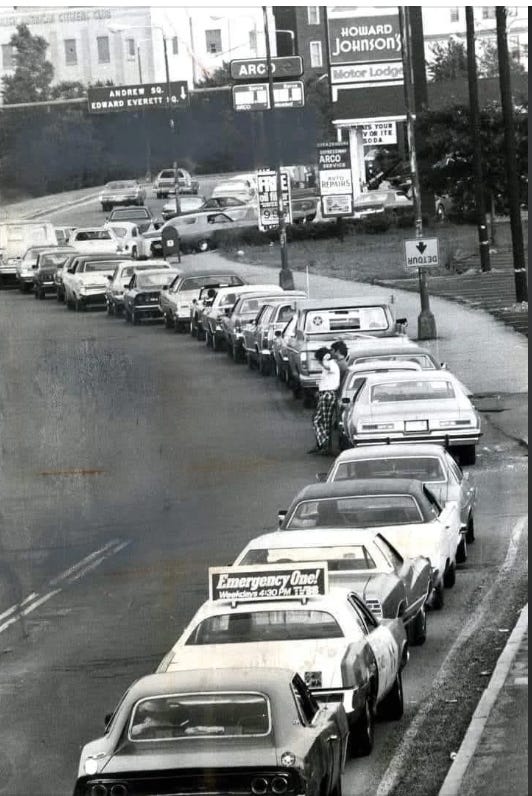
Enacted through the Energy Policy and Conservation Act of 1975 under President Gerald Ford, the SPR was conceived to mitigate the economic and national-security impacts of severe petroleum supply interruptions caused by geopolitical turmoil or natural disasters.
The SPR also fulfills U.S. obligations under the International Energy Agency’s coordinated emergency response system, requiring member countries to maintain strategic stocks equivalent to at least 90 days of net imports.
By storing a large, government-controlled inventory of crude oil—authorized at up to 714 million barrels and stored in underground salt caverns along the Texas and Louisiana Gulf Coast—the reserve acts as a buffer supply that can begin entering the market within roughly 13 days of a presidential order.
Construction and filling of the four SPR sites began in the late 1970s. Inventory grew steadily through the 1980s and 1990s, with intermittent drawdowns for hurricanes, pipeline disruptions, and limited sales.
Levels peaked near 727 million barrels in the late 2000s before declines from congressionally mandated sales and exchanges. A major drawdown occurred in 2022 under the Biden administration in response to the Russia-Ukraine war, reducing stocks significantly; subsequent refill efforts partially restored inventory, leaving roughly 415 million barrels in mid-February 2026.
The military operation against Iran that commenced in late February 2026—widely described as a U.S.-Israeli campaign—triggered the largest coordinated release of strategic stocks in IEA history.
In March 2026, IEA members agreed to make 400 million barrels available, with the United States committing 172 million barrels from the SPR, largely structured as loans or exchanges under which companies repay the crude plus a premium.
As of the week ending July 17 2026, SPR inventories had fallen to 311.4 million barrels—the lowest level since March 1983.
This is a cumulative drawdown of approximately 104 million barrels since the conflict began, equivalent to roughly one-quarter of the pre-war stockpile and a reduction of more than 18 percent from early-2026 levels.
Weekly draws have frequently exceeded several million barrels, driving the reserve well below its long-term average and raising questions about remaining operational margins, cavern integrity, and the ability to respond to another crisis.
In short, the SPR remains a cornerstone of U.S. energy security policy, born of the lessons of 1973 and repeatedly tested by subsequent shocks. The 2026 Iran conflict has subjected it to one of its most sustained and substantial drawdowns, illustrating both its utility as a short-term price and supply stabilizer and the limits of even the world’s largest emergency oil stockpile when geopolitical disruptions prove prolonged.
I grew up in Texas and my maternal grandfather worked (on the banking side) in the Texas petroleum industry, the fortunes of which I have carefully followed for years. The psychopathic clowns who are currently running this country are not telling us the truth about the enormous risk to the real economy that is growing with each passing day that the pointless war of choice again Iran continues.
Most Americans who are alive today have grown so accustomed to cheap, readily available energy that they take it completely for granted. As soon as the Strategic Petroleum Reserve draws down, thereby removing the buffer, this country will face a marked reduction of available fuel products, with an array of severe negative consequences for the real economy, including outright fuel shortages and significant inflation of food costs.
An energy shock will also imperil the gazillions of CAPEX investment in A.I., which absolutely requires cheap and plentiful energy.
I hope I am wrong, but I fear that this country (and the entire West) will soon be facing a severe economic and financial crisis.
I'm grateful to John for finally publicizing this situation, which is utterly absent from the mainstream and most of the "alternative" media.
What he didn't mention is that the issue is not so much gasoline (which comes from "sweet" crude of which the U.S. is a major source, though it doesn't have a lot of refinery capacity for it), but rather of diesel and aviation fuel, which comes from "sour" crude, which is what is being drawn down from the SPR. We've imported sour crude from Canada, Mexico, Venezuela, Russia, and the Mideast, the latter two (now unavailable) contributing a major share.
The fact that the SPR, which was trying to make up for that to keep supply up and prices down, is now about "out of gas" on that front means that the two main energy supports for commerce — diesel and jet fuel — are about to run seriously short in the short term, aggravated by Trump's restarting the war and military aviation having priority for jet fuel.
Little or very expensive transportation for food, fuel, and commodities will be causing us SERIOUS hurt, very soon. I've tried to lay this out at https://dickatlee.com/oil .
I know you hate Trump but I think your loathing pushes you to fear monger the coming apocalypse. Global energy production, supply, transportation and refining is much more resilient than the absolute SPR level.