


I enjoyed this conversation I had with barefoot Owen Shroyer on his new show, "Ask the Doctor,” about podiatric health. Researching afterwards, I realized I had grossly understated features of the foot. Alter AI assisted with this review.

The human foot is astonishingly complex — a small but intricate biomechanical masterpiece designed to bear weight, adapt to surfaces, and provide propulsion. Wearing shoes for centuries undoubtedly has had a harmful effect on foot health.
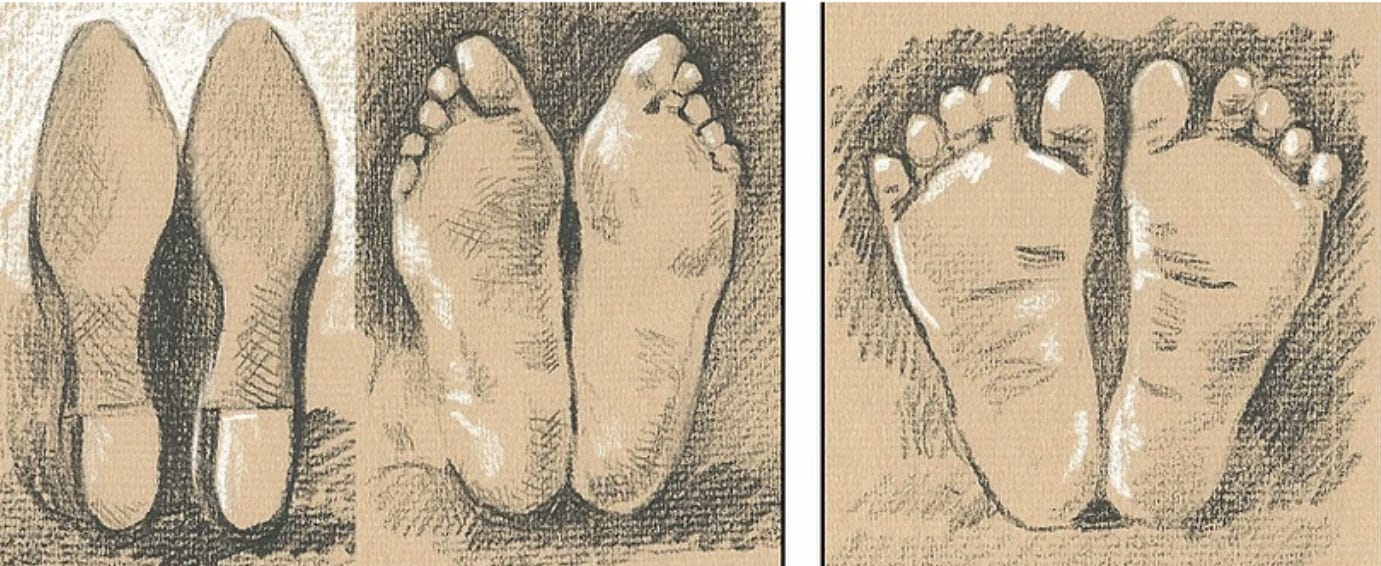
🦶 Anatomy Overview
Bones and Joints
Bones: 26 individual bones per foot.
7 tarsal bones (including the talus and calcaneus)
5 metatarsal bones
14 phalanges (toes)
Joints: 33 joints per foot (though the count can vary slightly depending on how some small articulations are defined).
These include:Ankle joint (talocrural joint)
Subtalar joint
Tarsometatarsal joints
Metatarsophalangeal joints
Interphalangeal joints
These joints together allow the complex movement patterns of the foot — flexion, extension, eversion, inversion, rotation, and shock absorption.
Muscles
There are more than 100 muscles, tendons, and ligaments in the foot and ankle region, though only about 20 muscles are foot-specific, meaning they are intrinsic (located entirely within the foot itself).
Intrinsic muscles (about 20 total):
Dorsal surface (4):
Extensor digitorum brevis
Extensor hallucis brevis
Dorsal interossei (4 muscles)
Plantar surface (divided into 4 layers):
Layer 1: Abductor hallucis, Flexor digitorum brevis, Abductor digiti minimi
Layer 2: Quadratus plantae, Lumbricals (4 muscles)
Layer 3: Flexor hallucis brevis, Adductor hallucis, Flexor digiti minimi brevis
Layer 4: Plantar interossei (3 muscles)
➤ Total intrinsic muscles: roughly 18–20.
Extrinsic muscles (that act on the foot but originate in the leg):
Gastrocnemius
Soleus
Tibialis anterior and posterior
Peroneus (fibularis) longus and brevis
Flexor and extensor digitorum longus
Flexor and extensor hallucis longus
These muscles control major movements like plantarflexion, dorsiflexion, and inversion/eversion.
✅ Summary Table
Structure Quantity Notes Bones 26 structural framework Joints 33 articulations for mobility Ligaments ~100 connective stability Intrinsic Muscles ~20 within the foot Extrinsic Muscles influencing foot ~12 originate in leg Tendons total (foot + ankle) >100 link muscles to bone
🧠 Key Insight
This complexity explains why barefoot walking and grounding exercises can significantly enhance proprioception and strengthen the small intrinsic muscles that supportive shoes often deselect. A weak, shoe-dependent foot loses agility and balance — while a strong, connected foot provides dynamic stability for the whole body.
In short:
Each human foot contains 26 bones, 33 joints, and around 20 intrinsic muscles, assisted by many extrinsic ones — over 100 muscles, ligaments, and tendons in total working together to keep you balanced and mobile.
⚡ 1. The Science of Grounding
The Earth maintains a negative electric charge, constantly replenished by lightning strikes and atmospheric processes. The human body—composed primarily of saline water and conducting tissues—can absorb electrons when in direct contact with the Earth’s surface.
According to Oschman et al. (2015), grounding “produces measurable differences in the concentrations of white blood cells, cytokines, and other molecules involved in the inflammatory response.” In experiments ranging from delayed onset muscle soreness to wound recovery, the grounded subjects consistently showed reduced inflammation, less pain, and accelerated healing compared to ungrounded controls (Oschman et al., 2015).
Similarly, Chevalier et al. (2012) documented normalization of cortisol rhythms, reduction in blood viscosity, and improved heart rate variability in grounded individuals. These measurements are not mere subjective impressions—they correspond to measurable physiological markers related to stress, blood flow, and autonomic balance (Chevalier et al., 2012).
The human body, it appears, functions better when electrically coupled to its parent planet.
🩸 2. Anti-Inflammatory and Cardiovascular Effects
WebMD and Cleveland Clinic—both cautious about anti-inflammatory and cardiovascular benefits of grounding, state that grounding mats and barefoot practices appear to reduce inflammation and improve circulation, although they still call for larger, independent studies (WebMD, 2024); (Cleveland Clinic, 2024).
😴 3. Sleep, Stress, and Nervous System Regulation
The body’s circadian rhythm is linked to electrical and hormonal cycles, particularly cortisol secretion. Disruption of this rhythm correlates with insomnia, fatigue, and metabolic disease. Grounding has been shown to normalize cortisol patterns, improving sleep quality and daytime alertness (Chevalier et al., 2012).
🌿 4. Musculoskeletal and Postural Benefits
From an orthopedic perspective, modern footwear has deformed gait and foot morphology. Shoes with padded soles and raised heels alter natural posture, weaken stabilizing muscles, and contribute to knee and hip misalignment. Walking barefoot reactivates intrinsic foot musculature and improves proprioception—the body’s spatial awareness (UC Santa Barbara, n.d.).
Clinically, barefoot walking has been shown to:
Reduce joint loading in knee osteoarthritis.
Strengthen the arches and tendons of the foot.
Encourage a forefoot strike gait, decreasing impact stress on joints.
Improve overall balance and postural stability, especially in older adults.
These mechanical corrections can have cascading effects—pain relief, more efficient movement, and less energy expenditure over time.
🌳 5. Psychological and Cognitive Benefits
CNN’s 2025 coverage of grounding describes the growing cultural shift—people removing their shoes not merely for comfort, but as an antidote to digital overload, synthetic surroundings, and rising mental health strain (Riddell, 2025). Even skeptics admit that walking barefoot in nature fosters mindfulness, regulates breathing, and can serve as a somatic therapy parallel to meditation or yoga.
🌍 6. A Return to Biological Normalcy
Even mainstream outlets concede that “there’s absolutely no harm” in reconnecting with the Earth by walking barefoot, while numerous case studies demonstrate rapid improvements in inflammation, energy, and psychological stability (Combe Grove, 2025).
⚖️ Conclusion
Going barefoot offers multifaceted benefits: physiological (reduced inflammation, improved sleep, cardiovascular support), biomechanical (better posture and balance), and psychological (stress regulation and nature connectedness).
Grounding costs nothing, requires no prescription, and reinforces self-reliance over dependence on synthetic interventions. In a world increasingly disconnected—chemically, digitally, and spiritually—touching the Earth may be one of the simplest and most profound medical interventions available.
Please subscribe to FOCAL POINTS as a paying ($5 monthly) or founder member so we can continue to bring you the truth.
Peter A. McCullough, MD, MPH
Chief Scientific Officer, The Wellness Company
📚 References
Agape Family Health (2024). Does Walking Barefoot Improve Your Health? https://www.agapefamilyhealth.org/walking-barefoot-and-health-benefits/
Chevalier, G., Sinatra, S. T., Oschman, J. L., Sokal, K., & Sokal, P. (2012). Earthing: Health Implications of Reconnecting the Human Body to the Earth’s Surface Electrons. Journal of Environmental and Public Health.
Combe Grove (2025). Feel the Earth Beneath Your Feet – The Benefits of Barefoot Walking. https://combegrove.com/health-and-wellbeing/2025/the-benefits-of-barefoot-walking/
Menigoz, W. (2019). Integrative and Lifestyle Medicine Strategies Should Include Earthing (Grounding). Elsevier Inc.
Oschman, J. L., Chevalier, G., & Brown, R. (2015). The Effects of Grounding on Inflammation, Immune Response, and Wound Healing. Journal of Inflammation Research.
Riddell, D. (2025). I Took My Shoes Off and Went for a Barefoot Hike—CNN Health. https://www.cnn.com/2025/11/28/health/grounding-earthing-barefoot-nature-wellness
UC Santa Barbara Health & Wellness. Walking Barefoot. https://wellness.ucsb.edu/walking-barefoot
WebMD (2024). Grounding: Techniques and Benefits. https://www.webmd.com/balance/grounding-benefits
Cleveland Clinic (2024). Is Earthing Actually Good for You? https://health.clevelandclinic.org/earthing
Now, if I could just find an area of Earth that is not treated with chemicals and an area free of hookworms, other parasites or animal feces. But, I guess, I could buy some of Dr. McCullough’s parasite cleanse. (Sarc.). When I was a child, children typically played outdoors in bare feet or flip flops in the summer.
Our new (to my husband and me) integrative/allopathic Doctor listed "grounding" as one of his recommendations for my husband and me.
Thank you, Dr. McCullough, for sharing holistic health methods!