


This morning I woke up to the news that two US warships—the guided-missile destroyers, the USS Frank E. Petersen Jr. and USS Michael Murphy have entered the Persian Gulf during the current ceasefire with Iran to conduct mine-clearing operations. These vessels are the the first, and currently the only U.S. warships confirmed to have crossed the Strait of Hormuz to operate directly within the Gulf following recent conflict.
The news reminded me of the 2002 U.S. Joint Forces Command Millennium Challenge war game— the largest and most expensive military simulation in history up to that point, costing roughly $250 million and involving over 13,500 participants across multiple live and simulated sites.
Set in the fictional year of 2007, the exercise was designed to test the Pentagon’s emerging doctrine of “transformation”—that is, network-centric warfare and rapid operations enabled by advanced command-and-control technologies.
The scenario placed U.S. Blue forces, equipped with projected future capabilities, against a Red Team opposition force (OPFOR) modeled on a Middle Eastern adversary (widely understood to represent Iran or Iraq) in a Persian Gulf anti-access/area-denial environment.
The war game’s purpose was to explore critical operational challenges facing joint U.S. forces after 2010, validate new concepts and technologies, and inform future strategy, procurement, and training decisions.
Retired Marine Lieutenant General Paul K. van Riper, a decorated combat veteran and former president of the Marine Corps University, was selected to command the Red Team.
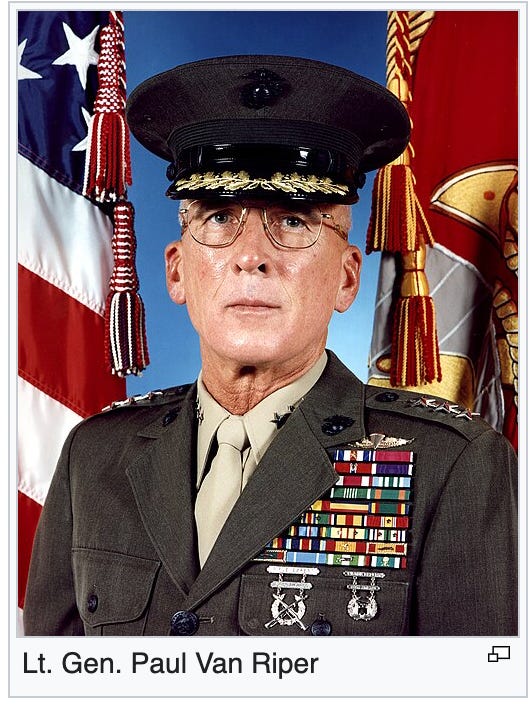
Instead of playing the scripted role of a predictable, technologically inferior adversary, van Riper chose an aggressive asymmetric strategy intended to exploit the assumptions that were the basis of Blue’s high-tech approach.
General van Riper ordered his forces to maintain strict radio silence, relying on low-tech, pre-modern methods of communication.
When Blue’s carrier battle group entered the Gulf, van Riper launched his surprise attack. In a coordinated barrage lasting only minutes, Red forces used cruise missiles from ground launchers, commercial ships, and low-flying civilian aircraft, while swarms of small speedboats packed with explosives conducted kamikaze attacks.
Blue’s sophisticated Aegis radar and missile-defense systems were overwhelmed; sixteen to nineteen U.S. warships—including an aircraft carrier—were “sunk,” with an estimated 20,000 American sailors killed in the simulation.
The outcome shocked the exercise controllers, and a few days later, the war game was suspended. It was then restarted, with Blue forces resurrected and Red Team heavily constrained: certain weapons and tactics were disallowed, Red unit locations were sometimes revealed to Blue, and free-play rules were so suppressed that the final result appeared preordained.
Blue ultimately “won,” but van Riper resigned in protest midway through, later describing the revised exercise as rigged to reinforce existing doctrine rather than genuinely test it. He publicly called the entire effort a waste of taxpayer money.
Millennium Challenge 2002 is a cautionary tale about the dangers of confirmation bias in military experimentation. While it was intended to demonstrate the superiority of network-centric warfare, it instead revealed the vulnerabilities of the most advanced forces to creative, asymmetric tactics. The episode highlighted that technology alone does not guarantee victory when an imaginative adversary refuses to fight on the terms dictated by the stronger side.
With President Trump talking about imposing a naval blockade of the Strait of Hormuz, he and his advisors should beware the Millennium Challenge. Numerous independent military analysts are sounding that alarm that Iran’s current drone and ballistic missile capability surpasses the capability of the weapons used by General van Riper’s Red Team in the 2002 war game.
John, you act like you know what the latest ship defense tech is and that it is comparable to 2002. It's not. Yet again, John, you show you know nothing about what is going on in the Persian Gulf present day. Get your popcorn and watch, maybe you will learn.
Praying for God's wisdom and guidance for Trump and for peace and fairness for all countries involved.