


A nationwide study of Denmark’s female population aged 15 to 59, published in JAMA Network Open, examined hormonal contraceptive use from 2000 through 2024. The underlying population included approximately 3 million females, with researchers comparing 1,473 women diagnosed with meningioma against 14,717 matched controls.
The study examined contraceptive progestogens, the hormone class used across nearly all major hormonal birth-control methods, including combined pills, progestin-only pills, injections, hormonal IUDs, implants, patches, and vaginal rings.
Most hormonal birth controls analyzed in the study were associated with an increased risk of meningioma brain tumors. Specifically, 8 of the 12 formulations with calculable estimates showed statistically significant or borderline-significant elevations, while several additional methods could not be reliably assessed because too few cases occurred.
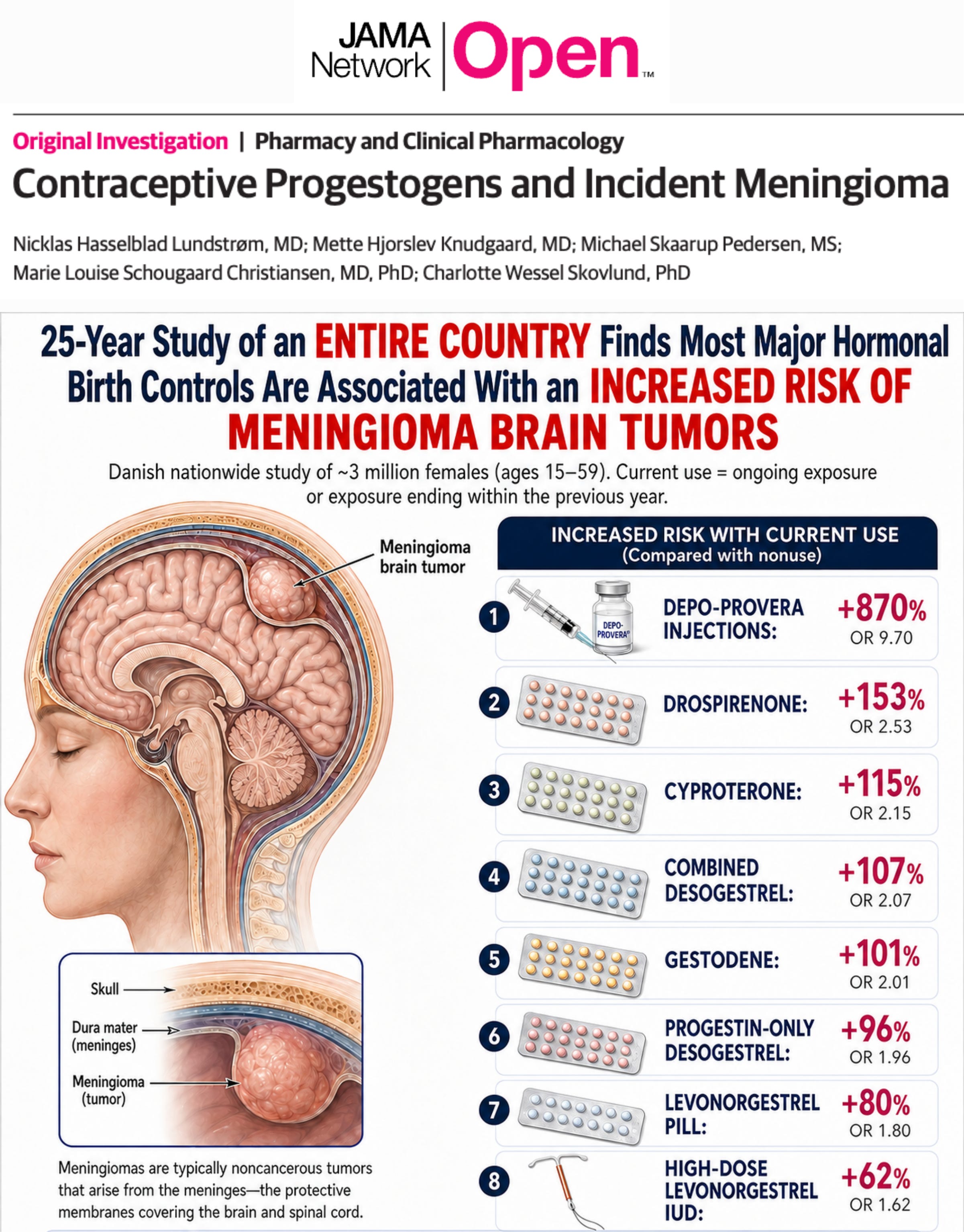
Meningiomas arise from the membranes surrounding the brain and spinal cord. Even when noncancerous, they can compress vital brain structures, cause seizures, cognitive decline, vision loss, weakness, and permanent neurological damage, and may require brain surgery.
Overall meningioma risk by hormonal contraceptive
The study’s primary analysis compared each woman’s most recent contraceptive exposure with nonuse and found the following increases in meningioma odds:
DEPO-PROVERA INJECTIONS: +355%
OR 4.55; 95% CI, 2.19–9.45
PROGESTIN-ONLY DESOGESTREL: +73%
OR 1.73; 95% CI, 1.17–2.56
COMBINED DESOGESTREL: +66%
OR 1.66; 95% CI, 1.31–2.10
CYPROTERONE: +61%
OR 1.61; 95% CI, 1.00–2.59
DROSPIRENONE: +58%
OR 1.58; 95% CI, 1.05–2.37
HIGH-DOSE LEVONORGESTREL IUD: +58%
OR 1.58; 95% CI, 1.28–1.94
GESTODENE: +44%
OR 1.44; 95% CI, 1.17–1.77
LEVONORGESTREL PILL: +40%
OR 1.40; 95% CI, 1.12–1.76
These overall estimates were concerning, but the strongest associations appeared among women with ongoing or very recent exposure.
Current hormonal birth-control use and meningioma risk
“Current use” was defined as ongoing exposure or exposure ending within the previous year. Risk estimates were generally highest in this group.
DEPO-PROVERA INJECTIONS: +870%
OR 9.70; 95% CI, 3.85–24.42
DROSPIRENONE: +153%
OR 2.53; 95% CI, 1.45–4.42
CYPROTERONE: +115%
OR 2.15; 95% CI, 1.05–4.41
COMBINED DESOGESTREL: +107%
OR 2.07; 95% CI, 1.41–3.04
GESTODENE: +101%
OR 2.01; 95% CI, 1.47–2.74
PROGESTIN-ONLY DESOGESTREL: +96%
OR 1.96; 95% CI, 1.26–3.08
LEVONORGESTREL PILL: +80%
OR 1.80; 95% CI, 1.33–2.46
HIGH-DOSE LEVONORGESTREL IUD: +62%
OR 1.62; 95% CI, 1.29–2.04
Conclusion
This was an observational case-control study, so it cannot prove that hormonal contraception directly caused the tumors. However, the investigation had major strengths: nationwide population coverage, detailed long-term prescription records, validated cancer diagnoses, exclusion of women with prior hormone-replacement therapy, and consistent results across multiple sensitivity analyses.
The findings indicate that increased meningioma risk may extend beyond Depo-Provera injections to multiple combined birth-control pills, a progestin-only pill, and high-dose levonorgestrel IUDs.
Epidemiologist and Foundation Administrator, McCullough Foundation
Support our mission: mcculloughfnd.org
Please consider following both the McCullough Foundation and my personal account on X (formerly Twitter) for further content.
When will we stop trying to improve on mother nature by selling profitable, proprietary prescription drugs that interfere with normal biochemistry of the human body?
Note always synthetic progestins are used. Bioidentical progesterone should be used as it has a completely different safety profile, but no money to be made from bioidentical hormones for big Pharma. So, to hell with all the young women and the older women!