


We have just assembled decades of evidence to evaluate the remarkable multi-target effects of nattokinase, an orally administered fibrinolytic enzyme derived from natto, the traditional Japanese fermented soybean food. Across the literature, nattokinase shows activity spanning spike protein, amyloid, abnormal microclots, fibrin, coagulation, blood pressure, platelet activity, and atherosclerotic plaque.
Our new paper, “Proteolytic Targets and Clinical Benefits of Oral Nattokinase: Spike Protein and Amyloid Degradation, Fibrinolysis, and Cardiovascular Risk Reduction,” was produced through a collaboration between The Wellness Company and the McCullough Foundation. It represents one of the most comprehensive evaluations of nattokinase to date, uniquely integrating its proteolytic, cardiovascular, pharmacokinetic, amyloid, and spike-protein literature into a single review.
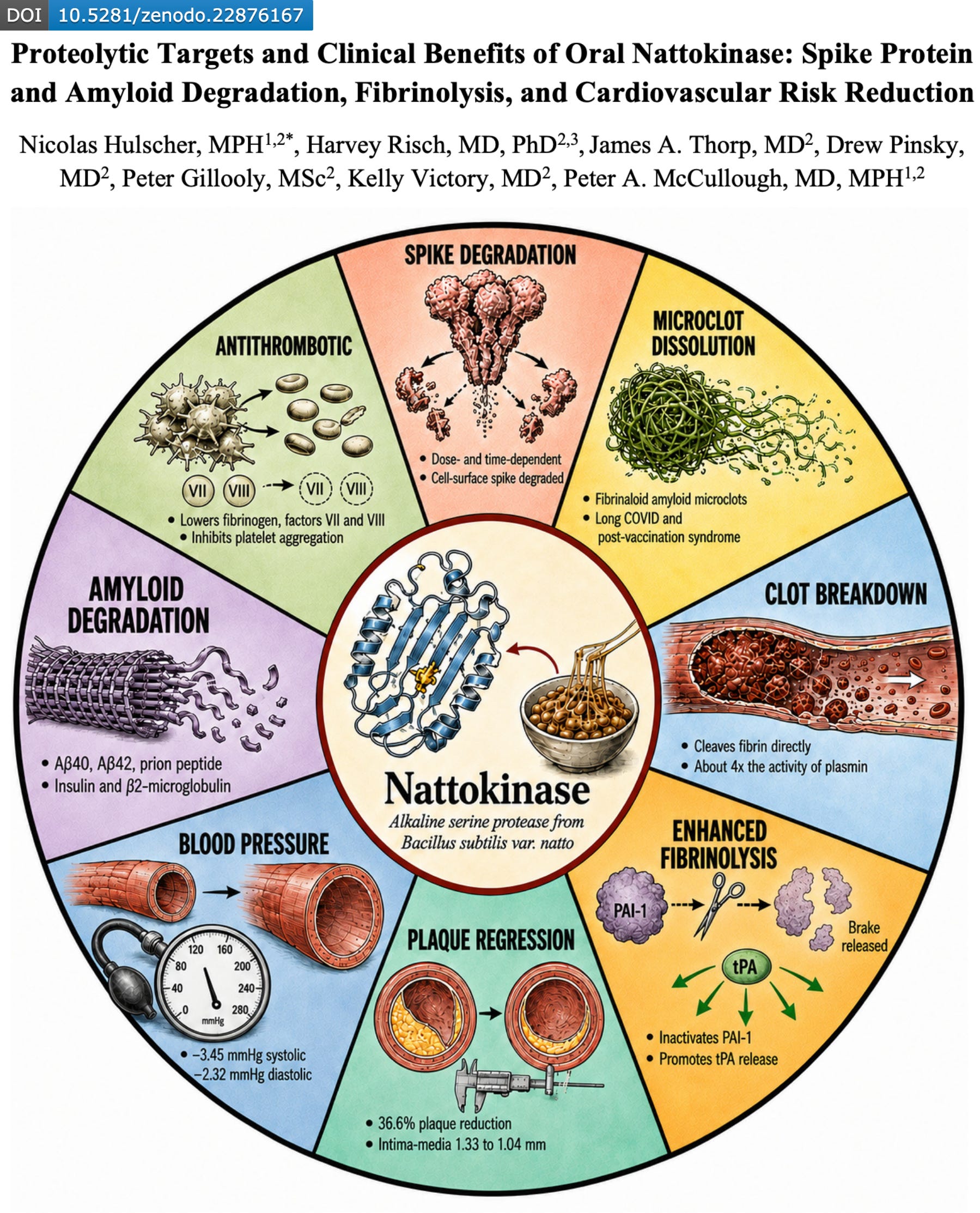
The paper brings together the evidence across eight major domains:
SPIKE PROTEIN DEGRADATION
Three independent laboratories have reported that natto-derived or related serine proteases can degrade SARS-CoV-2 spike protein in vitro.
Most importantly, purified nattokinase itself produced dose- and time-dependent degradation of full-length spike protein and the S2 subunit across a broad concentration range. Researchers also demonstrated degradation of spike expressed on the surface of cells.
Different preparations, different model systems, same basic conclusion: spike protein is susceptible to degradation by this class of proteolytic enzymes.
AMYLOID DEGRADATION
Nattokinase has also demonstrated activity against several structurally distinct amyloid proteins.
Published studies report degradation of Aβ40, Aβ42, human prion peptide fibrils, insulin fibrils, and β2-microglobulin fibrils. This broad activity suggests that nattokinase can attack abnormal cross-β protein structures rather than acting on only one specific amyloid protein.
AMYLOID MICROCLOT DISSOLUTION
Recombinant nattokinase has directly degraded fibrinaloid amyloid microclots in vitro.
These abnormal structures are composed largely of misfolded fibrin(ogen) and have been reported in persistent illness following COVID-19 mRNA injection. Because spike protein itself can drive fibrin(ogen) into a fibrinolysis-resistant amyloid state, nattokinase is particularly relevant: it may target both the abnormal clot structure and, experimentally, the spike protein involved in its formation.
BLOOD CLOT BREAKDOWN
Fibrinolysis remains nattokinase’s best-established biological activity.
Nattokinase can directly cleave fibrin independently of plasminogen. Experimental work also found that it cleaved cross-linked fibrin with roughly six-fold the catalytic efficiency of plasmin in vitro and dissolved thrombus about four times as effectively at an equivalent molar dose in an animal model.
BOOSTING THE BODY’S NATURAL CLOT-DISSOLVING SYSTEM
Nattokinase does not only attack fibrin directly.
It can also cleave and inactivate PAI-1, one of the body’s major brakes on fibrinolysis, while promoting release of tissue plasminogen activator (tPA). This gives nattokinase two potential routes to the same endpoint: direct clot breakdown and enhancement of the body’s endogenous fibrinolytic machinery.
SHRINKING ARTERIAL PLAQUE
The human carotid imaging findings are among the most striking observations in the review.
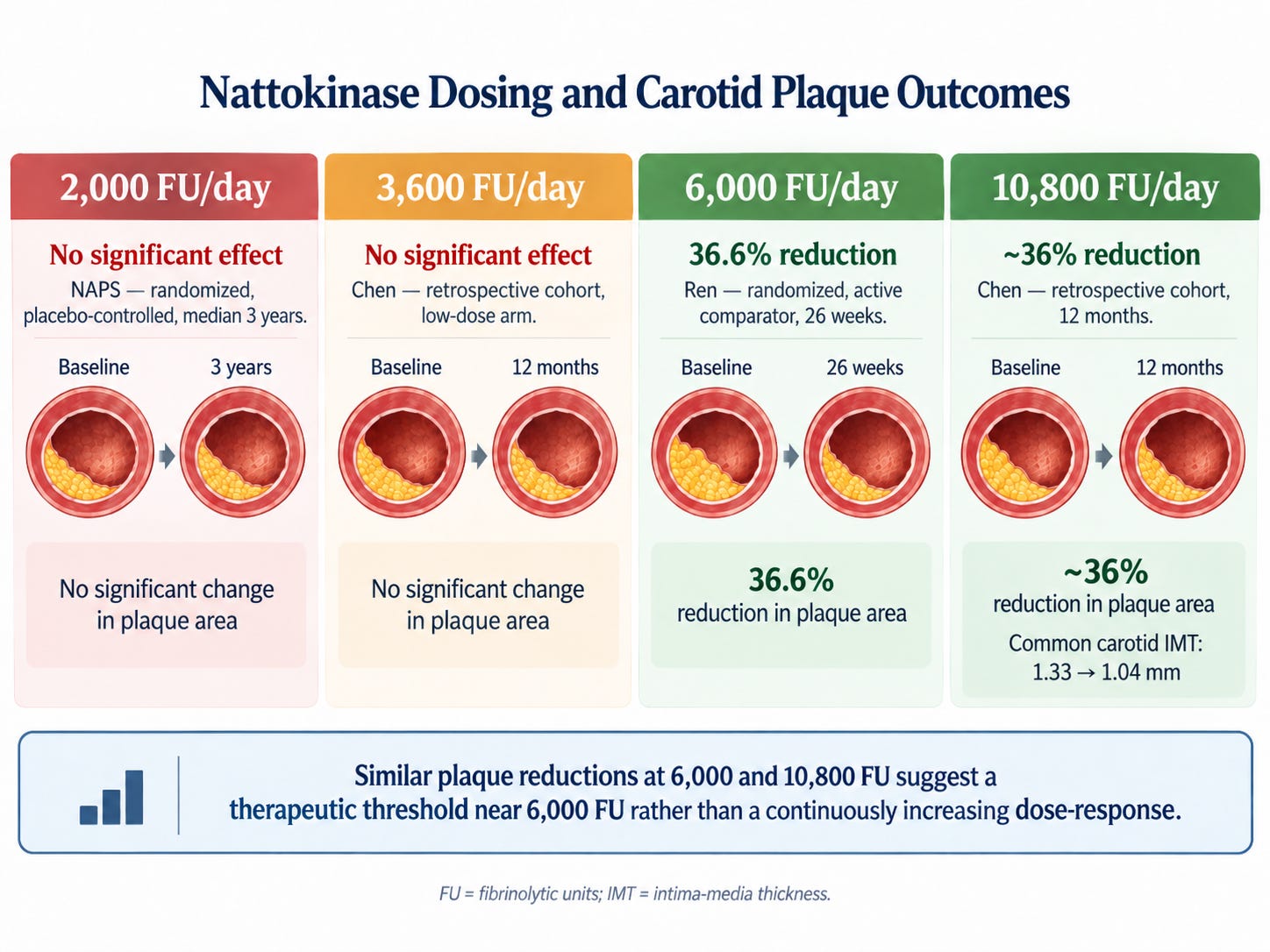
At 2,000 FU/day, a long-term randomized placebo-controlled trial found no significant plaque effect. A lower-dose arm at 3,600 FU/day was also ineffective.
But at 6,000 FU/day, carotid plaque area fell by 36.6% over 26 weeks.
At 10,800 FU/day, another study reported an approximately 36% reduction over 12 months, together with a decline in carotid intima-media thickness from 1.33 to 1.04 mm.
That dose pattern raises the possibility of a therapeutic threshold around 6,000 FU/day.
LOWERING BLOOD PRESSURE
Randomized human evidence also supports a modest blood-pressure effect.
A meta-analysis of six randomized trials involving 546 participants found average reductions of approximately 3.45 mmHg systolic and 2.32 mmHg diastolic blood pressure.
REDUCING COAGULATION AND PLATELET CLUMPING
Human studies have reported reductions in several important coagulation markers, including fibrinogen, factor VII, factor VIII, and von Willebrand factor.
Nattokinase has also been shown experimentally to inhibit platelet aggregation and thrombus formation, adding another pathway through which it may influence cardiovascular risk.
THIS ISN’T JUST A TEST-TUBE STORY
After oral dosing, nattokinase-related material has been detected in human blood, with peak serum immunoreactivity occurring at roughly 13 hours.
In a randomized, double-blind, placebo-controlled crossover study, a single oral dose also changed multiple clotting and clot-breakdown markers within hours, including increased D-dimer and fibrin degradation products, reduced factor VIII activity, increased antithrombin, and prolonged aPTT.
LOWER CARDIOVASCULAR AND STROKE MORTALITY WITH NATTO INTAKE
Long-term population data point in the same direction.
In prospective Japanese cohorts, higher natto intake was associated with a 25% lower risk of cardiovascular mortality and a 32% lower risk of stroke mortality.
SAFETY
Nattokinase has been well tolerated across human studies, with no notable adverse events reported across six randomized trials. Even 10,800 FU/day for 12 months was used in a large observational cohort without reported excess bleeding.
Its main precaution is predictable from its clot-dissolving effects: people taking blood thinners or antiplatelet medications should use it only with medical supervision, and pregnant women should avoid nattokinase because its safety in pregnancy has not been established.
CONCLUSION
Nattokinase is inexpensive, orally available, already widely used, and holds immense promise for cardiovascular risk reduction in the post-COVID era.
The major unanswered question is no longer whether nattokinase can degrade these targets under experimental conditions. It can.
The critical translational question is whether orally administered nattokinase reaches circulating or tissue spike protein, fibrinaloid microclots, and other pathological protein targets at concentrations high enough to reproduce these effects in humans.
It now deserves large-scale clinical testing for cardiovascular risk reduction and other post-vaccination injury applications.
We plan to launch some of these studies shortly. In particular, we will be studying the potential spike-reducing effects of Ultimate Spike Detox (8,000 FU nattokinase) in a large cohort of participants.
Epidemiologist and Foundation Administrator, McCullough Foundation
Support our mission: mcculloughfnd.org
Please consider following both the McCullough Foundation and my personal account on X (formerly Twitter) for further content.
Thank you for sharing information. Even though I am too poor to see Dr. McCulloigh, I am smart enough to help myself with your excellent research. I appreciate your work.
Please don't stop.
I've been taking a product that contains Nattokinese for years (way before cvd) for endometriosis pain. It works amazingly well. In fact, it is the only thing that reduced the pain enough so I could work, and it does not leave me feeling loopy like the pain meds that docs prescribed. And I'm not having to have surgeries every couple of years to remove endo. I'm glad to know it has other benefits as well.