


For years, the public was told a simple story: the mRNA “stays in the arm,” degrades within hours, never enters the bloodstream, never crosses the placenta, never reaches the reproductive system, and certainly cannot be shed or transferred to others. These claims were repeated endlessly by agencies, fact-checkers, news outlets, and medical institutions, despite the fact that no long-term human biodistribution studies had ever been performed.
A new peer-reviewed study published in Annals of Case Reports titled, Detection of Pfizer BioNTech Messenger RNA COVID-19 Vaccine in Human Blood, Placenta and Semen, ends that narrative. Credit to VaccineMole on X for being the first to break this study.
Researchers from Bar-Ilan University and several Israeli medical centers used nested PCR combined with Sanger sequencing—a far more sensitive and specific method than the standard qPCR used in earlier studies—to test for Pfizer mRNA in human tissues from 34 participants, including 22 pregnant women, 4 male sperm donors (8 samples), and 8 additional adults.
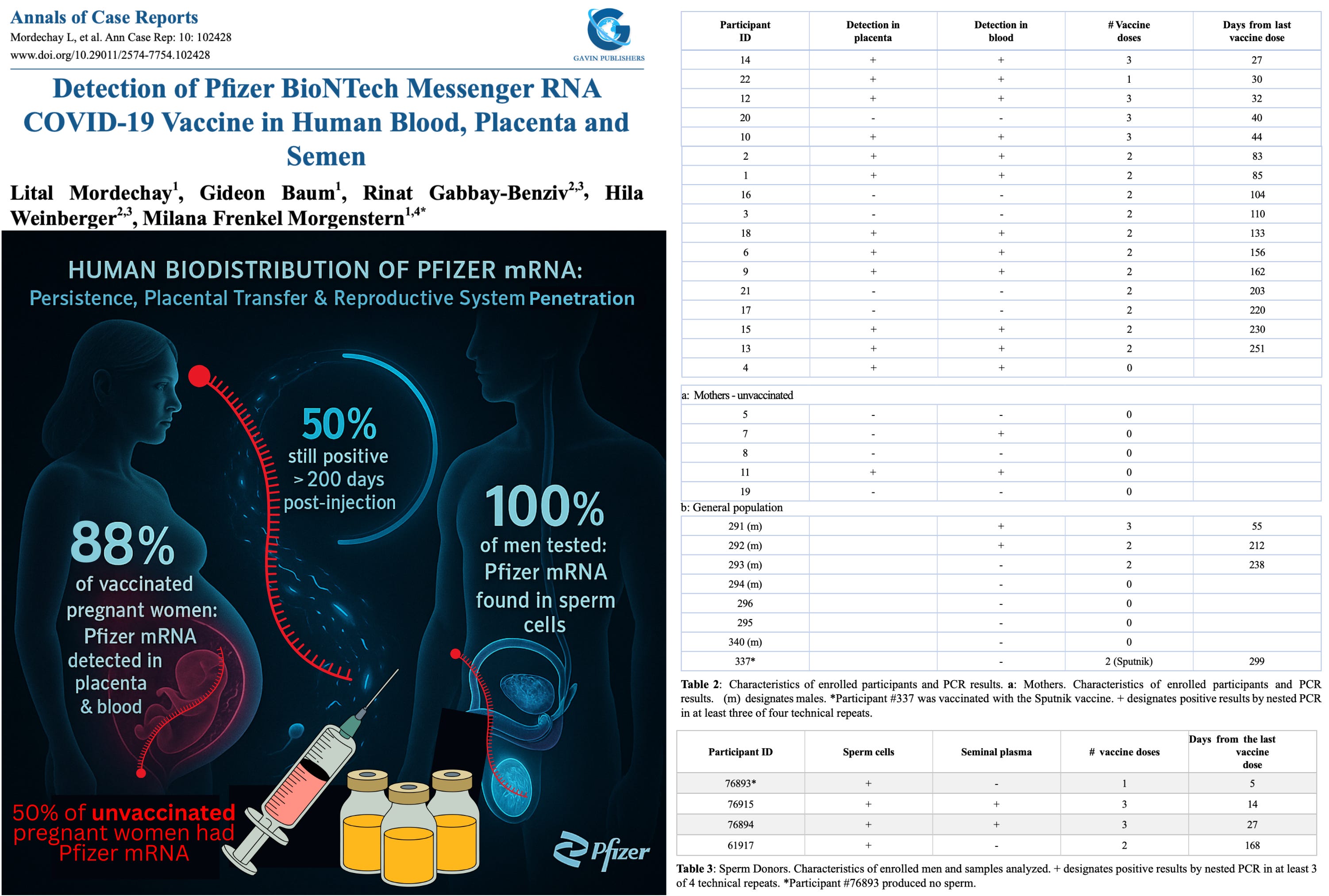
Their findings are deeply worrisome: 88% of pregnant women vaccinated within the last 100 days showed detectable Pfizer mRNA in both blood and placental tissue. Among male sperm donors, 100% of those who produced sperm had vaccine mRNA in their sperm cells, and 50% had it detectable in seminal fluid—long after vaccination.
Even more concerning, Pfizer mRNA was detected in 50% of the unvaccinated women tested —two in both placenta and blood, and one in blood alone; a result that forces the scientific community to confront the reality of shedding, something officials categorically deny.
Most striking of all, mRNA was still present in 50% of individuals more than 200 days after injection.
This is the clearest evidence to date that the injection does not degrade “within hours”—but instead persists, circulates, and deposits into human reproductive and fetal tissues.
The implications are enormous.
METHODS: WHY THIS STUDY SUCCEEDS WHERE OTHERS FAILED
One of the strongest aspects of this paper is the methodology. Where previous studies failed to detect vaccine mRNA, the authors explain exactly why: they were using qPCR, which lacks the sensitivity to detect low-abundance RNA months after injection. The new study instead used nested PCR, a two-step amplification technique that dramatically increases sensitivity and specificity, followed by Sanger sequencing, which literally reads the amplified sequence and confirms it matches the Pfizer construct. Each positive result was only considered valid if it appeared in at least three of four independent technical repeats, further reducing any chance that background noise or accidental contamination was driving the findings.
This approach is also fundamentally different from the PCR tests used during the pandemic to diagnose “COVID cases.” Those tests relied on single-step qPCR run at extremely high cycle thresholds—often 35–45 cycles—where background noise, trace contamination, and harmless RNA fragments can generate false positives. The method used in this new study, by contrast, requires two successful rounds of primer binding and amplification, reproducibility across multiple repeats, and then an independent sequencing confirmation to verify the identity of the product.
In other words, the COVID diagnostic PCR could detect any fragment of viral RNA and label it a “positive,” while this study’s nested PCR plus sequencing can only detect one thing: the exact Pfizer mRNA sequence, verified letter-by-letter.
This means the researchers were not detecting “noise”—they were detecting true, molecularly confirmed vaccine mRNA. It is the most definitive approach yet applied to this question.
Vaccine mRNA detected in the placenta
88% of women vaccinated within 100 days of delivery had detectable mRNA in both blood and placenta. Even after 230–251 days, vaccine RNA was still found in some placentas.
This directly contradicts every official statement claiming mRNA “does not reach the placenta.”
mRNA detected in sperm and seminal fluid
Of the four vaccinated men tested:
Three produced viable sperm—and 100% of them had Pfizer mRNA in their sperm cells.
Two had detectable mRNA in seminal plasma.
One man vaccinated 168 days earlier still had mRNA present in sperm.
This raises profound questions about male fertility, germline exposure, and the possibility of transmission.
Long-term persistence
Across blood and placental tissue:
Half of individuals tested more than 200 days after vaccination still had detectable Pfizer mRNA.
This is far beyond what Pfizer, regulators and public health authorities have claimed.
mRNA detected in unvaccinated pregnant women
Perhaps the most shocking finding:
50% of unvaccinated pregnant women had detectable Pfizer mRNA.
Two unvaccinated pregnant women had Pfizer mRNA in both their blood and placenta.
A third unvaccinated woman had mRNA in her blood alone.
The authors state plainly: “The source of this RNA has yet to be investigated.”
This appears to be the first direct evidence of mRNA vaccine shedding.
CONCLUSIONS
These results carry enormous implications. They confirm that the mRNA does not stay at the injection site; it does not rapidly degrade; it does reach the placenta; and it does enter the reproductive organs.
This verifies the biological mechanism behind delayed serious adverse events and also explains transgenerational adverse events—why babies born to vaccinated mothers are now dying at high excess rates even years later.

And beyond these concerns, the unvaccinated positives raise the specter that shedding is indeed real.
In conclusion, this study demonstrates:
Long-term persistence
Systemic distribution
Reproductive system exposure
Placental exposure
Possible shedding to unvaccinated individuals
This should immediately trigger market withdrawal and apologies to the public for inflicting grave harm based on fraudulent assumptions.
As more evidence accumulates each week, the legal ramifications for allowing these products to remain on the market become ever more severe.
Epidemiologist and Foundation Administrator, McCullough Foundation
Support our mission: mcculloughfnd.org
Please consider following both the McCullough Foundation and my personal account on X (formerly Twitter) for further content.
It seems to me that anybody that had this stuff shed into them would be able to sue pfizer (despite the vaccine immunity) because those that were shed upon did not agree to be vaccinated or damaged.
Everything hypothesized is coming to fruition. Us tinfoil hatters, we the unvaxxed & ‘unclean’ who tried desperately to get our family and friends to listen, are reading daily that we were correct (and most importantly, our sources were correct), yet our government, healthcare bureaucrats & their media pawns are still trying to poison us.
Those warned family and friends? Most do not care. Most have moved on, and from my personal experience, will never read this post, will not even contemplate the horrors of what we all read & have discussed here for years. They are in complete denial, and I continue to pray daily.