


By Peter A. McCullough, MD, MPH
Nearly every day I encounter a patient who either cannot tolerate or does not have trust in the safety of prescription cholesterol-lowering drugs, namely statins. At The Wellness Company, we saw the need to fill this void.
Cholesterol Support — A Natural Answer to a Statin-Weary World

🫀 The Elephant in Every Adult’s Chest
Cardiovascular disease remains the single largest killer on the planet. It doesn’t discriminate by politics, wealth, or geography—it kills the banker and the bartender with equal enthusiasm. By middle age, a massive slice of the population is walking around with some degree of atherosclerotic burden, whether they know it or not. The question was never whether to address cardiovascular risk; it’s how.
Here’s the problem nobody in the white coat wants to admit out loud: a huge segment of the adult population cannot tolerate or does not trust statins. Muscle pain, brain fog, fatigue, elevated liver enzymes, and—for some—a genuine fear of the long-term metabolic consequences. The “statin-intolerant” population isn’t a fringe minority; it’s millions of people who got the prescription and quietly threw the bottle in the back of the cabinet.
For those people, the options have historically been thin: take the drug and suffer, move on to multiple other medicines, injections, or do nothing and hope. Cholesterol Support from The Wellness Company steps directly into that gap.
🌿 The Formula, Laid Bare
Let’s be clear about what’s actually in Cholesterol Support from TWC, because transparency is the whole point of the brand:
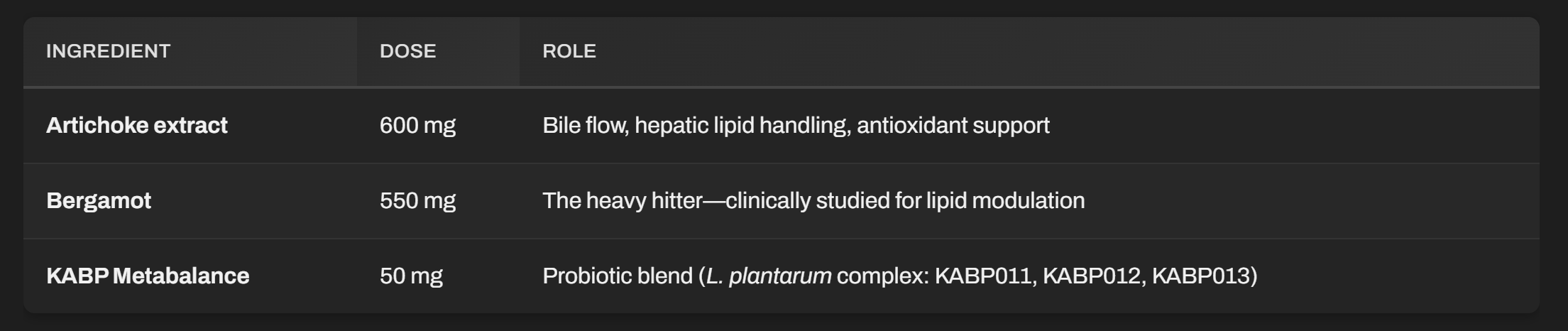
Unlike many products, the doses are actually disclosed at meaningful levels—which alone puts this ahead of 90% of the other supplements.
Bergamot at 550 mg is the standout. Bergamot (Citrus bergamia) contains a cocktail of polyphenols—most notably brutieridin and melitidin—that act on the same HMG-CoA reductase pathway statins target, but through a gentler, broader mechanism. The artichoke extract complements it by supporting bile acid output and hepatic clearance, which is how the body actually disposes of cholesterol rather than just suppressing its synthesis.
And the probiotic? That’s the part most people glance over. The KABP Metabalance blend is where the formula earns its “Support” name—because this isn’t just about a number on a blood panel.
🔬 Beyond the Number: Why “Cholesterol Reduction” Is a Red Herring
Here’s the conceptual shift that matters, and it’s one the pharmaceutical model has spent decades obscuring: atherosclerotic cardiovascular risk is not just a cholesterol problem. It’s also secondary inflammation, oxidation, and endothelial dysfunction.
Natural interventions reduce cardiovascular risk through mechanisms that have nothing to do with crushing LDL into the floor:
Endothelial function — Bergamot and artichoke polyphenols improve nitric oxide signaling and vessel flexibility. Plaque doesn’t form in a healthy, compliant artery.
Oxidative stress — Oxidized LDL (oxLDL) is the actual atherogenic particle. Polyphenols neutralize the free radicals that convert benign LDL into the oxidized, foam-cell-forming version.
Inflammation — Atherosclerosis is fundamentally an inflammatory disease. The probiotic component addresses gut-mediated inflammation and systemic immune tone, which mainstream cardiology has only recently begun to take seriously.
Bile acid metabolism — Artichoke’s cynarin and luteolin stimulate bile output, which is the body’s primary cholesterol elimination route. Statins don’t touch this pathway meaningfully.
This is why a natural formula can underperform a statin on raw LDL points and still support risk reduction actual cardiovascular outcomes. The biomarker is a proxy; the physiology is the truth. A 30% LDL drop achieved through oxidative and inflammatory suppression and bile acid modulation is worth a lot to holistic health.
⚖️ Who This Is For
The statin-intolerant/averse adult who wants an evidence-based alternative rather than nothing.
Anyone with borderline lipids who isn’t ready for a lifetime prescription.
People who understand that risk is multifactorial and desire natural solutions.
Those who want transparency—real doses, real disclosures on the product.
Cholesterol Support represents something the medical establishment has been slow to offer: a multi-ingredient genuine, mechanism-based alternative that treats the cardiovascular system as a system. This product goes well with other over-the-counter risk-modulators including omega-3 fatty acids (I recommend >2000 mg of EPA+DHA per day), dry aged garlic >1200 mg per day, and nattokinase >10,000 FU per day. All of these should be approved by the managing doctor and the individual risks including bleeding should be understood for the group.
✅ The Verdict
A tightly designed, honestly dosed, three-ingredient formula that targets cardiovascular risk at the level of inflammation, oxidation, and bile metabolism—not just LDL suppression. For the statin-averse and statin-intolerant majority who’ve been left without options, this is one of the more credible natural entries on the market and is well positioned for recommendation by functional nurses. If you are a nurse, check out the Functional Nurse Academy.
📝Please subscribe to FOCAL POINTS as a paying ($5 monthly) or founder member so we can continue to bring you the truth. AlterAI may be used to assist in searches, synthesis, and review.
Peter A. McCullough, MD, MPH
Chief Scientific Officer, The Wellness Company

📚 References
Mollace V, et al. Hypolipemic and hypoglycaemic activity of bergamot polyphenols: From animal models to human studies. Fitoterapia. 2011.
Gliozzi M, et al. Bergamot polyphenolic fraction enhances rosuvastatin-induced effect on LDL-cholesterol, LOX-1 expression and protein kinase B phosphorylation in patients with hyperlipidemia. Int J Cardiol. 2013.
Wider B, et al. Artichoke leaf extract for treating hypercholesterolaemia. Cochrane Database Syst Rev. 2013.
Bundy R, et al. Artichoke leaf extract reduces symptoms of irritable bowel syndrome but has no effect on plasma cholesterol. (Note: hepatic/bile pathways studied separately in hepatocyte models.)
Costabile A, et al. Probiotic modulation of the gut microbiota and serum lipids: a systematic review. (Lactobacillus plantarum strains and lipid metabolism.)
Ross R. Atherosclerosis—an inflammatory disease. N Engl J Med. 1999.
Note: Product-specific clinical data should be reviewed via The Wellness Company’s published materials. Consult a qualified clinician before discontinuing any prescribed medication.
The real question is what is actually a dangerous number of bad cholesterol. We know the numbers were randomly reduced when statins were brought to market. The acceptable number was 300 and heart disease ( and dementia - possibly due to lack of cholesterol) has only increased . Why are we taking cholesterol reducing meds/supps if reducing levels doesn’t reduce heart disease?!
In studying healthy long lived people who had no health problems, one of the most important factors was their diet. Medical doctors don't study nutrition in med school and most won't bring up the subject of nutrition with their patients. If doctors were able to give the right nutritional information, it would eliminate major health concerns, such as, heart, disease, cancer, arthritis, etc. Perhaps, this is the reason that the AMA does not promote nutrition in med schools. There would not be enough people to treat.