


For several weeks now, Pete Hegseth has reminded me of the villain Charles “Chaz” Perrone in Carl Hiaasen’s Skinny Dip.
Chaz pretends to be a marine biologist so that he can falsify water quality lab reports for his sleazy boss, "Red" Hammernut, a crooked Big Ag tycoon who is one of the biggest polluters of the Everglades.
Chaz is fantastically shallow and narcissistic, obsessed with his own appearance, sexual conquests, and material status. He constantly cheats on his wealthy wife, Joey, viewing marriage as a glorified bank account. His ignorance of marine biology and oceanography is so complete that he does not know the flow direction of the Gulf Stream, which leads him to make a catastrophically erroneous calculation when he tries to murder his wife by throwing her an ocean liner in the Florida Straits.
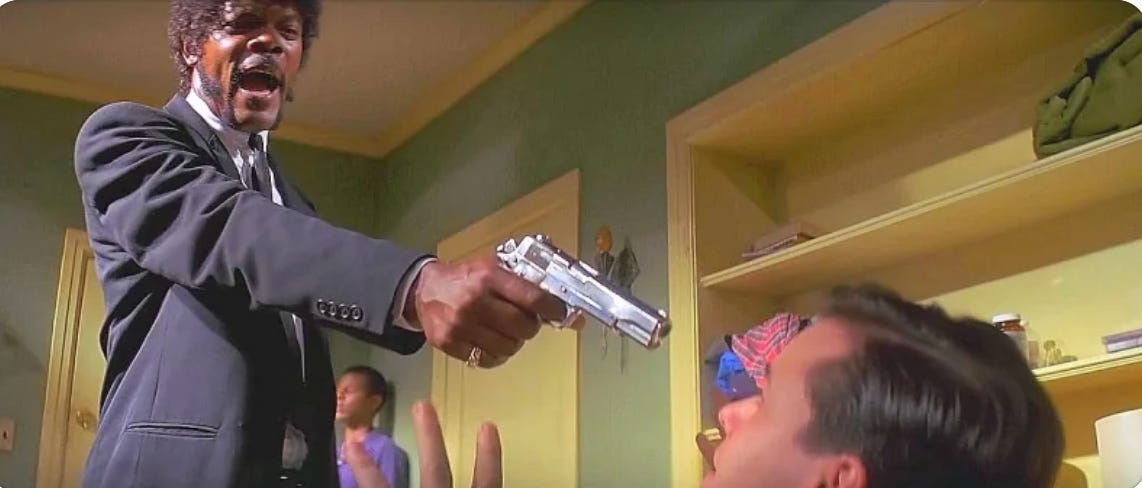
Until yesterday, I thought it would be unfair to compare Hegseth to Perrone, so I kept my musings to myself. Then I saw the news that, on April 15, Hegseth delivered a “prayer” during one of his creepy Old Testament “worship services” in the Pentagon that he ripped off from the mafia hitman, Jules Winnfield (played by Samuel Jackson) in Quentin Tarantino’s 1994 film, Pulp Fiction.
Hegseth’s “prayer” was a nearly word-for-word recitation of Jules’s monologue right before he murdered three young men at the beginning of the film.
In the film, Jules declares that he is quoting Ezekiel 25:17—a short verse in the Book of Ezekiel that is part of a prophecy of divine vengeance against the Philistines. The verse reads, “I will execute great vengeance on them with wrathful rebukes. Then they will know that I am the Lord, when I lay my vengeance upon them.”
For his screenplay, Tarantino modified and expanded this to read:
Ezekiel 25:17. The path of the righteous man is beset on all sides by the inequities of the selfish and the tyranny of evil men. Blessed is he who, in the name of charity and good will, shepherds the weak through the valley of the darkness, for he is truly his brother’s keeper and the finder of lost children. And I will strike down upon thee with great vengeance and furious anger those who attempt to poison and destroy My brothers. And you will know I am the Lord when I lay My vengeance upon you.
For his “prayer,” Hegseth delivered the exact same monologue, only he changed the final line to read:
And you will know my call sign is Sandy when I lay My vengeance upon you.
As the title Pulp Fiction signals, the film portrays a world in which fact and fiction, pop culture references, style and substance, seriousness and irony, all blend together, making it impossible for the viewer to ascertain what is real.
Even the spectacle of a boy’s head exploding from a pistol shot in the back of a car, spattering brain matter and blood on everyone, is somehow—for many viewers—made to seem comical instead of serious.
When I watched Pulp Fiction in Manhattan cinema in 1994, I appreciated the style and punchiness of the dialogue, but the film made me feel extremely uncomfortable, like I was watching the harbinger of the end of American civilization.
As uneasy as the film made me feel, if you had told me back then that, 32 years hence, a U.S. Secretary of Defense would quote Jules’s stylized monologue in a Pentagon “worship service” within the context of waging war on Iran, I would have told you that you had completely lost your mind.
I’m sorry to say, but this characterization is pretty disingenuous. With a tiny amount of research, anyone can clearly see the context in which Hegseth used this “prayer”/monologue.
Before he even utters it, Hegseth clearly attributes the “prayer” to what he said CSAR (combat search and rescue) itself calls its CSAR 25:17, which is modeled after Ezekiel 25:17 (as was Tarantino’s film’s), loosely I may add, and obviously a rip off the Pulp Fiction “prayer.”
To be fair, Hegseth didn’t call it scripture; it’s what the CSAR supposedly prayed before its rescue mission of the downed WSO a couple weeks ago.
Not sure why he decided to use it during his prayer meeting, because it just opens him up for twisting it and ridiculing him like he’s some fool who doesn’t realize that he isn’t saying a real Biblical prayer or something. People often only read the headlines and don’t bother to check to see what is the truth behind them.
So, is that the case here on your part? Sloppiness or a willingness to attribute the worst characteristics to someone to whom you vehemently disagree? Or just an innocent mistake?
But anyone who served in the military, as I have, understands that this type of prayer before embarking on a mission is both inspiring and sobering to those who are participating in it. And perhaps that is why Hegseth quoted it this week to close out his meeting. It was a nod to those brave service members who performed that amazing rescue mission.
Secretary HairGel is an inadvertent parody of “Christian”Zionists and addled evangelicals. And this element hypocritically accuses Muslims of religious extremism.
https://x.com/drew_ponder/status/2044841054877393022?s=67&t=BcRbQIg4-yLIWDE4ASw6UQ